

Traditionally, selecting a heavy-duty lubricant meant meeting the right original equipment manufacturer (OEM) specification, giving operators confidence their equipment was protected in harsh environments.
That precedence is beginning to change. Mining equipment is larger, more productive and increasingly automated, while operators push for higher availability and lower costs. Additionally, smaller reservoirs and longer, more continuous duty cycles are exposing fluids to greater stress than ever before.
The challenge is no longer simply choosing a lubricant that meets specifications, but one that keeps delivering protection as conditions grow more demanding.
Success story: Two Canadian mines and a game-changing custom made formulation
The Caterpillar TO-4 specification has long served as the benchmark for lubricants across mining and construction drivetrains. Meeting it remains essential for warranty purposes, yet operators increasingly recognise that compliance alone does not guarantee the longest equipment life in every condition.
That shift formed the backdrop of a customer acceptance trial run by Petro-Canada Lubricants at two Canadian mine sites, set up to investigate transmission life across a fleet of heavy equipment.
The lubricant already in use at the two sites was performing as intended, but an unusually severe duty cycle suggested there was scope for improvement.
“The challenge wasn’t the lubricant itself. It was the severity of the application, the duty cycle and the geography where they operate,” said Gord Susinski, senior advisor, technical services at Petro-Canada Lubricants. “They needed something more tailored to their operations.”
Rather than recommending an off-the-shelf alternative, the two sides explored several formulation options before settling on one worth testing in a long-term trial. “We started asking what was possible rather than simply looking at what was already available,” said Andrew Peterson, senior sales manager at Petro-Canada Lubricants. “The discussions became less about choosing a different oil and more about understanding what the application actually needed.”
Proving performance where it matters
The trial spanned almost three years across two sites in similar climates but markedly different conditions. Separated by only 50 kilometres, one site worked hard, abrasive ground while the other operated on much softer terrain, producing two distinct duty cycles.
Originally designed to confirm whether a new formulation could match existing performance before extending it, the trial simply continued because the equipment kept operating.
“We did not intend for it to become a 33-month trial,” says Peterson. “We kept gathering data because the equipment continued performing.”
For Susinski, that gave a level of validation laboratory testing alone could never replicate. “We had one transmission exceed 20,000 hours before the trial ended,” he says.
“We wanted to keep running it to failure, but never really found the limit.”
Engineering for a tougher operating environment
The trial reflected the broader challenge facing the future of mining equipment.
While specifications such as TO-4 remain the benchmark, the equipment they protect has evolved: machines run longer under heavier loads, reservoirs are shrinking, and autonomous haul trucks are cutting into maintenance windows by operating around the clock.
“Equipment today is simply working harder,” says Susinski. “You have smaller reservoirs, higher operating temperatures and autonomous machines that don’t stop for shift changes or breaks. All of that places much greater demand on the lubricant.”
Additionally, attention is shifting toward shear stability, a lubricant’s ability to hold its viscosity as it is subjected to extreme mechanical force. As viscosity falls, so does the protective oil film between metal surfaces, and wear increases.
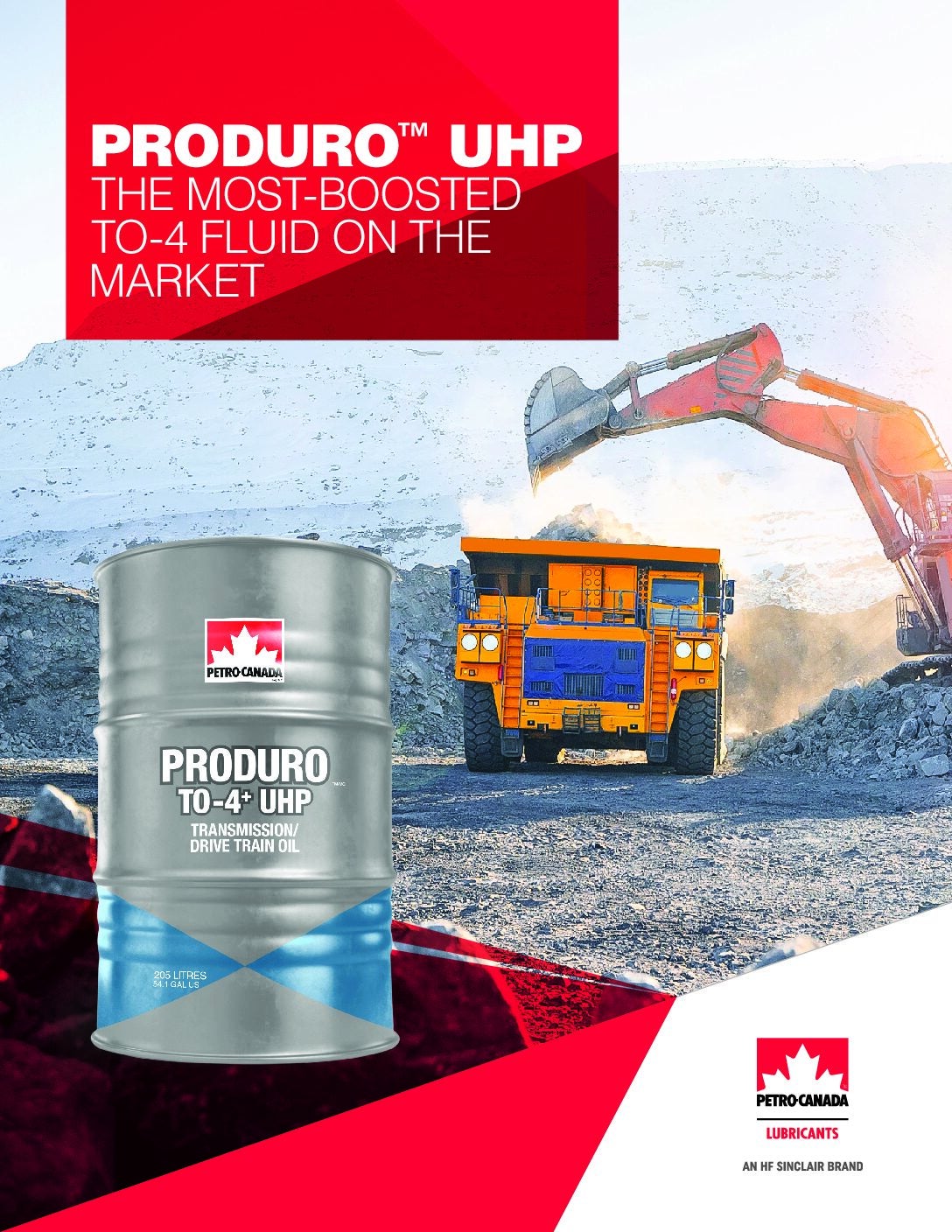
That principle guided the development of PRODURO™ TO-4+ UHP. “The gears are constantly working the oil,” explains Peterson. “Over time that naturally reduces viscosity. The objective was to develop a formulation that better resists that mechanical shear, so it continues protecting the equipment throughout its service life.”
For operators, the benefits extend beyond component protection. A single all-season lubricant cuts seasonal oil changes and simplifies inventory across large fleets, while longer equipment life and extended drain intervals reduce waste oil and filter volumes, supporting customer sustainability targets.
“There was a certain amount of a sustainability aspect that we looked at,” says Peterson, “including regulatory changes in products, and what could prove harmful, and what not.”
Shifts in additive chemistry, along with Caterpillar’s evolving specifications for certain drivetrain applications, are prompting manufacturers to plan further ahead, with Petro-Canada Lubricants working towards formulations that meet both current and future requirements.
Innovation starts with partnership
If there is one lesson beyond lubricant technology, it is the value of collaboration.
Developing PRODURO™ TO-4+ UHP was not the result of laboratory research alone. It evolved through dialogue between customer maintenance teams, field specialists, product engineers, additive suppliers and research scientists.
“When you have a customer prepared to work with you, you can move beyond asking what’s available today,” says Peterson. “You start asking what’s possible, and that’s where genuine innovation happens.”
For Susinski, the project shows that the industry’s next advances are unlikely to come from chemistry alone. “It took people from across the business, all bringing different perspectives,” he says. “Innovation doesn’t happen in isolation. It happens when you combine field experience with technical expertise to solve a real operational challenge.”
As mining pursues higher productivity, longer equipment life and lower operating costs, lubrication is becoming a strategic consideration rather than a routine maintenance decision.
The Canadian trial began with one operator seeking longer transmission life, but it points to a broader industry shift: future performance depends not on meeting today’s specifications alone, but on designing for tomorrow’s operating realities.
