

Globally, ore grades are falling and energy costs are rising. In comminution, the squeeze is particularly palpable – mining’s most energy-intensive processes, crushing and grinding account for up to 70% of a mine site’s total energy use.
Comminution is also deeply inefficient; traditional milling uses 1.1% of the applied energy for fracturing rock – the rest is lost as heat and vibration. According to Mikel Torre, global business unit manager for grinding at ABB’s Process Industries Division, there are also operational losses to consider, “caused by variability, such as overgrinding material, operating away from the optimum load or reacting too slowly to changes in ore characteristics”.
Go deeper with GlobalData


Discover B2B Marketing That Performs
Combine business intelligence and editorial excellence to reach engaged professionals across 36 leading media platforms.
The opportunity for efficiency gains has thus defined comminution as a key area of innovation, as miners look for solutions that are less wasteful, as well as less capital-intensive, energy-intensive and carbon-intensive.
Torre says that some of the most impactful innovation has been digital: “Digitalisation cannot change the physics of comminution, but it can address many of these operational losses.”
Indeed, digitalisation is already changing the capabilities of comminution equipment. Sensors provide real-time data on particle size, power draw, torque, slurry density, pH, froth and fluorescence. Advanced process control (APC) enables granular management and asset optimisation, enhanced by improving AI capabilities.
AI can also predict recovery, grade and energy consumption for the current ore feed and recommend set-point adjustments across processes; this is driving the next frontier of innovation, as operators seek to develop reactive automation.
Integrated sensors inform processing decisions
Ore variability is increasing as high-grade surface deposits run out and deeper resources offer less regular metal distribution. Integrated real-time sensing offers a pre-comminution ticket to consistency and predictability, as waste is eliminated prior to entering the crushing or grinding circuit, thus reducing energy consumption.
As a result, ore sensing has become a key focus for mining operators. Sensors can measure the quantities of a given element in ore, alongside the atomic density, magnetic properties, spectral signatures and visual properties. New solutions are also emerging, including in X-ray transmission and X-ray fluorescence (XRF), laser-induced breakdown spectroscopy, and hyperspectral and multispectral imaging.
Anglo American announced in July that it had carried out successful field trials of its active hyperspectral sensing (AHS) technology at its Minas-Rio iron ore operation in Brazil. Developed in partnership with Finnish researchers at VTT, AHS illuminates a target with a broadband laser that emits different wavelengths. A tuneable filter selects a band and, as the selected wavelength is changed between measurements, a hyperspectral image is developed.
Anglo American applied AHS to Minas-Rio to address variability from alumina-rich clay in the orebody. Speaking to Mining Technology, Daniel Finfer, innovation manager for sensing projects at Anglo American, describes the capability as “in-pit sensing”, adding that “while we are currently focused on alumina management, hyperspectral technology can be adapted for many value propositions”.
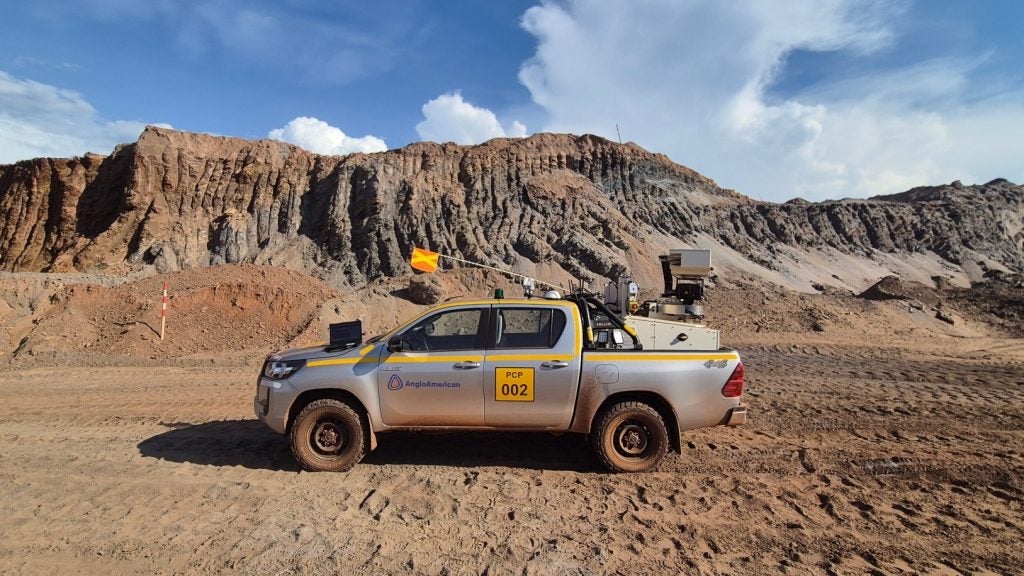
Outside of its partnership with VTT, Anglo American has prioritised innovation in sensing to improve both operational efficiency and recovery rates. The company commissioned its Sensor Fusion Loop in South Africa in 2022 to test real-world ore sorting and selective mining algorithms, and Finfer says it has allowed Anglo American “to explore potential low-capex, high-value propositions”, including retrofitting sensors to optimise existing capital.
Sensors – retrofitted or installed – are also increasingly being integrated into the wider system, so that data can be used to inform adaptive plant controls. Newmont, for example, had MineSense’s XRF system, ShovelSense, retrofitted at the Red Chris mine in 2024 and reported an 18.1% increase in produced ore. In 12 months, 825,000t of waste was removed from the ore stream and 1.6 megatonnes of ore was recovered from material classed as waste in traditional grade control.
Teck has also adopted ShovelSense at both its Highland Valley Copper mine in British Columbia and at its Carmen de Andacollo mine in Chile. At Carmen de Andacollo, ShovelSense diverts trucks in real time to maximise ore recovery and minimise transportation and processing of waste.
There is value in sensor data across the entire comminution circuit too. Finfer says: “When combined with emerging plant sensors, including real-time online particle size data, [linking sensor data with controls] can help reduce unnecessary milling recirculation, increase water efficiency and decrease maintenance costs.”
The cross-circuit digitalisation trend supports APC integration
There has been a broader shift towards integrated, holistic digitalisation in comminution circuits, particularly as cloud technologies have improved. Information provided by sensors – both on the ore itself and the workings of the comminution equipment – can be shared across assets to enable coordinated, real-time adjustments across the processing route, so that crushing, grinding and downstream recovery can be tuned together rather than optimised in isolation.
A 2025 report by Mining Technology’s parent company, GlobalData, noted that technologies connected through cloud computing facilitate “remote monitoring and operation of equipment from considerable distances in real time, enabling remote working for an industry that desperately needs it”.
Torre says this level of integration is the most “interesting” shift that comminution has experienced, adding that he expects the trend to continue: “The next step is much tighter integration between asset condition, process control and the digital layer.”
In June, ABB launched Grinding Connect, which centralises condition monitoring, diagnostics, maintenance workflows and support for gearless mill drives into a single digital environment. It also provides predictive maintenance for grinding, which enables operators to intervene earlier and reduce the risk of unplanned downtime.
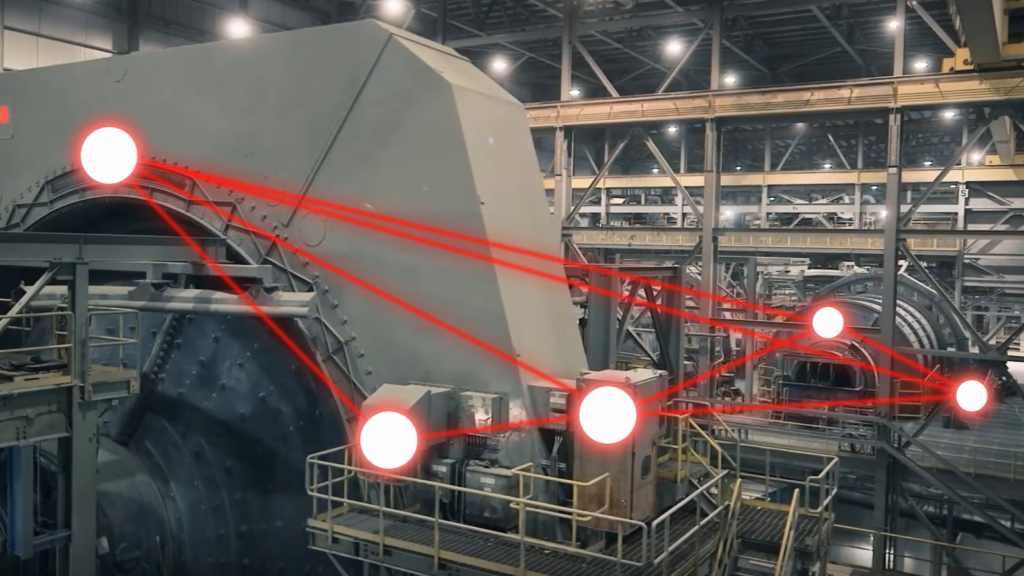
Although Grinding Connect does not offer APC, ABB’s broader suite does, and Torre says this is being continually improved through machine learning (ML) capabilities that are able to infer process variables. He says that, in comminution, APC “is one of the most direct levers” for improvement.
He points to Boliden’s Aitik open-pit copper mine in Sweden, which uses ABB’s Ability Expert Optimizer for model predictive control to optimise energy-intensive grinding circuits. During the evaluation, Torre says APC delivered a throughput improvement in the range of 1–3%.
Boliden also uses a digital twin alongside its APC for optimisation. This combination of the technologies offers a fuller scope – the APC manages process variables, while the digital twin simulates the performance.
Other operators have found convincing use cases for digital twins too: in 2023, Newmont used Metso’s Geminex platform to implement a metallurgical digital twin of its grinding and leaching circuit at its Lihir gold mine in Papua New Guinea. The twin was integrated into the APC systems to manage ore feed variability and material flows, and was reported to improve planning, control and mineral recovery while optimising energy, water and chemical use.
The next frontier: real-time influence
APC and integrated sensors are driving the granularity of insights and control available to operators, while digital twins allow testing of control strategies without risking physical assets. However, the full impact of digitalisation lies in the speed at which comminution circuits can react to insights.
According to Torre: “Digital twins, AI-assisted diagnostics and better sensing all have a role to play, but the real value comes when that intelligence can influence the production process in real time. Ultimately, that is the direction we see mineral processing moving in – towards more integrated and increasingly autonomous operations.”
Autonomous capabilities have been elevated by the introduction of AI and ML across operations. In APC, this means that more tasks can be automated to react intelligently to real-time sensor data, while in predictive maintenance, inputs from vibration or thermal sensors can inform modelling on liner wear, bearing failure or other equipment concerns, before unplanned downtime occurs.
Finfer agrees that Anglo American is shifting towards deeper digital integration to provide fuller control, noting that “we continue to be enthusiastic about opportunities to link upstream pre-crusher ore sensor data with adaptive plant controls”.
This, he says, will improve efficiency: “Comminution is well-known to be a highly energy-intensive part of the mining chain, so the opportunities for digitalisation are extensive.”
Independent software vendor Brainial provides AI automation solutions tailored for the mining industry, using data collected from integrated Internet of Things devices to calculate optimal process parameters and enable real-time adjustments in operations. According to GlobalData’s reporting, Brainial has reported an increase in throughput in the grinding process by between 5% and 10% for its clients, and a reduction in energy consumption of approximately 3%.
GlobalData called Brainial’s technology “promising”, noting that efficiency savings achieved through integrated technologies mean that “mining companies can potentially generate millions in additional revenue while simultaneously reducing energy consumption […] thereby minimising their environmental impact”.
Looking forward then, integration across digital technologies will determine an operator’s ability to react in real time, and the quality of insights to work from. Efficiencies in comminution will be improved through better ore characterisation and system modelling, which will be supported by improving AI capabilities and APC systems.
Torre concludes: “Better sensing gives us greater visibility, advanced control can respond continuously to changing conditions and predictive analytics can identify equipment issues earlier.
“The next step is to bring these capabilities together, so the circuit can be optimised as part of the wider production system rather than as an isolated asset.”


