


Mining has always been a test of materials. Every stage of the mining value chain, from crushing and conveying to slurry transport, leaching, oxidation and refining, places equipment under extreme stress. Components must contain aggressive chemicals while withstanding impact, abrasion, pressure, heat, corrosion and, in some cases, oxygen-rich environments where safety risks become even more complex.
For much of mining’s history, material selection was relatively straightforward: choose something strong enough to survive the mechanical load. Today, that is no longer sufficient. Modern mining operations require materials that are not only strong, but also precisely engineered for the environment in which they operate – especially in mineral processing, where reliability directly affects throughput, safety and operating cost.
Wear resistance becomes a bigger priority
In early industrial mining, materials such as cast iron, carbon steel and bronze were widely used because they were available, affordable and mechanically robust. They performed well in structural applications and basic handling systems, but as mines became larger and processing plants more intensive, simple strength was no longer enough.
The rise of high-throughput crushing, grinding and slurry handling introduced new problems: wear, abrasion and erosion. Equipment was no longer failing only because it broke under load; it was wearing away from continual contact with abrasive ores, high-velocity slurries and repeated impact.
This drove the adoption of harder and more wear-resistant materials, including alloy steels, manganese steels and high-chrome irons. Rubber linings and polymer-based materials also became important, particularly in slurry pumps, mill linings and pipework, where flexibility and abrasion resistance could reduce maintenance requirements.
These developments marked an important turning point. Material selection was no longer just about strength. It was about matching the material to the failure mechanism – a theme that now shapes most severe-service mining design decisions.
The hydrometallurgical challenge – how to overcome
As mining companies pursued more complex ore bodies, hydrometallurgical processes became increasingly important. Technologies such as high-pressure acid leaching (HPAL) and pressure oxidation (POX) allow operators to recover critical minerals from ores that would otherwise be difficult or uneconomic to process.
However, these processes introduced some of the harshest operating conditions in mining.
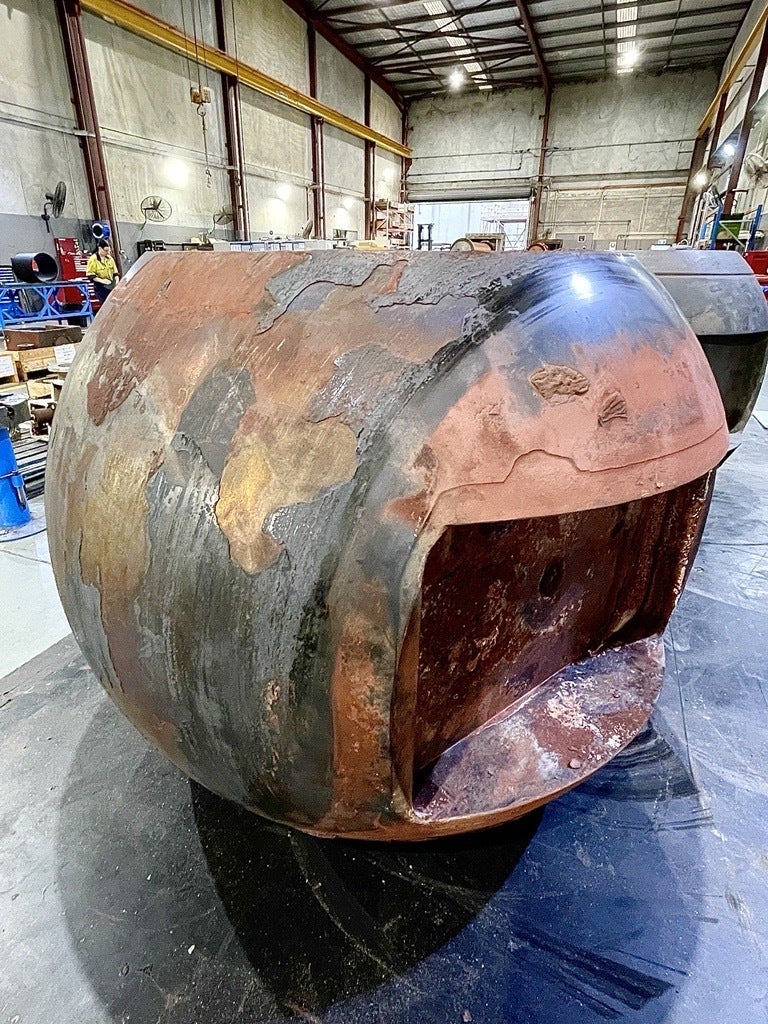
HPAL and POX circuits can combine high temperatures, high pressures, acidic media, abrasive slurries and aggressive chemical environments. In POX applications, oxygen-enriched conditions add another layer of complexity, because material behaviour in oxygen service must be carefully controlled to manage ignition and combustion risks.
In these environments, conventional steels may not provide sufficient corrosion resistance, leading to the delamination or flaking of standard coatings and even high-performance alloys can face limitations. The result is a constant balancing act between corrosion resistance, wear resistance, safety, maintainability and cost. Unplanned downtimes is often the most expensive outcome.
Why coatings moved into the limelight and are now reaching the limits of their intended function
To extend equipment life without manufacturing entire components from expensive exotic alloys, mining operations have long used coatings, overlays and surface treatments. These approaches are logical: wear and corrosion occur at the surface, so protecting the surface can deliver significant improvements in component life.
Traditional thermal spray coatings have been widely used in severe-service valve trim and other processing components. They can provide a hard protective layer, but they also have limitations. Many are mechanically bonded rather than metallurgically integrated with the base material. They can also contain microscopic porosity. In aggressive acid slurry service, that porosity can allow corrosive media to reach the substrate underneath, leading to under-coating corrosion, cracking, and delamination, thereby exposing the softer base metal that can rapidly erode and/or corrode leading to equipment performance failure, accelerating erosion, corrosion and ultimately loss of sealing performance.
This is where the next phase of materials technology is emerging: not simply coating a component but engineering its surface at a deeper level, to withstand combined erosion and corrosion in HPAL and POX duty.
FM-1500™: a new approach
Score’ FM-1500™ technology is an example of this new generation of engineered surface solutions.
Rather than relying on a conventional coating that sits on top of the component, FM-1500™ modifies the surface of titanium valve trim using a metallurgically bonded titanium nitride-based layer. In practical terms, the protected surface becomes integrated with the component, rather than being a separate layer that can peel or delaminate.
The technology has been developed for severe HPAL and POX slurry service, where erosion and corrosion occur together. Its key advantages include a dense, non-porous structure, high hardness and a substantially thicker modified layer compared with typical thermal spray coatings.
In one HPAL autoclave discharge application described by Score, a valve’s internal components that had previously required replacement after around six months achieved more than two and a half years of service following retrofit with FM-1500™. For operators, that type of improvement can translate into fewer shutdowns, reduced maintenance exposure and lower total cost of ownership.
BM-1600™: addressing the POX oxygen-service problem
POX circuits present a different but equally demanding challenge. Components must resist corrosion and erosion while also being suitable for oxygen-enriched environments.
Score developed the BM-1600™ technology for these duties. It uses a dual-layer system: a dense, fusion-bonded corrosion-resistant layer combined with a low-friction ceramic topcoat. The objective is to protect the substrate, maintain sealing performance and reduce the failure modes associated with conventional coatings.
Importantly, BM-1600™ has also been validated for oxygen-service conditions using globally recognised testing methods. This matters because in POX applications, material performance is not only an uptime issue — it is also a safety issue.
In some of the most severe field applications described by Score, BM-1600™ has extended service life in POX valve applications from around 4 weeks to over 12 months. As with any severe-service technology, results depend on the exact duty, process conditions and component design, but the direction of travel is clear: material technology is becoming more specialised, more application-specific and more critical to plant reliability.
The future of material selection in mining
The evolution of material selection in mining reflects a broader industry trend. Operators are moving away from simply asking, “What is the strongest material?” and toward asking, “What failure mechanism are we trying to address?”
That change is especially important as mines process lower-grade and more complex ores, operate under tighter environmental constraints and seek to reduce unplanned downtime.
Future material strategies will increasingly combine base alloys, advanced coatings, surface modification, digital inspection and condition-based maintenance. The most successful solutions will not necessarily be the most expensive materials, but the ones that deliver the best performance over the full life cycle of the asset.
For severe-service mining applications, technologies such as FM-1500™ and BM-1600™ show how far material engineering has advanced. They represent a shift from generic protection toward purpose-designed surface technologies that address the specific realities of severe service mineral processing such as HPAL and POX operations. In modern mining, materials are no longer passive components. They are performance enablers. And in the most demanding processing environments, choosing the right material technology can be the difference between recurring failure and reliable operation.
