
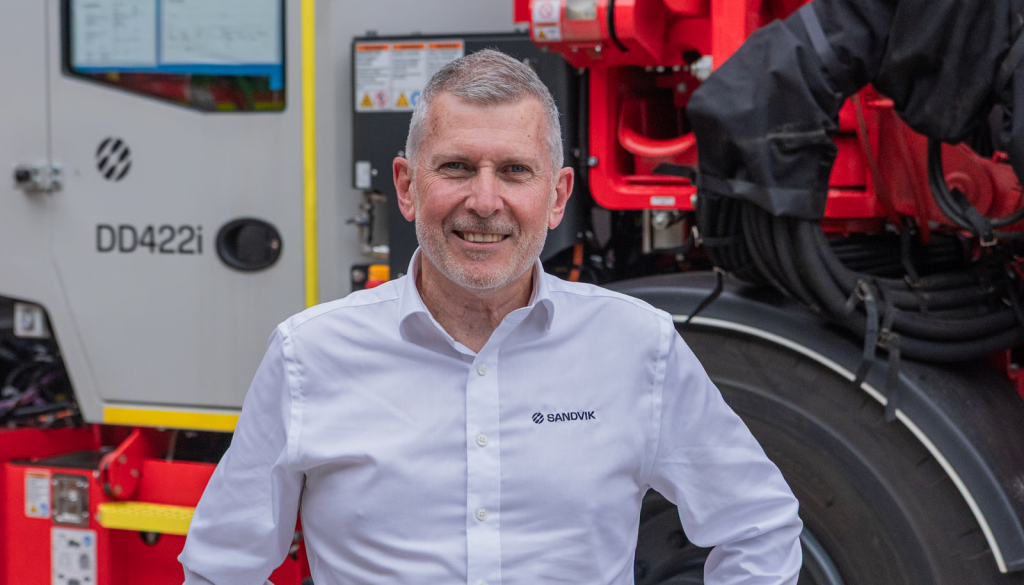
Australia is one of the most competitive mining markets in the world, says Sandvik Australia, New Zealand and Papua New Guinea sales area vice president Craig Johnston, who believes the company’s proven equipment, aftermarket capabilities and growing portfolio of digital and automation solutions have it well positioned for the future.
It is a future he expects to bring significant change for both miners and their suppliers, as technology, mineral and metal markets, and the industry’s technical, cost and sustainability challenges continue to evolve rapidly.
“Our ambition is to position ourselves not only as an equipment supplier but as a long-term technology partner, helping customers unlock value through data, connectivity and advanced solutions,” Johnston said recently.
Here he talks about the conversations likely to define this year’s major IMARC event, held at ICC Sydney from October 27-29.
What does Sandvik do and what role does it play in the mining industry?
Sandvik is a mining equipment and technology partner that supports customers across the entire mining value chain. We manufacture equipment for drilling, loading and hauling, rock tools, ground support, aftermarket services, automation, digital technologies and electrification solutions that enable mines to operate more safely, productively and sustainably.
In Australia our role is particularly significant because this is one of the world’s most advanced mining markets. Australian miners have consistently been early adopters of new technologies and as a result the industry here has become an important proving ground for innovations that are later adopted around the world.
As mining continues to evolve, our role is to turn innovation into practical outcomes, helping customers implement technologies that deliver real operational benefits.
What are you seeing as some of the biggest challenges facing the mining sector right now?
There are several challenges converging at once. Cost pressures, geo-political uncertainty, workforce constraints and supply chain challenges remain significant issues across the industry.
At the same time, many operations are mining deeper, lower-grade and more complex deposits, which can increase both technical and economic challenges.
Overlaying all of this is the growing expectation that the mining industry must improve safety performance, reduce environmental impact and contribute to the energy transition.
The challenge for the industry is not choosing between growth, sustainability and profitability. It’s delivering all three at the same time.
What technologies, innovations or approaches do you think will have the biggest impact on mining over the next few years?
I believe the biggest impact will come from the convergence of several technologies rather than any one technology operating in isolation.
Automation, digitalisation, AI and electrification are all important but their real value will come when they work together as part of an integrated mining system. Moving from automating individual processes towards connected operations where equipment, data and decision-making are increasingly aligned in real time.
Ultimately the technologies that succeed will be those that improve safety, productivity and operational performance.
As mining companies look to improve productivity and safety, what role do you see automation, digitalisation and new equipment technologies playing?
These technologies will be fundamental to the future of mining because they have the potential to truly improve both safety and operational performance. Automation can remove people from some of the highest risk areas of a mine, while digital technologies provide the data and visibility needed to make better and faster decisions.
We’re already seeing a shift towards remote and increasingly autonomous operations, where people supervise and manage equipment from safer environments rather than being exposed to operational hazards. Importantly, this isn’t about replacing people. It’s about enabling people to work differently, focusing more on optimisation, planning and decision-making, while technology handles repetitive or hazardous tasks.
The ultimate goal being not to remove people from mining; it is to remove people from harm.
How important is collaboration between mining companies, METS businesses and other parts of the ecosystem in tackling the challenges facing the sector, and has an event like IMARC played a role in building those connections for Sandvik?
Collaboration is critical. No single mining company, OEM, technology provider or service business can solve the industry’s challenges on its own. The best outcomes are achieved when mining companies, METS businesses and technology partners work together to combine operational experience with technical expertise.
Events such as IMARC play an important role because they bring those groups together and create opportunities for conversations that may not otherwise occur.
For Sandvik, IMARC isn’t just about showcasing technology. It’s about listening to customers, understanding emerging priorities and identifying opportunities to collaborate on solutions that deliver real value.
Who are you hoping to connect with at IMARC this year, and what conversations or opportunities are you most looking forward to?
I’m looking forward to reconnecting with customers and partners while also meeting people and organisations we perhaps haven’t worked with before.
I’m particularly interested in hearing how industry leaders are approaching the challenges of productivity, safety and sustainability and where they see the biggest opportunities for innovation.
One of the strengths of IMARC is that it brings together the full mining ecosystem in one place. The opportunity to exchange ideas, learn from different perspectives and explore new partnerships is what makes the event so valuable.
The opportunity to exchange ideas, learn from different perspectives and explore new partnerships is what makes the event so valuable.
Can you share an example of a relationship, agreement, opportunity or other outcome that came from your involvement with IMARC?
It’s often difficult to point to a single agreement or project and say it started at IMARC because that’s not typically how these projects develop.
What IMARC does exceptionally well is bring the industry together and create opportunities for conversations that lead to future collaboration.
One recent example we’ve shared at IMARC is our work with Glencore at George Fisher mine in Queensland, where we collaborated on the implementation of automated underground trucking. Projects like this demonstrate the value of close collaboration between mining companies and technology partners in delivering real operational outcomes.
For me, the greatest value of IMARC is that it creates the environment where those conversations and relationships can develop into future opportunities.
