


Centrifugal slurry pumps operate in some of the most demanding conditions in the mineral and materials processing industry. The abrasive solids they handle subject pump wet end parts to severe, continuous wear. As a result, slurry pumps must be among the most rugged components in the processing system.
Premature part wear affects more than the slurry pump itself; it also shortens maintenance intervals and can contribute to costly downtime across the entire operation. For processing sites looking to extend pump life, selecting the right material for the application can reduce overall operating costs.
It may seem intuitive that the hardest material available will provide the longest wear life for a given pump part. But hardness is only part of the equation. Slurry wear results from a complex combination of factors including erosion, corrosion, slurry characteristics, and operating conditions.
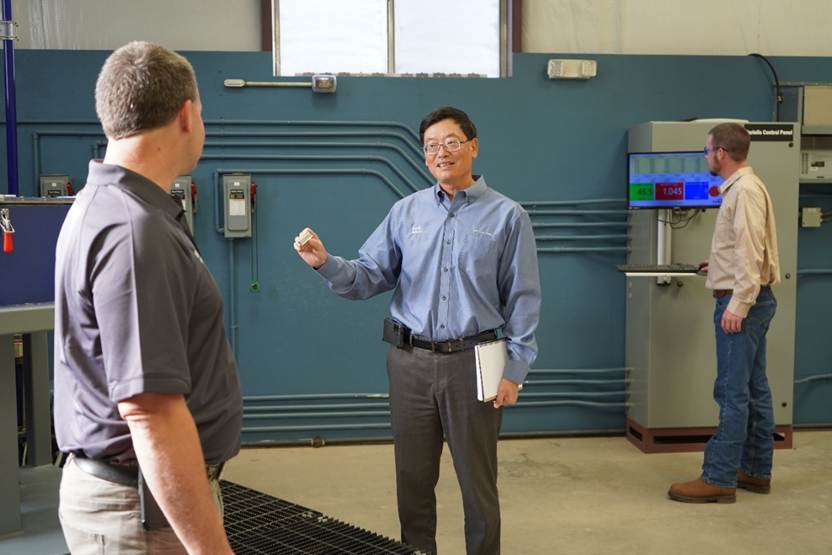
“The most effective material for a slurry pump application should be determined by the specific operating conditions rather than by one property, such as hardness,” explained Harry H. Tian, Ph.D., Director of Metallurgy and Materials R&D at KSB GIW. “A material that works well in one application may not perform the same way in another.”
Materials science provides the foundation for developing wear-resistant materials and selecting the right material for a given application. To do both effectively, it is important to first understand the dominant wear mechanisms and operating environment involved and then match the properties of a material to those realities. This application-specific approach can significantly extend component life, increase pump reliability, and help reduce total cost of ownership.
Understanding how slurry pumps wear
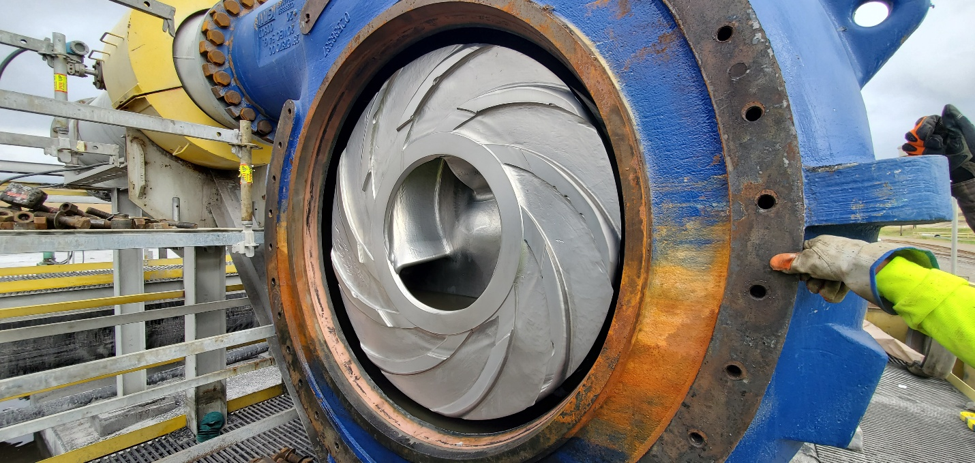
The useful life of a slurry pump is primarily determined by the wear on its wet end components, but that wear is rarely caused by a single mechanism. Erosion, particle impact, and corrosion can all occur on wet-end components inside the slurry pump. In this complex set of conditions, one wear mechanism may influence another, resulting in a different kind of wear outcome than each would produce independently.
Most centrifugal slurry pump wear is erosive wear caused by particles moving within the slurry fluid that slide and strike against the internal surface of wet end parts. This erosive wear occurs in two main forms: sliding abrasion and impact erosion. Sliding abrasion refers to a compressed layer of slurry particles moving along a wear surface and gradually removing material. Impact erosion occurs when individual slurry particles collide with the wear surface, creating small deformations, cuts, and fatigue cracking over time. Most real-life wear results from some combination of these two mechanisms.
When slurries contain chemically aggressive liquids, corrosion also factors into the wear equation. Corrosive slurries can weaken or remove portions of the wear surface. When combined with erosive wear, this results in a phenomenon called erosion-corrosion in which corrosion softens or removes portions of the material’s surface while erosion continually exposes fresh material. These mechanisms reinforce one another and often produce more severe material loss than the sum of what either would create alone, which is referred to as the synergistic effect.
Variables that shape the wear environment
A complicated mix of slurry and operating variables also contributes to the wear environment and, in turn, helps determine which material is best suited for a given application.
Particle characteristics are one important factor. Larger particles can increase impact and gouging, while sharp, angular particles are typically more aggressive than rounded particles. Higher solids concentrations expose wear surfaces to more particle interactions, and increased slurry velocity generally intensifies erosion. Mineral composition can further affect wear by influencing characteristics such as particle hardness and density.
Chemical and operating conditions add another layer of complexity. Slurry pH and chemical composition can introduce corrosion, while temperature affects both material behaviour and wear. Pump design and hydraulics also influence how wear develops by altering slurry velocity and particle trajectories, which can change where material loss occurs and how severe it becomes.
Different combinations of these factors can produce dramatically different wear environments, even in applications that appear similar. This means that effective material selection depends not only on identifying the dominant wear mechanisms, but also on understanding the unique slurry and operating conditions that influence them.
Engineering the right balance of material properties
Using materials science to improve slurry pump performance starts with designing a material with the right combination of properties for the intended service conditions.
Material hardness is an important consideration in many slurry applications because greater hardness often improves resistance to cutting and abrasion. But toughness and impact resistance also matter. In applications involving large particles or high impact loads, wear parts must withstand repeated mechanical stress. Extremely hard materials may be more brittle and vulnerable in these conditions.
“Higher hardness often translates into better wear resistance, but when stress and impact are predominant, a harder material may be more susceptible to cracking or accelerated material loss,” Dr. Tian said. “The key is finding the right balance among hardness, toughness, strength and impact resistance.”
Processing and manufacturing also play a key role in determining how a material performs. For white irons in particular, the method used for casting, heat treatment, and other processing steps defines the resulting microstructure and material properties. Two components that are both classified as high-chromium white irons may perform very differently because of how they are processed.
A materials toolbox for slurry wear
KSB GIW has developed a broad portfolio of proprietary materials to address the range of wear conditions found in slurry processing. These materials can also be modified to meet the specific demands of an application.
High-chromium white cast iron alloys are among the most wear-resistant materials for severe slurry duties, including large particle and high pressure service. KSB GIW’s Gasite® family of proprietary high-chrome white iron alloys relies on hard chromium carbides embedded in a resilient metallic matrix to withstand wear. Within this family, Gasite® 28G is KSB GIW’s best-in-class standard material, providing strong wear resistance and long service life across a wide range of slurry applications. For aggressive chemical slurries, specialty alloys such as Gasite® T50G and Gasite® T90G, both ultra-high-chromium white irons, combine strong performance in abrasive conditions with enhanced corrosion resistance.
For particularly demanding wear conditions, KSB GIW also offers Endurasite®, a high-chrome white iron developed specifically to extend slurry pump life. It is 25% or more wear-resistant than typical high-chrome white irons and has outperformed standard alloys by 50% or more in aggressive applications such as oil sands.
Not every slurry environment is best served by a hard metal alloy. Elastomers, primarily rubbers and urethanes, are another useful material category because they respond differently to particle impact. As slurry particles strike an elastomer, it deforms to absorb the impact energy and then rebounds, returning much of that energy to the slurry. This resilience can allow elastomers to outperform hardened metals in applications involving fine particles.
Ceramics offer another option where very high hardness is required, although lower toughness can limit their use in high impact conditions. Composite materials help balance these properties by combining ceramics with metals, epoxies, or elastomers to provide high wear resistance along with greater toughness or elasticity.
Surface technologies can further improve wear performance without changing the material of the entire component. KSB GIW’s Enduraclad® is a laser-welded, wear-resistant coating containing tungsten carbide that can be applied to white-iron surfaces experiencing severe or localised wear. Enduraclad® can provide approximately five times the wear resistance of uncoated high-chrome white iron and extend part life by up to 50%.
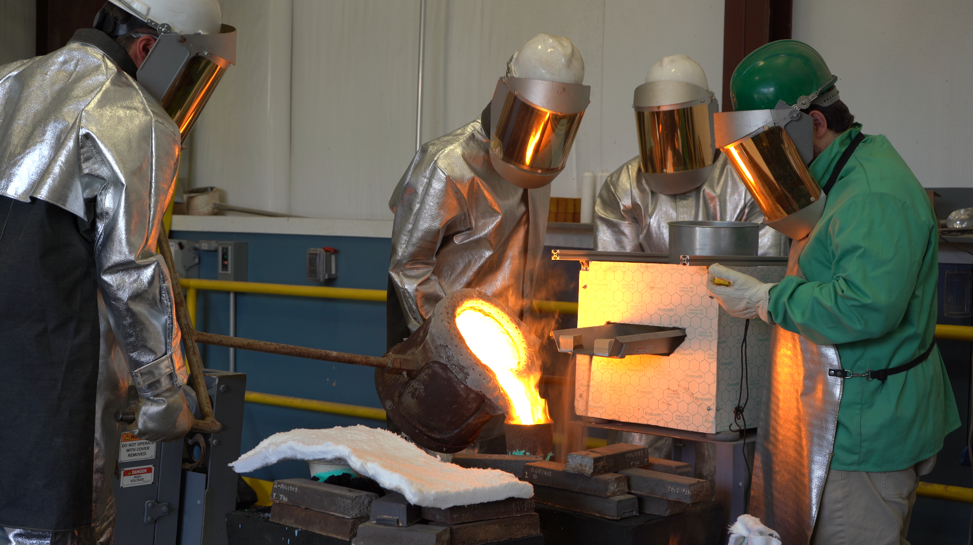
To ensure that each material’s designed characteristics are carried through to the finished wear part, KSB GIW carefully develops and controls its proprietary processing methods in-house, using specialised equipment and trained operators to maintain consistency from one component to the next.
Matching the material to the application
Effective material selection also requires understanding the conditions the wear part will face. Before recommending a material, KSB GIW engineers evaluate the relevant wear mechanisms, slurry and operating variables, hydraulic conditions such as flow rate and pressure, and the customer’s desired service life.
These factors are considered alongside laboratory testing, analysis of previous wear patterns and failures, field performance data, and benchmarks from similar applications. Because slurry wear results from so many interacting variables, application experience is especially valuable for interpreting that information and predicting how a material is likely to perform under a particular set of conditions.
“KSB GIW has decades of expertise in understanding how materials behave and identifying the degradation, failure or wear mechanism involved,” Dr. Tian said. “That knowledge allows us to apply materials science and engineering principles to develop or select the most appropriate materials for targeted conditions.”
From materials science to measurable wear life
The value of materials science becomes clearest when a material choice translates into measurable success in the field. A good material and application match can significantly improve slurry pump component life and performance.
In one example, a phosphate-processing application was pumping slurry containing both a high concentration of acidic material and abrasive solids, exposing wear parts to erosion-corrosion. The existing standard duplex stainless steel wear parts were designed primarily for corrosive wear and did not provide enough mechanical wear resistance.
KSB GIW formulated its specialised super-erosion-corrosion-resistant white cast iron, Gasite® T90G, specifically for this application. The original stainless steel components typically lasted approximately three to four months. With Gasite® T90G, wear life increased to four to six times that of the original components, reaching 12 to 18 months or more.
Materials selection as a reliability strategy
Slurry pump wear cannot be eliminated, but it can be better understood and managed. Because particle characteristics, slurry chemistry, and operating conditions vary so much from application to application, no single material will be the best for every job.
The most effective strategy is to understand the wear environment well enough to match a material’s properties to the conditions it will actually face. The right material selection can extend component life, decrease maintenance frequency, and improve the reliability of pump operation. Longer and more consistent wear life can also reduce unplanned downtime and replacement costs, making materials selection an important part of managing the pump’s total cost of ownership over its service life.
KSB GIW is also applying this application-specific approach to future materials development. Areas of focus going forward include exploring methods for ultra-refining material microstructures, investigating new alloy-design concepts such as high-entropy alloys and complex composites, and applying AI-assisted methods to materials R&D. As slurry processing environments become more demanding, these technologies could provide the industry with additional tools for the challenges ahead.
