

Lomiko Metals is proposing to develop the La Loutre Graphite project as an open-pit operation in Quebec, Canada.
A preliminary economic assessment (PEA) for the project was completed in July 2021 and a technical report was filed in May 2023.
Recommended White Papers

Recommended Buyers Guides

A pre-feasibility study (PFS) for the mine was completed in March 2026, with the associated technical report filed in May. The study outlined a 28-year mine life and estimated an initial investment of C$756.7m ($539.5m).
The next-stage feasibility study is expected to take 18 months and will run in parallel with a 32-month environmental impact assessment.
Construction and commissioning are set to take a further 18 months once permits have been secured.
La Loutre Graphite project location
The La Loutre Graphite project is located in Papineau County in Quebec’s Outaouais region, around 30km west-south-west of Mont-Tremblant.
The land package consists of a continuous block hosting 76 claims and covering an area of 4,527.97 hectares (111,889acres), with Lomiko holding 100% of the mineral rights. Of these, 42 claims carry a 1.5% net smelter return royalty.
Geology and mineralisation
The La Loutre property sits within the Nominingue-Cheneville Deformation Zone, described as a 10km-wide ductile shear zone at amphibolite facies, with lit-par-lit monzonite and diorite injections within Mesoproterozoic porphyroclastic paragneiss.
Lithologies include biotite gneiss (±diopside), with quartzite forming a substantial proportion of outcrop. The stratigraphy comprises a thick paragneiss package interlayered with thinner quartzite and marble units.
Mineralised zones are largely hosted by paragneiss and broadly follow stratigraphy, with graphite flakes disseminated through graphitic paragneiss at varying concentrations.
Reserves
The probable mineral reserves at the La Loutre graphite project are estimated at 46.8 million tonnes (mt) grading 4.79% graphite with 2.24mt in contained graphite as of February 2026.
Mining method at La Loutre Graphite project
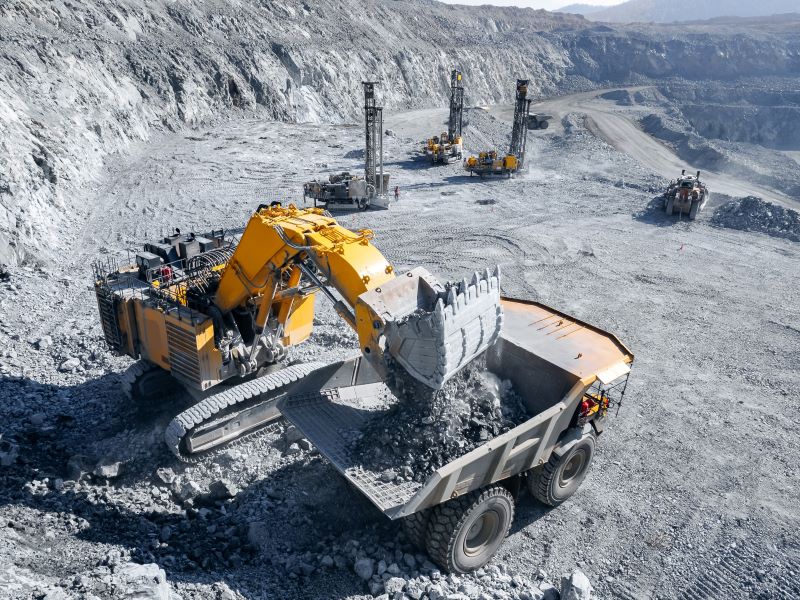
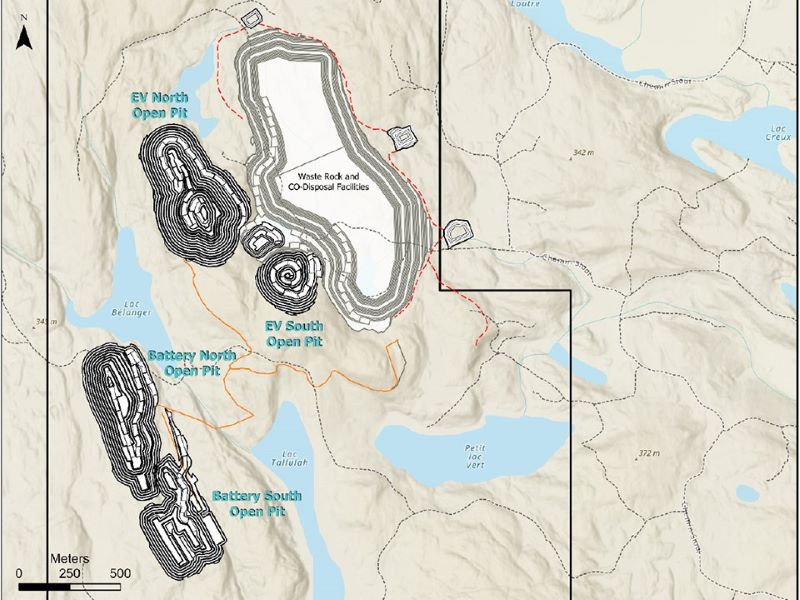
The La Loutre Graphite project is set to be developed with a conventional truck and shovel open-pit mining approach across two deposit areas, the Battery Zone (BZ) and the Electric Vehicle Zone (EV), each planned as a separate open pit with an average life-of-mine strip ratio of 2.4:1.
The EV pit is designed to a maximum depth of 155m, with elevations from 185m to 373m near the entrance. The BZ pit is due to reach 175m, with elevations ranging from 140m up to 353m close to the entrance.
Mining will involve drilling 114mm blast holes, blasting with bulk emulsion, and loading with hydraulic shovels and front-end loaders into 100t off-road trucks.
Material above a 3% carbon graphite cut-off is intended for the primary crusher or a high-grade stockpile, while ore grading 1.5–2.99% will be placed on a low-grade stockpile during the first five years to support net present value and then used as required for blending through the remaining mine life.
Ore processing
The processing plant is designed for 4,750t per day, based on an average feed grade of 4.79% carbon graphite. The overall graphite recovery is projected at 93% to produce a 97% carbon graphite product.
The run-of-mine ore will be crushed using a jaw crusher before stockpiling, then reclaimed to a semi-autogenous grinding mill. The ground material will pass through rougher and scavenger flotation, followed by primary polishing and a first stage of cleaner flotation.
Concentrate from the first cleaner stage will feed a secondary polishing mill, after which three more cleaner flotation stages are planned. The fourth cleaner concentrate will then be screened and classified, with oversize routed to a coarse concentrate stirred mill and undersize to a fine concentrate stirred mill.
The coarse stream will then be moved through two additional cleaning flotation circuits, while the fine stream will undergo densification flotation followed by three further cleaning stages.
The final concentrate products will be recombined, dewatered via a graphite filter press and dried in a natural gas-fired dryer. The graphite flakes product will be screened into three different sizes and bagged.
Tailings from the scavenger, primary, coarse and fine flotation circuits will be combined and thickened. Overflow water will be collected and returned to the process water tank for reuse, while thickener underflow will be dewatered using a tailings filter press. Filtered tailings will be stockpiled before haulage to a waste disposal facility designed for co-disposal of filtered tailings and waste rock.
Site infrastructure
Access to the site is via Highway A-15 north from Montreal, then Highway R-117 to Saint-Jovite, followed by Highway R-323 west for 40km to Lac-des-Plages, from where secondary and forestry roads continue to the project area.
The project’s power supply options under review involve two transmission alternatives from Hydro-Québec. One scenario will build and upgrade a CHE 235 line from the west to supply 7MW in three stages, with a 45MV-ampere (MVA) short-circuit rating. The second will use the existing CHE Neville 236 corridor from the east to supply 7MW, with a 35MVA short-circuit rating. Diesel generators are planned for emergency power.
Fresh water is expected to come from local wells and be treated using a pre-packaged potable water system to supply domestic needs and plant safety stations, with the unit located near the administration area.
Contractors involved
The PEA was prepared by Ausenco Engineering Canada, an engineering and consulting company, along with Ausenco’s specialist ESG group Hemmera Envirochem, and consultancies Moose Mountain Technical Services and Metpro Management (Metpro).
The technical report was prepared by InnovExplo, an independent mining and exploration consultancy, with inputs from Soutex, a mineral processing consulting company.
The PFS was led by DRA Global, an engineering and project delivery company, with contributions from Norda Stelo, an engineering company; Knight Piésold, an engineering and environmental consulting company; and Metpro.
