
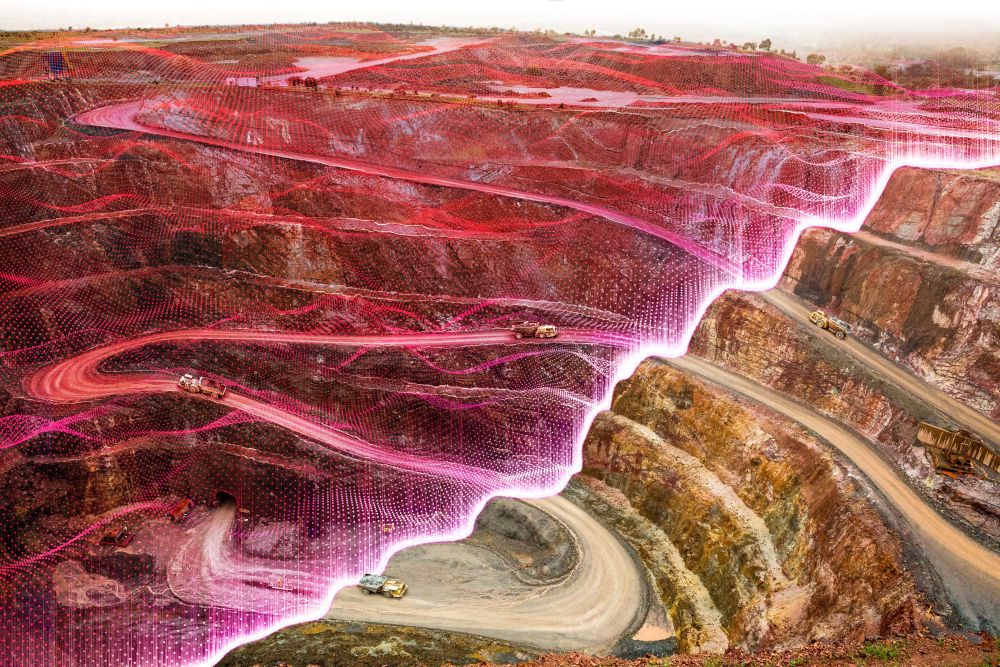
For years, the conversation around critical minerals has centred on discovering new deposits and diversifying supply. Both remain essential, but neither can close the near-term supply gap quickly enough on its own.
The International Energy Agency’s (IEA) latest Global Critical Minerals Outlook reveals this tension. Governments are placing critical minerals at the centre of industrial and economic security strategies, yet investment in new supply fell by 9% last year. Added to this, new projects continue to face lengthy development timelines.
That means we need to think differently about where the next tonnages of critical minerals can come from. The opportunity is not only buried in future mines but also lies within mines already in operation.

Securing the materials the world will need
Critical minerals have gone beyond being just an energy transition issue. They have become strategic inputs into modern economies, underpinning everything from electricity networks and batteries to semiconductors and advanced manufacturing. Secure access is therefore increasingly tied to countries’ ability to build infrastructure, maintain industrial capacity and compete in fast-growing technologies.
Nevertheless, the energy transition is adding substantially to that demand. UN Trade and Development calculations show just how sharply clean technology demand is set to grow. Clean technologies’ share of global lithium demand is projected to rise from 62% in 2024 to 87% by 2040. For nickel, the share rises from 17% to 42%, while graphite increases from 32% to 52%.
Critically, demand is growing at the same time as a widening range of industries and technologies depending on reliable access to the same strategically important materials. Supply disruption or constraint is therefore not a mining issue but an industrial and economic one.
For governments, miners and their customers, the challenge is to build a supply system capable of delivering more reliably, competitively and sustainably.
The fastest opportunities are already operating
New mines and mine expansions remain essential to meeting long-term demand, but the realities of permitting, financing, engineering and construction mean new capacity cannot be the industry’s only response.
Existing operations offer a more immediate opportunity. They already have resources being extracted, infrastructure in place and established routes to market. Increasing the productive capacity of those assets can therefore contribute additional supply while the next generation of mines is still being developed.
At the same time, technology has an important role to play in bringing new sources of supply online efficiently. In Germany, for example, Vulcan Energy’s Lionheart Project aims to produce lithium for the European battery supply chain from a domestic resource. The project will require electrical infrastructure capable of distributing power across its lithium extraction and processing facilities.
The industry also enters this challenge from a position of relative strength. PricewaterhouseCoopers reports that the world’s top 40 mining companies generated revenues of $909bn (£679.7bn) in 2025, up 3.3% from $880bn. The question is how investment can be directed not only towards tomorrow’s capacity but towards improving the productivity of the assets already in production.
This is not a choice between new and existing mines. Meeting long-term demand will require both: developing new resources for the future while getting more from existing assets.
Fortune favours efficiency
Even relatively small improvements, multiplied across millions of tonnes of material, can have a significant cumulative effect. Higher recovery means more saleable metal from the same ore. Greater equipment availability will increase throughput. Improved energy efficiency reduces the resources required for every tonne produced. Working in tandem across an entire site, the impact can be profound.
Mining already has many of the technologies required to unlock these gains. Electrification, automation and digitalisation can connect equipment and processes that have traditionally been managed separately, creating greater visibility across the value chain.
When operational data can be translated into decisions in real time, mines can respond faster to changes in ore characteristics, process conditions and equipment performance. More stable processes can improve consistency, while condition monitoring and predictive maintenance can help reduce unplanned downtime.
Meanwhile, electrification can improve energy efficiency while supporting decarbonisation goals.
The greatest opportunity comes from bringing these capabilities together. A mine is a complex, interconnected system where changes in one part of the process can have consequences elsewhere. Connecting data, equipment and operational decision-making gives operators a clearer picture of those interdependencies and where productivity is being lost.
With critical minerals, efficiency isn’t only about reducing cost. Every improvement in recovery, throughput, availability or energy intensity can contribute to getting more value from resources already being mined.
The next critical minerals frontier may therefore be closer than we think.
Looking ahead
The critical minerals challenge will not be solved by technology alone, just as it will not be solved by exploration alone. New resources and more diverse supply will remain essential, but alongside the search for new deposits, we should not overlook the capacity already available to us. In the years ahead, the advantage will not only belong to those with the largest mineral endowments. It will increasingly belong to those able to turn those resources into production most efficiently, reliably and responsibly.
