

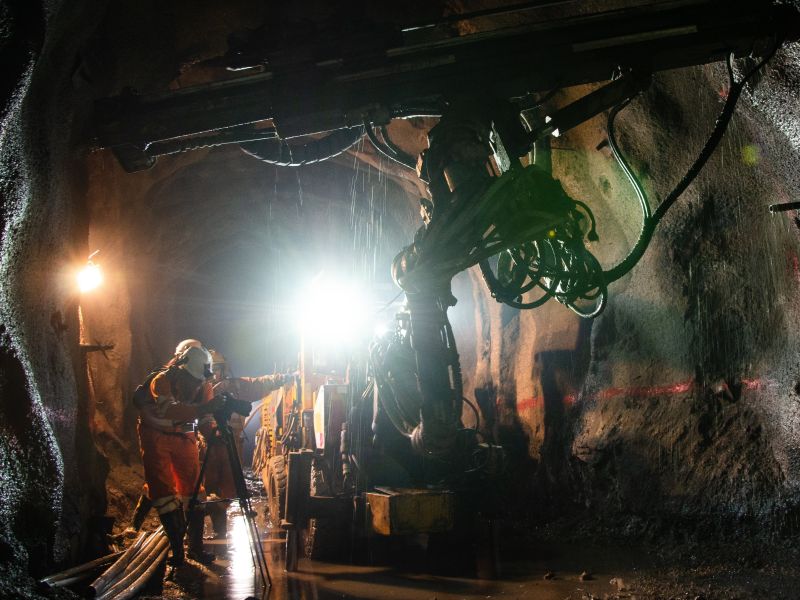
The Era Dorada gold development in Guatemala is advancing towards production under Canadian operator Aura Minerals.
The company took control of the underground asset after taking over Bluestone Resources, the previous owner, in January 2025.
Recommended Buyers Guides

A preliminary economic assessment (PEA) was published in June 2025, followed by a comprehensive feasibility study (FS) in December 2025. The feasibility study estimated initial capital expenditure of approximately $382m to support an operational life of 18 years.
Aura Minerals secured the construction licence to begin early ground preparation in January 2026, receiving final commercial endorsement from its board of directors in April 2026.
Underground mine development will start in September 2027, followed by commissioning of processing facilities in October 2027 and reaching full nameplate capacity by January 2028.
Era Dorada project location
The Era Dorada asset is situated within the Department of Jutiapa in south-eastern Guatemala, falling entirely under the administrative jurisdiction of Asunción Mita.
Situated approximately 160km by road from Guatemala City and 9km west of the border with El Salvador, the site is governed by an exploitation licence covering approximately 15.25km².
Geology and mineralisation
The deposit is classified as an epithermal gold-silver system linked to geothermal hot spring activity, displaying low-sulphidation characteristics with high-grade vein swarms and broader zones of lower-grade disseminated mineralisation.
The local geological setting forms part of a volcanic province dominated by Tertiary volcanic flows, volcaniclastic sequences, and sedimentary strata, including ignimbrites, siltstones, limestones, and conglomerates that have undergone intrusion by andesitic and rhyolitic dykes.
Hydrothermal alteration defines a structural footprint roughly 5km long and 1km wide. Economic mineralisation is hosted within a west-dipping, north-south oriented sedimentary package of siltstones, sandstones, and limestones (Mita Group). The precious metals occur primarily in quartz epithermal veins and disseminated throughout the Salinas conglomerates and rhyolites. High-grade zones are concentrated within banded chalcedony veins exhibiting variable orientations and local calcite replacement textures.
Era Dorada project reserves
The proven and probable mineral reserves at Era Dorada were estimated to be approximately 8.7 million tonnes (mt), grading 20.4g/t gold, with a silver equivalent of 6.23g/t as of December 2025.
Mining methods
Underground operations will rely primarily on long hole stoping (LH), which will generate approximately 98.5% of total recovered metal. Mechanised cut-and-fill (MCF) mining will contribute 1.2% of output, with the remaining 0.1% extracted via room-and-pillar mining. Subsurface structural integrity will be maintained using paste fill alongside cemented rockfill.
LH stoping will employ both longitudinal and transverse configurations. Transverse stoping will be dedicated to thicker zones exceeding 20m, applied to continuous single lenses or merged structures.
Individual stopes will measure up to 10m in strike length and 20m in height. Stope thickness will range from 2.6m to 51.1m after wall dilution allowances, with a baseline minimum stope width of 1m before dilution. Extraction will proceed via an overhand retreat sequence towards level accesses, with stope entries established through 4m × 4m crosscuts driven as top and bottom ore drives.
The overhand MCF method will be deployed in areas with lower rock quality or complex geometries where bulk LH extraction is unsuitable.
Underground access is planned through two existing exploration openings, designated as North and South portals. Ore will be hauled via the North portal directly to the primary crusher while development waste will exit through the South portal to surface dumps. Temporary access roads will be established by upgrading existing tracks.
Ore processing at Era Dorada
The processing plant has a design throughput of 1,600 tonnes per day (tpd) and an overall availability of 92%. Average metal production is projected at 100 kilounces of gold equivalent per annum across 15 years of the mine plan.
Run-of-mine (ROM) ore will be broken down in a primary jaw crusher before feeding a comminution circuit consisting of an open-circuit primary semi-autogenous grinding (SAG) mill, a pebble crusher, and a ball mill.
The ball mill will run in reverse closed circuit alongside a hydrocyclone cluster. Oversize material discharging from the SAG trommel will travel along a conveyor equipped with tramp metal detection and removal equipment to protect the pebble cone crusher.
Slurry from the pump box will be fed into a bank of ten 250mm hydrocyclones, containing six operational units and four on standby. Approximately 25% of the cyclone underflow will report to a gravity concentrator feed screen, whose undersize will be fed to a semi-continuous batch gravity concentrator. Cyclone overflow at a target grind size of P80 of 53µm will pass through a trash screen before flowing by gravity into an 18m diameter pre-leach thickener.
Thickened slurry will enter a carbon in pulp (CIP) circuit, where activated carbon will adsorb gold and silver cyanide complexes. The loaded carbon will flow by gravity to an acid-wash column. Following acid washing, the elution circuit will strip precious metals using a heated solution of fresh water, sodium cyanide, and sodium hydroxide.
The pregnant strip solution will pass through electrowinning cells to deposit the metals. One electrowinning cell will handle the elution solution while a second cell treats pregnant solution from the intensive gravity leach circuit. The resulting gold-silver sludge will be filtered, dried, and smelted inside a propane-fired furnace in the on-site gold room to produce gold and silver doré.
Era Dorada site infrastructure
Year-round logistics to the project site will be maintained via the Pan-American Highway (Highway CA1), which routes through the settlement of Asunción Mita.
Utility power will be drawn from an existing municipal substation in Asunción Mita. An 8.6km, 69kV single-circuit overhead transmission line will be constructed to connect the regional substation to the project switchyard.
Process water will be sourced primarily from thickener overflow within the pre-leach and tailings circuits, supplemented by dewatering discharges pumped from underground boreholes and mine workings. Raw water will be purified at a dedicated water treatment plant (WTP), collected in storage reservoirs, and reticulated across the property.
Construction contractors will manage their own catering, transport, and temporary housing, as an early construction village will not be established. A permanent operations camp will be built adjacent to the mine site before commissioning to house operational staff.
Contractors involved
The feasibility study for the Era Dorada development was prepared by Ausenco (Brazil), Snowden Optiro, and Kirkham Geosystems.
