


In the face of volatile commodity prices, rising maintenance costs, and increasingly stringent emissions regulations, mining customers are under growing pressure to optimize their operations. The transition to newer, more efficient, and sustainable equipment requires substantial capital expenditures, making upgrades financially challenging for many operators.
Capital expenditure (CAPEX) in mining primarily involves acquiring assets such as trucks, loaders and excavators. These decisions commit substantial capital, with acquisition costs shaping long-term balance sheets. In addition, financing structures and depreciation profiles determine replacement cycles, making the timing and frequency of purchases a critical lever for managing total lifecycle costs. Despite this, according to GlobalData’s detailed capital expenditure analysis, miners are projected to invest heavily across both development and sustaining CAPEX from 2025 to 2030. The forecast places sustaining CAPEX at approximately US$279 billion and development CAPEX at an additional $393 billion for the period[i].
Meanwhile, operating expenditure (OPEX) comprises the recurring costs that accumulate over the life of a mining fleet, such as fuel, lubricants, tyres, parts, etc., which are essential and escalate in cost under harsher conditions. Add to this labour for scheduled maintenance, together with unplanned breakdowns and downtime, and these recurring expenses compound over time. Indeed, their cumulative impact can exceed initial capital outlay.
Total Cost of Ownership (TCO) takes a more comprehensive view across an asset’s entire lifecycle. For example, by repowering ageing equipment with new engines or systems, companies can significantly reduce TCO compared to end-of-life replacements, by boosting productivity and reducing emissions.
End-of-life decision point
The end-of-life decision for mining fleets is reached when rising failure rates, longer repair times, and declining efficiency erode both the economic case and the safety justification for keeping assets in operation. However, decommissioning can be complex, with disposal adhering to strict environmental and safety regulations, while replacing an entire fleet brings its own challenges. Upfront capital investment often requires detailed approval and allocation cycles, and lead times for new equipment can be extensive. Further, during this changeover, workflow disruptions are likely, with a period of reduced operational readiness as systems and teams adapt to new standards and interfaces.
Is repowering a real alternative to replacement?
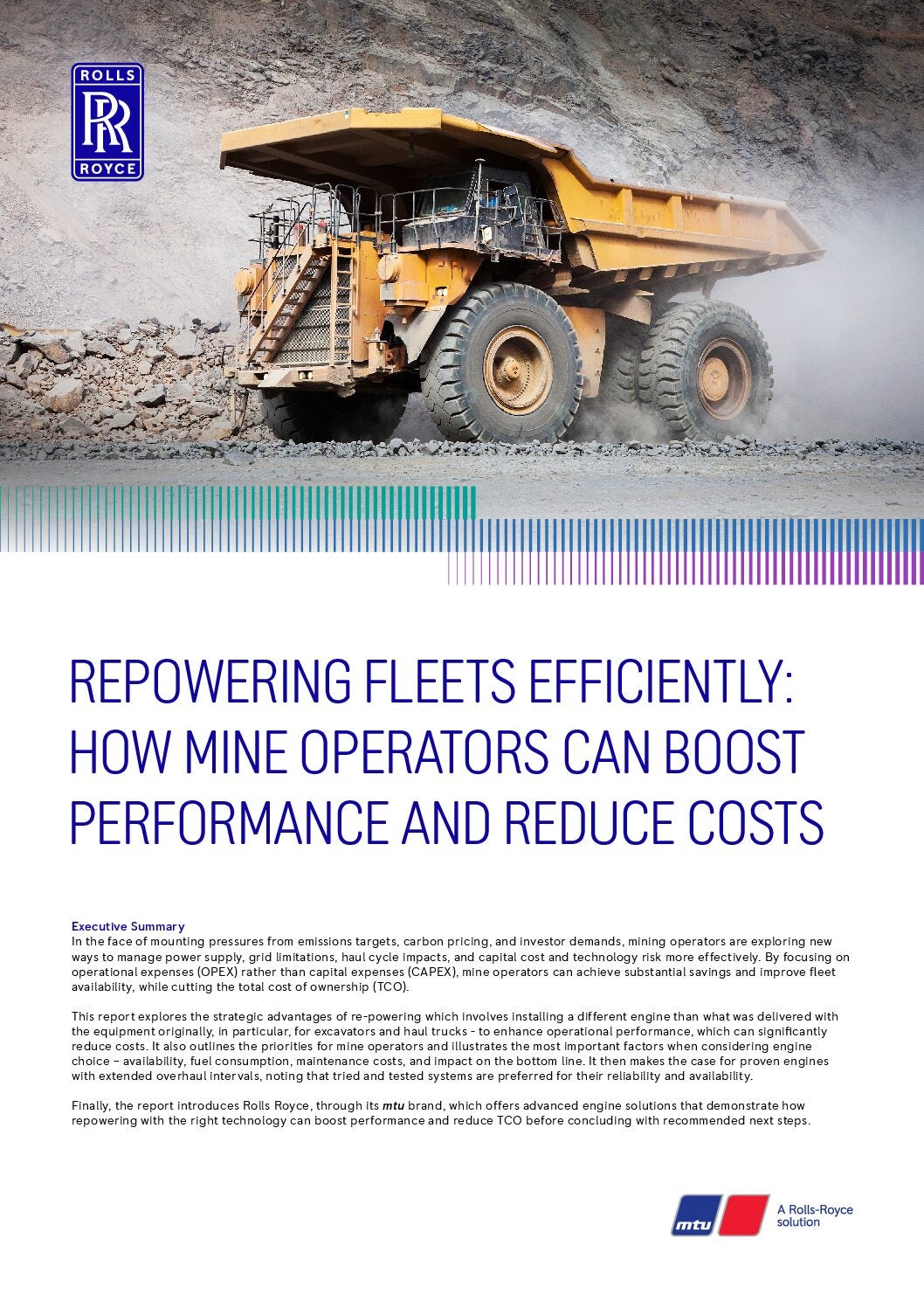
Instead of retiring a vehicle at end-of-life, operators can retain the existing chassis while modernising its core systems, such as the engine. This approach transforms the heart of the machine, delivering substantial operational and sustainability benefits without incurring the full capital outlay of a new vehicle. Such upgrades can defer major CAPEX for several years while offering immediate gains in efficiency, reliability, and environmental compliance.
For example, repowering a haul truck fleet with new engines increases efficiency which lowers emissions per operating hour and sustains productivity. Just as important, repowering helps futureproof mining fleets against volatile fuel costs and tightening emissions regulations, all while preserving capital and minimising workflow disruption.
Introducing the Rolls-Royce Power Systems mtu Series 4000 diesel engine
A cornerstone of the Rolls-Royce Power Systems repower solution, the mtu Series 4000 diesel engine[ii] is designed to extend the lifecycle of mining equipment and is central to enhancing the performance and sustainability of typical mining applications, including haul trucks, loaders, and excavators, where uptime and efficiency are critical.
The Series 4000 excels in high-altitude environments and maintains strong performance and productivity where derating is often a challenge. Its consistent power delivery and rapid engine response translates into higher productivity, ensuring that mining operations run smoothly and efficiently. Additionally, the engine’s design focuses on lower fuel consumption and reduced CO₂ emissions, directly impacting operational expenditures and supporting sustainability targets.
Key benefits of repowering with mtu
A significant advantage of the mtu Series 4000 is its extended time between overhauls (TBOs), which reduces lifecycle maintenance costs and minimises downtime. However, repowering with mtu is more than just an engine swap. It involves comprehensive integration, validation, and service support, including training, parts availability, and advanced diagnostics, ensuring seamless operation and long-term reliability for mining operators.
Repowering mining fleets with mtu engines is a lifecycle strategy that unlocks a second, and even a third, productive life for haul trucks and other heavy equipment. Rather than retiring vehicles at end-of-life, operators upgrade engines, preserving existing assets, deferring major replacement CAPEX, and improving performance and sustainability.
Emissions reductions without exhaust aftertreatment
The Series 4000 engine achieves emissions reductions without exhaust aftertreatment systems, thanks to its advanced design. It uses key systems that work in harmony to reduce emissions at their source. Cooled and regulated Exhaust Gas Recirculation (EGR) helps reduce oxides of nitrogen (NOx). An advanced high pressure common rail fuel system helps reduce particulate emissions while regulated turbocharging with two stage charge air cooling helps maintain power and performance under even the harshest of conditions. Add to this a robust engine block, engineered to withstand high peak cylinder pressure and you have a design that simplifies maintenance and reduces downtime risk compared to other emissions systems.
Case study: Sustainable fleet repowering at Los Bronces, Chile
Located in central Chile near the Santiago Metropolitan Region, Anglo American’s Los Bronces copper mine was interested in lowering the environmental impact of their Komatsu 930E haul truck fleet. Rather than using selective catalytic reduction (SCR), which adds complexity, increases the maintenance burden, adds an additional fluid to handle and provides additional failure points, Los Bronces chose another option.
In 2018, Detroit S.A. and Rolls-Royce Solutions partnered with Los Bronces to repower thirty (30) Komatsu 930E trucks with the mtu 16V 4000 C05 engines, which achieves Tier 4 compliance without SCR.[iii].
The project has delivered substantial environmental gains, with approximately 9,960 tonnes of CO₂, 91 tonnes of particulate matter, and over 3,000 tonnes of NOₓ eliminated since implementation.
The Los Bronces programme shows that repowering ageing mining fleets with modern, low-emission engines offers a practical path to extend asset life, cut TCO, and improve sustainability. By avoiding full replacement while enhancing reliability, efficiency, and compliance, operators can navigate cost, emissions, and productivity pressures with a more resilient, future-ready fleet strategy.
For more on how mtu can help with your vehicle propulsion technologies, download the free paper below.
[i] GlobalData: Global Mining Sector Capital Expenditure Analysis To 2030, February 2025.
[ii] https://www.mtu-solutions.com/eu/en/applications/mining/repower-solutions.html
[iii] https://www.mtu-solutions.com/content/dam/mtu/download/applications/mining/MTU_LosBronces_SuccessStory.pdf/_jcr_content/renditions/original.media_file.download_attachment.file/MTU_LosBronces_SuccessStory.pdf
