
The Carolina Lithium Project, previously known as the Piedmont Lithium Project, is an open-pit mine under development in the Carolina Lithium Belt, a historic lithium mining and producing region in North Carolina, US.
The mine was originally 100% owned by Piedmont Lithium. The company was granted 404 permit approval from the US Army Corps of Engineers in November 2019.
Recommended Buyers Guides

The project was also granted CWA Section 401 Individual Water Quality Certification by the North Carolina Division of Water Resources.
Piedmont Lithium unveiled the results of the updated scoping study in August 2019. A definitive feasibility study technical report was published in January 2022.
In September 2025, Piedmont Lithium completed a merger with Sayona Mining. The combined company was named Elevra Lithium.
The project is expected to have a mine life of 11 years and one month and is predicted to produce a total of 883,000t of lithium hydroxide.
The State Mine Permit and the applicable General Stormwater permit for the project have been secured.
Elevra Lithium is currently assessing potential financial backing from the US Federal Government and reviewing potential strategic counterparties alongside alternative project financing structures.
Carolina Lithium Project location
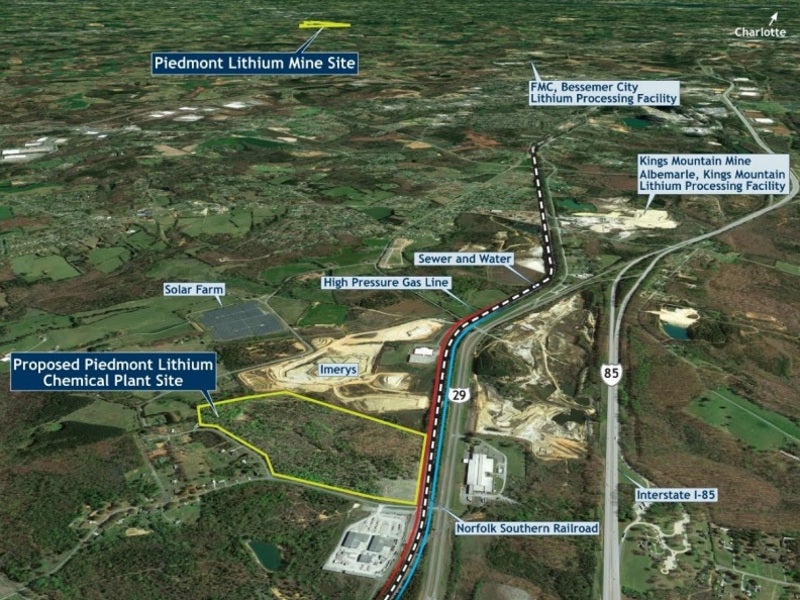
The Carolina Lithium Project sits in rural Gaston County, North Carolina, roughly 40km north-west of Charlotte.
The project area covers approximately 3,245 acres in total. It lies around 15km north-east of Kings Mountain and around 10km south-west of Lincolnton.
Geology and mineralisation
The project lies within the Inner Piedmont belt, close to the Kings Mountain shear zone. This geological belt comprises gneisses, amphibolites and schists that date from the Cambrian to the Neoproterozoic, and displays a range of metamorphic grades.
On the property, spodumene pegmatites occur within fine to medium-grained, foliated biotite–hornblende gneiss containing quartz and feldspar, which is commonly described as amphibolite, as well as in metasedimentary units such as schists and mudstones. The pegmatite dykes include both spodumene-bearing and spodumene-absent bodies, with lithium and associated by-product mineralisation concentrated in the spodumene-bearing dykes.
Carolina Lithium Project reserves
The probable mineral reserves at the Carolina Lithium Project were estimated at 18.26 million tonnes (mt) grading 1.10% lithium oxide, as of January 2022.
Mining method
The Carolina lithium project will be developed as an open-pit mining operation due to the orebody being exposed at several points on the surface.
The design assumptions include an average strip ratio of 11:6 with a 9.5m berm width, 12m working berm height and a 24m final wall berm height. Haul ramps are planned at 30m wide with a 10% gradient. The operation applies 10% mining dilution and assumes a 77% recovery for spodumene concentrate, while maintaining a minimum mining width of 50m.
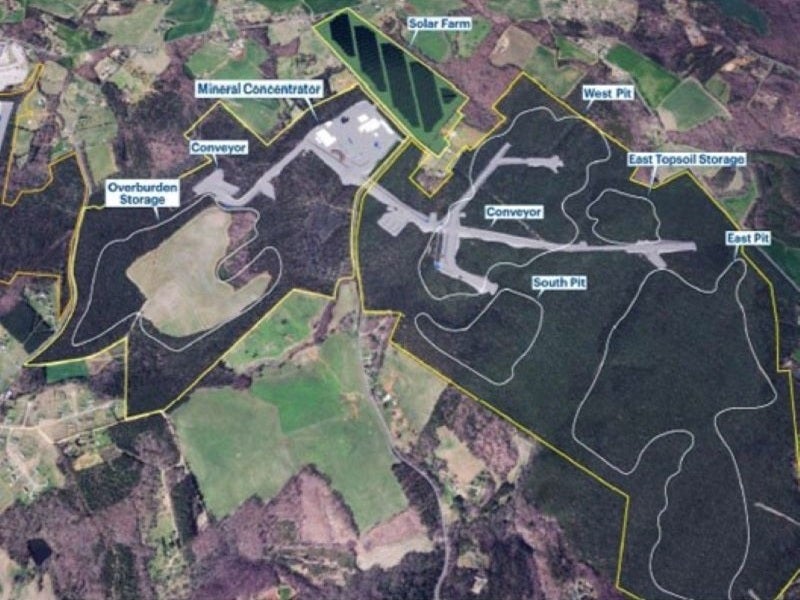
Mining is set to deliver approximately 1.9mt of run-of-mine (RoM) ore to the concentrator from three pits within the project area. Non-ore material, including waste rock, saprolite and soils, will be placed in the waste rock storage area, the future waste rock storage area and the topsoil storage area, with additional placement through backfilling in the East Pit and South Pit.
The proposed mining fleet comprises four 12.3m³ front-end loaders for waste and two 6.1m³ front-end loaders for ore. Waste is due to be processed using four Metso LT150E mobile jaw crushers, while ore is to be handled by two Metso LT130E mobile jaw crushers, supported by fixed and mobile conveyors. Ancillary equipment includes two dozers for waste management, a water truck, a motor grader, lighting units, six mobile rock breakers and other general-purpose support equipment.
Ore processing
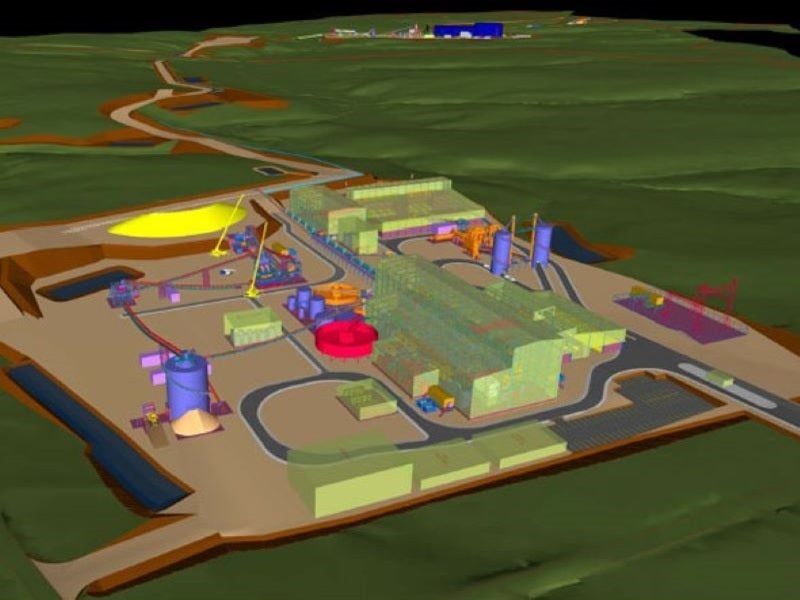
The Carolina Lithium Project processing facilities are intended to produce a saleable spodumene concentrate using dense media separation (DMS) and flotation at a concentration plant, before further upgrading the concentrate at a conversion facility to battery and technical-grade lithium hydroxide monohydrate.
Feed to the concentrator is delivered from an in-pit primary crushing circuit, then conveyed and stockpiled on the RoM pad. The ore will further undergo secondary and tertiary crushing before being upgraded through multiple DMS stages, followed by magnetic separation and flotation, to recover concentrate and remove gangue minerals.
At the conversion plant, spodumene will be processed via Metso:Outotec’s proprietary technology to first convert spodumene into lithium carbonate and then into soluble lithium hydroxide, enabling crystallisation of lithium hydroxide monohydrate.
Process solutions are recirculated where practicable to sustain lithium levels, maximise recovery and reduce overall water demand.
Carolina Lithium Project site infrastructure
The project can be reached through an established network of primary and secondary roads. Interstate Highway I-85 runs about 10km south of the site and connects to Charlotte Douglas International Airport, located roughly 30km to the east. A rail line runs along the property boundary to the north-west.
Electrical infrastructure is already in place and supplies electricity to nearby residents and landowners. Temporary power provision will be managed by contractors using fuel-powered generators.
Major transmission lines lie directly south of the project area, with access to up to 11.5GW of large-scale, low-cost generation located within 50km.
Water is available from a shallow water table, supported by two creeks that meet and pass through the centre of the property.
Contractors involved
SGS Laboratories, based in Canada, completed the metallurgical test work on variability and composite samples.
Marshall Miller & Associates (MM&A), a mining and geology consulting engineering services provider, is responsible for mine design, mine engineering, scheduling, pit optimisations and waste disposal. It is also involved in modelling and pit sequencing, as well in a capital estimate for the mine.
The estimate of mineral resource byproduct was provided by CSA Global, a geological and mining consultancy.
The contract for environmental activities and flaw analysis was awarded to HDR Engineering, a professional services company. It was also involved in the preparation of 401 and 404 permitting applications.
Johnston, Allison & Hord, a law firm, was contracted to provide legal advisory services.
Roskill (now part of Wood Mackenzie) was responsible for long-term price forecasting and marketability analysis of lithium products produced from the mine.
The definitive feasibility study was prepared by engineering, procurement and construction company Primero Group Americas, with additional inputs from McGarry Geoconsulting, MM&A, Roskill and HDR.
