

For many mine operators, “AI in mining” continues to suggest future-facing applications such as fully autonomous fleets, predictive digital twins and command centers capable of real-time decision-making. While these technologies are advancing rapidly, many of the most valuable AI deployments in 2026 are more immediate and operationally focused. They are being applied through systems that improve visibility, identify people and equipment, reduce blind spots, prioritize alarms and support timely intervention before vehicle-to-person or vehicle-to-vehicle incidents occur.
AI in mining should not be understood as a means of replacing human decision-making. Its more immediate value lies in strengthening the information available to workers by improving the clarity, speed and consistency of operational insight in environments where visibility, communication and situational awareness are often constrained.
This capability is particularly important in underground mines, which are confined, dark, dusty, wet and constantly changing. In these environments, equipment operates in close proximity to personnel, visibility can be poor, and communications infrastructure must withstand vibration, abrasion, moisture and physical damage.
However, an AI-enabled system is only as useful as the reliability of sensor data it receives. For operators, this is where AI-enabled mining safety begins: with reliable visibility, robust sensing and systems that can perform consistently in real operating conditions.
AI in mining starts with reliable camera visibility
Before AI can classify a hazard, detect a person or trigger an alert, it needs a clear view of the operating environment. In mining, that is not a given.
Camera-based safety and monitoring systems have long offered value in haulage, loading, drilling, conveyor transfer points, chutes and remote operating areas, but the challenge has always been maintaining image clarity due to dust, mud, water, grease and oil that can rapidly obscure lenses. Cleaning equipment manually can expose workers to hazards, require access equipment or interrupt production. In remote or hard-to-reach areas, a dirty camera can quickly become a blind camera.
ExcelSense addresses this foundational problem with rugged, self-cleaning camera technology designed for dirty, high-impact industrial environments. Its ToughEye™ camera systems are built to maintain clear optical performance without traditional wipers, fluids, nozzles or regular lens-cleaning upkeep. For operators, this means fewer manual interventions, more reliable visibility and better data quality for downstream AI and automation systems.
Camera clarity should therefore be considered not only a maintenance requirement but also a prerequisite for AI-enabled performance. Where vision-based systems are used to detect personnel, equipment, stockpile conditions or material blockages, the consistency and quality of the image feed are critical. Poor visibility can increase the likelihood of missed detections, inaccurate alerts and reduced operator confidence. Clear, reliable image capture provides the basis for effective AI deployment in mining environments.
Sensing and data capture for safer mining operations
Effective mine safety systems increasingly draw on multiple sensing, monitoring and communication technologies. Cameras, proximity tags, radar, LiDAR, GPS or GNSS, inertial sensors, machine data and communications systems may all contribute to the operating picture.
Each sensor type contributes a different form of operational intelligence. Cameras provide visual context, while radar and LiDAR can support object detection and distance measurement. Proximity systems help identify when tagged personnel or equipment enter defined risk zones, and machine telemetry can provide information on speed, steering angle, gear selection and operating status. When combined, these inputs create a more complete view of mine conditions than any single technology could provide alone.
With multiple complex data streams, AI is increasingly being applied to interpret them. Instead of simply showing a video feed or sounding an alarm when a threshold is crossed, AI-enabled systems can help distinguish between people, vehicles, objects and background noise. They can support pedestrian detection, blind-spot monitoring and object classification. They can also help reduce nuisance alarms by adding context to the event.
For mine operators, this is a crucial step, as alarm fatigue is a real operational risk. If workers receive too many alerts that feel irrelevant or inaccurate, they may begin to ignore them. The purpose of AI is not to increase the volume of alerts, but to improve their relevance, accuracy and operational value.
Proximity detection systems for high-risk mining environments
Proximity detection remains one of the clearest examples of advanced sensing delivering practical safety value in mining. At its simplest, proximity detection identifies when people, vehicles or equipment are too close to one another. In underground environments, where restricted visibility and tight spaces increase the risk of struck-by, pinning and crushing incidents, this added layer of awareness is essential.
MSHA has consistently highlighted interactions between personnel and mobile equipment as a significant safety risk in mining. Pinning, crushing and struck-by incidents are among the hazards that proximity detection and collision warning technologies are intended to help address. In early 2025, MSHA also highlighted powered haulage as the most common classification among miner fatalities recorded between January 3 and March 5, reinforcing the need for stronger traffic management, situational awareness and equipment safety controls.
MSHA identifies proximity detection and collision warning technologies as important controls for mobile equipment safety, noting that these systems can stop machine motion or warn an operator when a person or object is detected in the machine’s path. The agency also states that mine operators are increasingly installing such systems on surface and underground equipment to help prevent pinning, crushing and struck-by incidents.[i]
Traditional proximity detection systems typically use zones. A warning zone may alert the operator to the presence of a person or object nearby. A danger zone may trigger a stronger alarm or machine response. More advanced systems can adjust alerts based on speed, direction of travel, equipment type and operating context.
AI can enhance these systems by improving object recognition, interpreting line-of-sight and non-line-of-sight risks, and helping the system understand whether a detected object represents an immediate hazard. For example, a camera-based AI model may identify a pedestrian in a vehicle’s projected travel path, while a proximity system may confirm the worker’s relative position. Sensor fusion can help operators move beyond basic detection toward more accurate situational awareness.
Collision avoidance technology for mobile mining equipment
Collision avoidance builds on proximity detection by moving from awareness to prevention. A collision avoidance system may warn the operator, escalate alerts, apply speed limits, initiate braking, or interface with machine controls, depending on the application, equipment, and the mine’s safety strategy.
MSHA advises mine operators to establish safe traffic patterns and rules, enforce speed limits, approach intersections with caution, and use proximity detection or collision-avoidance systems. These recommendations show that technology is most effective when deployed as part of a broader operational safety program, not as a standalone fix.
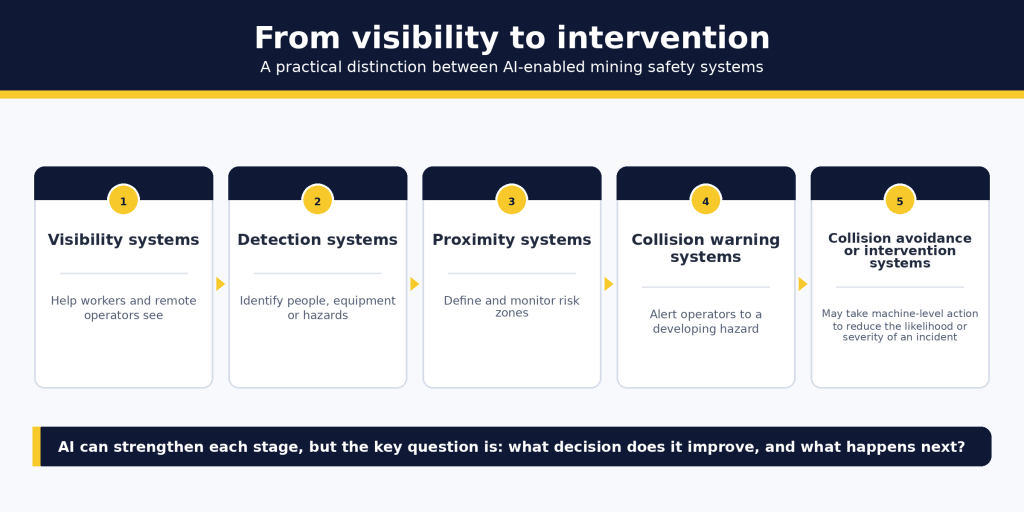
However, not every collision avoidance system is “AI,” and not every AI-enabled camera is a full collision avoidance system. AI-enabled mining safety systems progress from awareness to action. Visibility systems provide a clear view of the operating environment; detection systems identify people, equipment or hazards; proximity systems monitor defined risk zones; collision warning systems alert operators to emerging threats; and collision avoidance or intervention systems can support machine-level responses. The value of AI lies in strengthening each stage so operators can make faster, better-informed decisions.
Relevant proximity, collision-warning and intervention technologies available through Carroll’s portfolio include PBE’s PAS Proximity Alert System, which uses technologies such as electromagnetics, RFID, GPS and bi-directional radar to support collision avoidance in mining environments. The portfolio also includes PBE’s PAS-Z and PAS-ZR systems, with PAS-Z described as a dash-mounted proximity alert system that warns drivers to the presence of personnel, vehicles and obstacles, and PAS-ZR as a ruggedized version designed for above- and below-ground vehicles in construction and mining. PBE’s PAS-C Proximity Alert System is also relevant for detecting vehicles, personnel and infrastructure in proximity-risk scenarios. Alongside these systems, Nerospec USA vehicle intervention technologies support machine connectivity and advanced collision-prevention applications, whileELOKON/ELOshield technologies provide proximity warning, collision avoidance and pedestrian detection capabilities for industrial vehicle environments.
System integration and support for underground mining technology
The most advanced safety systems do more than detect hazards; they are integrated with clearly defined operational responses. These may include in-cab alerts, dispatcher notifications, automatic speed reduction, equipment interlocks, improved visibility for remote operations, or maintenance work orders triggered by system data. The best implementations also generate useful data. Event logs can show recurring risk areas, high-frequency interaction zones, problematic intersections or equipment routes that need redesign.
However, mines may have high-quality cameras, a capable proximity-detection platform, and advanced analytics, but its value depends on reliable deployment in the field. Underground AI requires supporting infrastructure such as power supplies, cabling, communications networks, mounting hardware, intrinsically safe equipment where required, repair capabilities and on-site technical support. These systems should not be treated as “install and forget” technologies; they must be selected for the mining environment, configured for the application, installed correctly, tested with operators and embedded into the site’s ongoing maintenance and safety processes.
Carroll Technologies Group plays an important role in this operational layer. As a supplier, integrator and service partner for mining safety, communications and monitoring technologies, Carroll helps operators move from individual devices to working systems. That includes supporting the deployment of rugged camera solutions such as ExcelSense, along with the broader communications, tracking, monitoring and safety infrastructure needed to keep mines connected and protected.
Assessing AI readiness in 2026
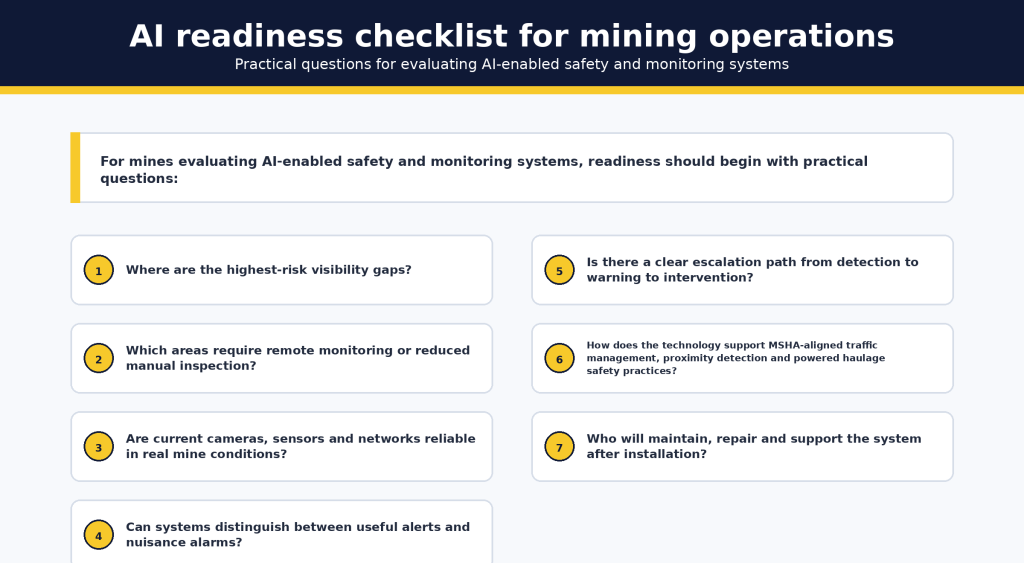
In 2026, the mine operators realizing the greatest value from AI are not necessarily those pursuing the most advanced or speculative applications. Rather, they are those that establish the operational foundations required for effective deployment: clear sensing, reliable connectivity, practical detection, accurate alerts, integrated intervention, and sustained technical support.
From self-cleaning cameras that keep vision systems usable in dirty environments to collision avoidance technologies that help protect workers around mobile equipment, AI in mining is already here. The opportunity now is to deploy it where it can make the greatest operational difference, and to work with partners such as Carroll Technologies Group who understand what it takes to keep these systems performing underground.
[i] Proximity Detection/Collision Warning Information from Technical Support | Mine Safety and Health Administration (MSHA)