

The McLaren titanium mineral sand project is an open-cut mine being developed in Western Australia (WA) by McLaren Minerals, a mineral exploration company.
A pre-feasibility study (PFS) completed for the project in January 2026 outlined a 15.9-year mine life, with an initial development capital expenditure of approximately A$179.3m ($125.5m) and planned annual ilmenite production of 407,000t.
Recommended Buyers Guides

In May 2026, McLaren Minerals completed a share purchase plan to raise A$1.65m towards the project’s bankable feasibility study, which is currently in progress.
McLaren titanium project location
The project sits on the western margin of the Eucla Basin, approximately 150km east of Norseman and 40km west of the Balladonia Roadhouse in southern Western Australia.
Located next to the Eyre Highway, the project covers two tenements, E69/2386 and E69/2388, totalling 197km2 and 136km2, respectively.
Geology and mineralisation
Mineralisation is hosted in Miocene to Eocene shoreline sands, bordered by palaeo channels to the west and variable surface reworking across the core of the deposit area.
The heavy mineral suite is dominated by ilmenite, rutile, leucoxene and zircon within the sand Mids fraction of 38 micrometres (µm)–1mm, and extends roughly 5km east-west and around 8.5km north-south.
McLaren titanium project resource
The indicated and inferred mineral resources at the McLaren titanium mineral sand project were estimated at 529 million tonnes (mt), grading 4.5% heavy mineral (HM) with 23.7mt in-situ HM as of November 2025.
Mining methods
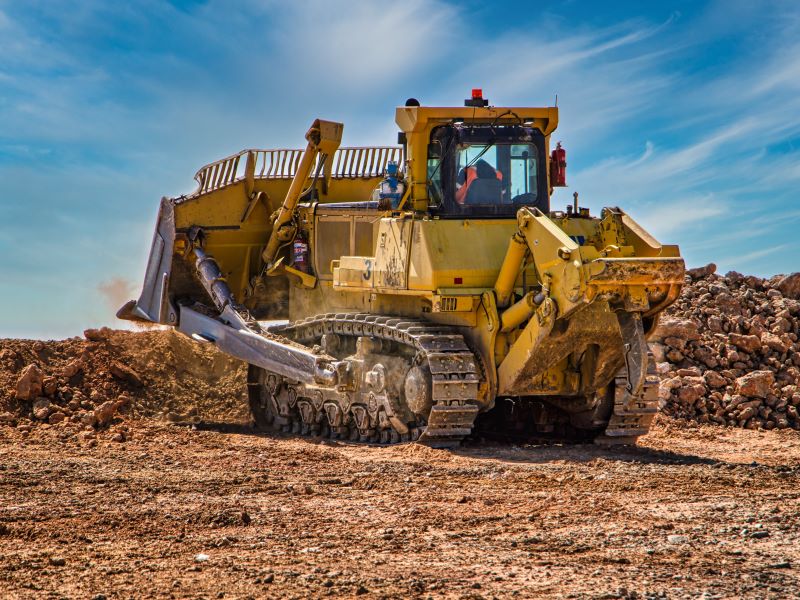
The McLaren titanium mineral sand project is expected to use conventional open-cut mining methods.
The mining unit plant (MUP) will use dry mining techniques and include a dozer trap and screening module. Power is intended to come from a local diesel generator with mine dozers providing feed.
Material will pass through a static grizzly screen at the dozer trap module to remove large oversize, then through a trommel screen to remove >2mm oversize using internal lifters and spray bars to help liberate clays and conglomerates. A slurry bin will add water to control pumping density for long-distance slurry transfer.
The MUP configuration includes a primary ore slurry pump, a 500PN16 pipeline and a primary booster pump, supported by facilities such as a control room, crib room, potable water supply, potable water storage and distribution, and a portable sewerage treatment plant.
Ore transfer is planned via overland pumping, with booster pumps arranged in pairs on draggable skids and powered by local diesel generator sets. Additional units will be added as the haul distance increases.
The McLaren deposit is described as having a high-slimes content, with the design case assuming that 25% of the feed solids are finer than 38µm. To manage this, the feed preparation plant will incorporate a two-stage deslime circuit and an IHC Constant Density tank to deliver a deslimed, density-regulated feed to a wet concentrator plant (WCP).
Ore processing
Processing is centred on the WCP, featuring a four-stage spiral gravity separation circuit with an intermediate sizing screen.
Heavy minerals are separated on spiral troughs, producing a heavy mineral concentrate for downstream treatment in the concentrate upgrade plant (CUP). Coarse sand tailings will be generated and managed through the co-disposal system.
The CUP will comprise a four-stage circuit that includes low-intensity magnetic separators, wet high-intensity magnetic separators, and rougher and cleaner spiral stages, producing magnetic and non-magnetic products.
The magnetic stream is identified as ilmenite, while the non-magnetic stream is a bulk product requiring dewatering and stacking ahead of transport.
Product dewatering is set to use a hydro-cyclone followed by stacking, with the magnetic product placed in a covered storage facility and the non-magnetic product stacked in the open.
Tailings and waste management
Slimes management will commence with the collection to a thickener feed box, combined with reclaimed process water, before feeding two large high-rate thickeners. Flocculant will then be added to aid settling, after which the settled slimes will be discharged and pumped to a co-disposal bin to be blended with the coarse sand tailings. Clarified process water will overflow to the process water dam.
The co-disposal system will combine slimes tailings and coarser sand tailings for deposition back into the mine void. During normal operations, deposition is planned at the rear of the mine pit, while at start-up, co-disposed tailings will be placed into the off-path tailings storage facility.
Overland slurry pumping will return the co-disposal material to the mining area, with the initial 650m horizontal duty handled by the WCP, primary co-disposal pump and the remaining duty provided by field booster pumps.
Contractors involved
The PFS for the project was prepared by IHC Mining, a provider of integrated solutions for mining.ibility study for the project was prepared by IHC Mining, a provider of integrated solutions for mining.
