

Across the world’s mines, diesel continues to shoulder most of the burden for fuelling operations. Haul trucks, loaders and support fleets depend on it; quite simply, it delivers reliable power and high productivity in tough conditions. Operators expect diesel powertrains to remain the majority fleet powertrain choice by 2040. Yet they also expect drop-in alternatives, like performance diesel fuel and renewable diesel to play an important role in the coming decade.[1] Mining fleets are looking for solutions which both deliver on the productivity and efficiency goals of existing mining operations and hardware and support a practical pathway to a lower emission mining future.
Supplies of renewable diesel, also known as HVO, are scaling fast. Global renewable diesel capacity is projected to rise from 2,914 million gallons per year in 2020 to 9,407 million gallons per year in 2030, undergirding availability for industrial users including mines.[2] This growth is driven by a wider shift across transport, freight and industry. It offers potential for adoption by mining companies over the next decade.
Real world momentum in mining is already visible. For example, two major mining operations – Imperial Oil’s Kearl Oil Sands operation and Rio Tinto’s Kennecott mine – have already demonstrated fleets can effectively run on renewable diesel.[3] Early adopters have demonstrated the chemistry and the logistics; the challenge now is to extend this experience across a wider share of the industry.
Why act now?
A combination of regulatory pressure and corporate goals means emission reduction initiatives are in the spotlight across the mining industry; dozens of the world’s top miners have net-zero ambitions by 2050.[4] And, in the interim, many are pursuing shorter-term emission reduction goals, typically aiming for around a 30% reduction by 2030.[5]
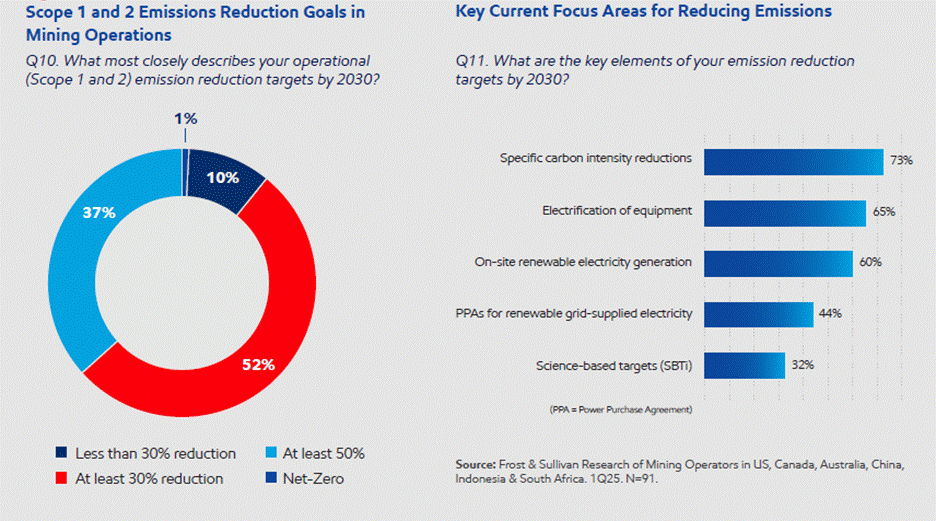
Diesel is central to that story. Mobile diesel fleets can account for 25% of miners’ Scope 1 and 2 emissions, and 90% of Scope 1 emissions in surface mines.5 For open pit operations with long haul routes and steep ramps, cutting emissions without undermining productivity is difficult; the haul fleet is a fundamental cog in the mining operation’s movement of ore. Renewable diesel offers a potential way to address this, changing the lifecycle greenhouse gas (GHG) emissions profile of the fuel without the need for a costly retrofit.
It boasts three key advantages. First, compatibility. For any operator grappling with constraints on maintenance windows and capital budgets, fuel solutions which can drop straight in to existing operations and infrastructure is critical. Renewable diesel can be used in many haul trucks without engine modifications, leveraging existing storage, dispensing and maintenance practices at mine sites.[6] For fleet managers, that means they can trial and then deploy the fuel using the same tanks, pipes and procedures already in place, rather than rebuilding fuel infrastructure from scratch.
Second, the fuel can support the GHG emissions reduction goals of mining operators while continuing to meet performance needs. The lifecycle GHG emissions reduction potential of renewable diesel is dependent upon production pathways and feedstock. Calculations and estimates vary between models and across jurisdictions but, by way of illustration, Directive (EU) 2023/2413 (“RED III”), amending Directive (EU) 2018/2001 (“RED II”), including Annex V assigns to renewable diesel from used cooking oil a default carbon intensity reduction vs conventional diesel of 83% and a typical reduction of 87% .[7]
Third, performance. Any energy solution that compromises productivity faces an uphill battle for adoption by mining operators. Evidence on renewable diesel coming from early movers is encouraging. Kearl ran Caterpillar haul trucks on 100% renewable diesel, reporting no loss of power or performance under demanding conditions. Rio Tinto Kennecott in Utah moved 97 haul trucks and heavy machines to renewable diesel following a site trial, with no power or performance loss reported.3 The marriage of lower lifecycle GHG emissions potential and continued productivity is what turns renewable diesel from an interesting idea into an option worthy of genuine consideration.
With net-zero ambitions of many mining operators for 2050 and interim 2030 goals approaching, the case for renewable diesel is worthy of serious consideration. Fleets that remain dominated by diesel powertrains have a go-to option that has been shown to work in real mining conditions. So, where supply is available and economics favourable, renewable diesel is in the mix.
How to prepare for the renewable diesel future
All operations are different. Topography, climate, ore body, haul profiles and fleet mix all influence fuel use and performance. This is why the first step towards implementation is site-specific pilots to gather essential data on how renewable diesel works in practice, tracking fleet KPIs before scaling further. During this stage, close cooperation between operations, maintenance and commercial teams is critical. Operators need confidence that the fuel behaves predictably; maintenance crews need clarity on any changes in filter life, oil condition or injector performance; procurement needs to understand cost, contracting options and supply reliability. With solid baseline data and careful monitoring, a pilot can show whether renewable diesel delivers the expected GHG emissions profile without harming productivity or equipment health.
With a pilot in place, logistical questions come to the fore. This means drawing up fuel supply roadmaps aligned to longer-run mine plans, factoring in the expansion of global renewable diesel capacity over the coming decade. In doing so, miners have an opportunity to line up multi-year supply arrangements that match their own GHG emission reduction timelines. Successful pilots stall when fuel is unavailable or projections around pricing have not been thought through. And suppliers, who must plan feedstock, production and distribution over many years, will value a collaborative approach.
The third step is to choose the right kind of support. This means working with a comprehensive mining specialist – one spanning fuel science, lubricants and in-field engineering – to help manage the risk of operational disruption while capturing GHG emissions and productivity gains. There are many small, subtle concerns that must be factored into integrating novel fuel supplies. These include ensuring renewable diesel use is consistent with engine manufacturers’ approvals, that maintenance intervals remain appropriate and that any changes in operation – however minor – are understood and managed. There are also training requirements to consider. Drivers and equipment operators are looking for confidence that, while the fuel in the tank has a different origin and lifecycle GHG emissions profile, the machine’s performance remains the same. Employing an experienced helping hand can tick all these boxes, allowing operators to focus on the bigger strategic picture.
For mines facing demanding production targets and challenging GHG emission reduction goals, renewable diesel offers a pragmatic route to lower-GHG-emission haulage that works with current fleets. ExxonMobil’s knowledge and roster of high-quality diesel – as well as synthetic lubricants, field engineering and data-led support – is a core part of the company’s offering for the mining sector. As the industry works through the transition from conventional diesel to new powertrains, there are opportunities today: lifecycle GHG emissions reduction potential with the mobile mining fleet of today. To learn more about ExxonMobil’s perspectives on the potential for lower emission, high efficiency mining operations, download the report on this page.
About Exxon Mobil
Exxon Mobil Corporation has numerous affiliates, many with names that include ExxonMobil, Exxon, Mobil, Esso, and XTO. For convenience and simplicity, those terms and terms such as “Corporation,” “company,” “our,” “we,” and “its” are sometimes used as abbreviated references to one or more specific affiliates or affiliate groups. Abbreviated references describing global or regional operational organizations, and global or regional business lines are also sometimes used for convenience and simplicity. Nothing contained herein is intended to override the corporate separateness of affiliated companies.
[1] ExxonMobil-commissioned research of 91 mining operators by Frost & Sullivan in 1Q25.
[2] GlobalData, Global Renewable Diesel Production Capacity Outlook to 2030.
[3] Imperial Oil & Finning Trial, Rio Tinto transitions to renewable diesel at Kennecott. For further background please see Mining Now, Imperial and Fining discussion on Canadian Mining, 2023. Testimonials referenced are by users of renewable diesel. ExxonMobil makes no representation that your experience will be similar or identical to that of these users. Actual results may depend on factors such as equipment used, its maintenance, operating conditions and fuel previously used.
[4] Reuters, World’s largest miners pledge net zero carbon emissions by 2050, October 2021.
[5] GlobalData, Net Zero Strategies in Mining, 2024.
[6] Renewable diesel can be used in most modern diesel engines without modifying the engine or blending with conventional petroleum diesel. Suitable for use in diesel engines certified to use CAN/CGSB 3.520, ASTM D975 and EN15940 specifications fuel. Verify fuel compatibility with your vehicle owner’s manual or by contacting your vehicle manufacturer.
[7] See for example Directive (EU) 2023/2413 (“RED III”), amending Directive (EU) 2018/2001 (“RED II”), including Annex V. To illustrate the potential difference based on feedstock, the default values in Annex V of the Renewable Energy Directive estimate to renewable diesel from used cooking oil a default carbon intensity reduction vs conventional diesel of 83% and a typical reduction of 87%.