

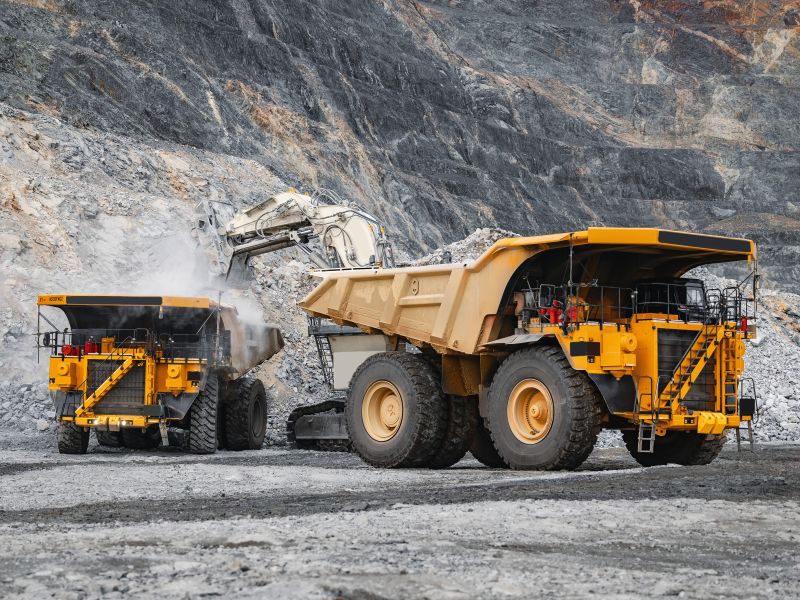
The Colossus rare earth project is an open-pit mine being developed in Brazil by Viridis Mining & Minerals.
The pre-feasibility study for the project was completed in July 2025, while a definitive feasibility study was completed in August 2026. The study outlined a 25-year operational life focused on the project’s Northern Concessions for an estimated initial capital investment requirement of approximately $405m (A$575.93m).
Recommended Buyers Guides

Over this 25-year schedule, projected overall output includes 111,000t of refined rare earth oxides, 74,000t of magnetic rare earth oxides (MREO) and 149,000t of refined mixed rare earth carbonate (MREC).
Initial commercial operations are scheduled to begin in the second half of 2028 (H2 2028).
The project has been selected for inclusion in the Brazil Climate and Ecological Transformation Investment Platform, a Brazilian Government initiative designed to attract substantial international capital to projects supporting the country’s climate transition and energy transformation priorities.
Colossus rare earth project location
The Colossus rare earth project is situated at Poços de Caldas in the state of Minas Gerais, Brazil. The property encompasses 16 mining tenements covering a total area of 2,552 hectares (ha)/6,306 acres divided into two primary zones, Northern Concessions and Southern Complex.
The initial development phase centres on the Northern Concessions, spanning four tenements across 837.1ha, which Viridis plans to amalgamate into a single operational mining group to centralise management and planning.
The subsequent development phases will focus on the Southern Complex, which encompasses 12 tenements over approximately 1,715ha.
Geology and mineralisation
The deposit sits within the Poços de Caldas alkaline complex, a circular caldera-style structure spanning approximately 800km² that ranks among the largest alkaline geological occurrences worldwide. The local geology comprises varied alkaline intrusive and volcanic lithologies such as nepheline syenites, phonolites and related rocks.
Bedrock rare earths were freed through extensive tropical weathering over geological timescales, forming an ionic adsorption clay profile across the concession area.
Colossus rare earth project reserves
The proven and probable reserves at the Colossus rare earth project are estimated to be 200.1 million tonnes (mt) grading 2,894 parts per million (ppm) total rare earth oxides and 715ppm MREO as of July 2026.
Mining methods
The Colossus rare earth project will employ conventional open-pit operations utilising excavators and articulated haul trucks, tailored to the shallow geometry of the ionic adsorption clays. The weathered regolith nature of the project area allows free digging, eliminating the need for routine drilling and blasting.
Extraction during the initial five years will focus strictly on higher-grade deposits in the Northern Concessions, aligning with initial regulatory permits and locating feedstock extraction near the processing plant. Integration of the Southern Complex into the operational schedule begins in the sixth year.
The 25-year mine plan schedules approximately 123.5mt of run-of-mine (ROM) feed, with mine planning based on a 10m × 10m × 5m parent block framework, evaluating ore dilution impacts on MREO concentrations.
The proposed pit parameters for the project are 5–10m bench heights, approximately 50-degree batter face angles and 5m berm widths, resulting in a waste-to-ore stripping ratio averaging 0.52:1. Working widths will be maintained at a minimum of approximately 20m.
The project will employ dual-lane haul roads measuring approximately 18m across, incorporating drainage and safety berms, with gradients capped at 10%.
Surface operations will rely on 50t-class excavators with approximately 3.5m³ buckets loading 40t-class and 40t haul trucks. Support fleets will feature bulldozers, graders, wheel loaders, compactors and water tankers for bench maintenance, material distribution and environmental rehabilitation.
Ore processing
The processing plant is engineered to process 5mt per annum of ore feed to produce refined MREC containing neodymium, praseodymium, dysprosium and terbium.
The ROM ore will undergo scrubbing, screening and classification via hydrosizers to remove barren coarse particles. Oversize fractions will pass through a ball mill before returning to the circuit.
Leaching of the ionic clays will take place at ambient temperatures using an ammonium sulphate solution. A counter-current decantation circuit and associated filtration units will wash and dewater the solids, yielding washed residue for pit backfilling.
Impurities will be precipitated from the pregnant leach solution using ammonium bicarbonate. Subsequent addition of ammonium bicarbonate will result in the precipitation of an intermediate MREC product.
The intermediate MREC material will be redissolved and sent to polishing filters and solvent extraction stages, which will isolate and remove lower-value lanthanum while concentrating heavy and light magnetic elements.
The resulting purified solution will undergo a final stage of ammonium bicarbonate precipitation, producing a refined MREC dry cake ready for packaging.
Offtake agreements
In June 2026, Viridis signed a letter of intent with Solvay for the supply of rare earth feedstocks by 2028.
As part of the agreement, Solvay will contribute its expertise in rare earth separation and processing technology to support the development of feedstock supplies from Brazil. The collaboration will involve refining rare earth materials into individual, high-purity oxide elements for use in electric vehicle motors, renewable energy systems, advanced electronics and defence equipment.
Colossus rare earth project site infrastructure
The project site connects to commercial and logistics corridors through roads BR-146, BR-267 and SP-342. A dedicated permanent road of approximately 1km from Avenida Alcoa to the project gate is planned, with regional roads accommodating traffic during initial construction.
Viridis has secured 27MW of power through the municipal utility DME and has contracted the 138kV electrical connection, which entails approximately 3.2km of dedicated transmission line.
Process water will be drawn from two nominated existing dams not designated for municipal use. Potable requirements are small, with approximately 3–5m³/h supplied under an agreement confirmed by municipal water agency DMAE.
Contractors involved
In September 2026, Virdis awarded the engineering, procurement and construction management contract for the project to Sedgman and its Brazilian engineering provider Blossom Consultoria e Assessoria.
Specialist clay filter press manufacturer Dewater Filter Press was contracted to supply a residue pressure filtration package in the same month.
