
Solstice Gold has announced multiple high-grade gold results and the identification of a new polymetallic occurrences following its latest drilling campaign at the Strathy Gold Project in north-east Ontario, Canada.
The exploration activity focused on the Red Cedar Discovery area within the Temagami Greenstone Belt, part of the Abitibi subprovince.
The winter-spring programme involved 14 diamond drill-holes, covering 3,087m and targeting a 600m × 1,000m area.
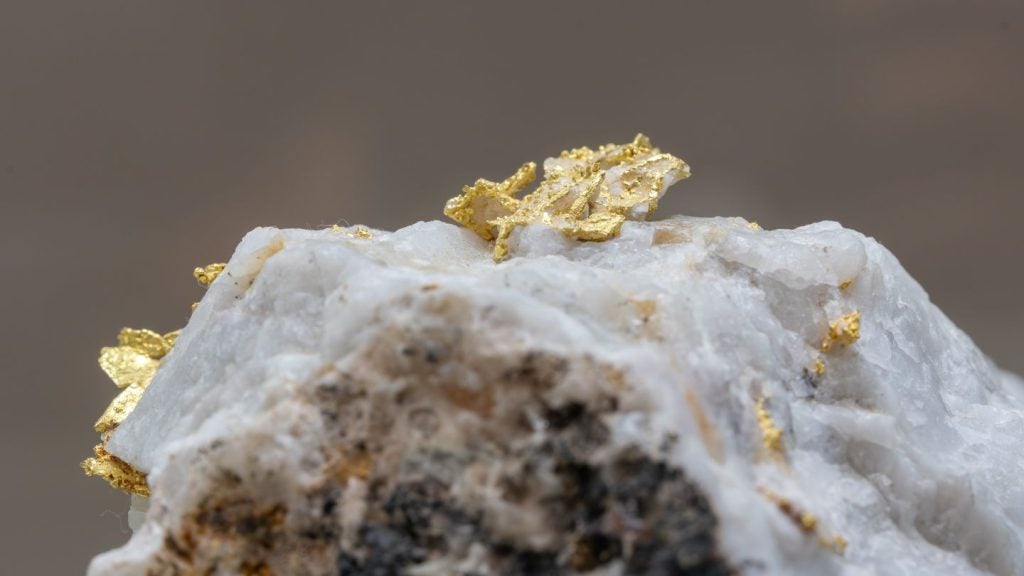
High-grade gold was encountered in three intercepts, each containing local visible gold.
These included 59.60 grams per tonne (g/t) gold over 0.5m in hole SGPDH26-04, and 25.10g/t gold over 0.6m and 8.37g/t gold over 0.4m in hole SGPDH26-11.
An additional intercept, which did not contain visible gold, returned 28.70g/t gold over 1m in hole SGPDH25-09.
The company noted that gold mineralisation occurred at shallow depths, mostly within 150m of surface.
A new polymetallic zone was intersected in hole SGPDH26-07, which returned 3.09g/t gold, 20.80g/t silver, 0.88% zinc and 0.27% lead over 3.83m at approximately 120m depth.
The mineralisation encountered in this intercept is similar to that found in the Leckie Gold Zone, which is situated approximately 600m to the west.
The Leckie Gold Zone has undergone extensive historical drilling, with more than 120 holes completed on Solstice’s claims, and has previously produced intercepts of 5g/t gold over 17.28m and 7.66g/t gold over 7.25m.
The latest results indicate the presence of at least two distinct target types, encompassing high-grade gold veins and broader polymetallic intercepts.
Eight of the 14 drilled holes returned gold intervals assaying at least 1g/t, while 13 holes showed intervals with at least 0.25g/t gold.
Solstice Gold’s technical team has mapped at least six generations of veining in the area, suggesting a complex geological history.
The company stated that ongoing geological, structural and geochemical analyses are aimed at improving the next phase of exploration.
Approval has been received for surface stripping in the Red Cedar area and further exploration is planned.
Further follow-up activities are expected to target the high-grade veins and the newly identified polymetallic zone.
Solstice Gold CEO Pablo McDonald said: “Our 2026 drilling has intersected new broad zones of shallow gold mineralisation, including both high-grade visible gold-bearing quartz veins associated with arsenopyrite (“aspy”) ± chalcopyrite (“cpy”) mineralisation and a newly identified polymetallic gold-silver-base metal intercept interpreted by the company’s technical team to represent a potential new “Leckie-type” structure.
“These results demonstrate the emergence of a large-scale, long-lived hydrothermal gold system with multiple mineralising events provides considerable potential for additional high-grade gold zones and broader mineralised structures across the project.”