

Cinovec is a lithium and tin mining project in the Czech Republic. It is the largest lithium resource in Europe and the world’s fourth-largest non-brine deposit.
A scoping study for the project was completed in 2015, and a preliminary feasibility study (PFS) was completed in June 2019.
Recommended Buyers Guides

European Metals holds control over the exploration licences of the project through its 100%-owned Czech subsidiary, Geomet. In April 2020, utility company CEZ invested £29.1m ($31.4m) in the project by acquiring a 51% equity interest in Geomet.
An updated PFS was released for the project in 2022, followed by a definitive feasibility study (DFS) in December 2025, which highlighted a mining life of 22.6 years for an initial development capital of $1.72bn.
Development background of the Cinovec mine
The project was designated as a “Strategic Project” under the EU Critical Raw Materials Act in March 2025.
In August 2025, Geomet received an updated preliminary mining permit from the Czech Ministry of the Environment for the Cinovec South deposit. The permit is valid for eight years until 2033 and covers an area of 1.4807km².
When combined with the current preliminary mining permits for Cinovec Northwest and Cinovec East (in force until 2028), this authorisation now covers the full Cinovec ore reserve. The company intends to combine all three permits into a single preliminary mining permit.
In December 2025, the full environmental impact assessment (EIA) for the Cinovec project was formally submitted to the Czech Ministry of the Environment, which completed its review and published the document in May 2026, allowing the process to proceed to a public hearing. The EIA process is expected to be completed by the end of 2026.
Cinovec lithium project location
The Cinovec lithium project lies in the Ústí nad Labem region of the Czech Republic, around 100km north-west of Prague.
The Cinovec deposit sits within the long-established Cínovec-Zinnwald mining district in the Krušné hory ore mountains, close to the Czech-German border.
Geology and mineralisation of the Cinovec mine
The Cinovec deposit is located in the Krusne hory-Erzgebirge region along the northern margin of the Bohemian Massif. Mineralisation is hosted in the upper section of the Cínovec granite cupola, a strongly fractionated, slightly peraluminous A-type granite. This upper part of the intrusion contains elevated levels of zinnwaldite, a lithium-bearing mica, and overlies a less fractionated biotite granite.
Mineralisation is typically grouped into tin-tungsten (Sn-W) quartz vein and lithium-bearing greisen (Li-greisen) assemblages. The highest-grade lithium is linked to greisen, a secondary rock that replaces the granite and is dominated by zinnwaldite and quartz, with lesser amounts of feldspar, fluorite and topaz.
Mineral reserves at Cinovec
The proven and probable mineral reserves at Cinovec were estimated at 54.4 million tonnes (mt) grading 0.27% lithium (0.58% Li₂O) with 145,000t in contained lithium as of December 2025.
Mining at Cinovec lithium project
The Cinovec lithium project will use a sub-level open stoping mining method with pillar support and paste fill. Individual stopes will measure 20m in height and 16m in width and will extend up to 50m in length. Stopes will generally be grouped into panels arranged as four stopes vertically by five stopes horizontally, forming a nominal 80m × 80m block.
A 10m rib pillar will sit on each side of a stope block to separate adjacent blocks horizontally. These rib pillars will be extracted once the neighbouring stope blocks have been mined and backfilled. Sill pillars will be located above and below each stope block. Each sill pillar will be 6m high, and when the 5m ore drive for the block below is included, the total pillar thickness will increase to 11m.
Mine access will be provided by a straight twin-decline system developed at a constant gradient. The portal will be positioned to account for surface access constraints while limiting linear development and maintaining an efficient haul distance to the processing plant. Locating the portal to the south-east of the orebody will allow the mine to operate both upward and downward through the deposit, which will support flexibility in the mine plan and schedule.
From the base of the twin-decline entry and egress, an internal twin-decline will extend north-east towards the lower levels of the northern mine area while a twin haulage route will run south-west to the southern extent. Access to the orebody will be gained either directly from these developments or through three spiral ramps located at the southern, central and northern areas of the orebody.
The primary and secondary run-of-mine (ROM) crushing stage for the Front-End Comminution and Beneficiation circuit (FECAB) will be installed underground. The layout will incorporate two primary crushers, a primary screen, a secondary crusher and a conveyor feed arrangement, linked by transfer conveyors and supported by ancillary equipment. Crushing and screening will be undertaken in an open-circuit configuration.
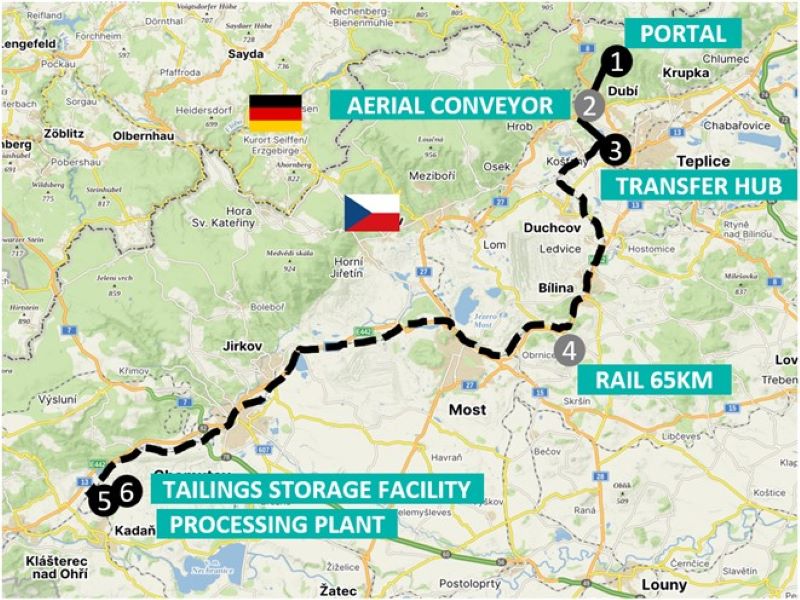
Crushed ore will be transported from the mine portal by an aerial conveyor extending 7.3km to the Dukla bulk materials handling hub. The aerial conveyor will comprise two separate sections connecting the mine portal area with the bulk materials transfer hub at Dukla.
Dukla will operate as an integrated bulk materials handling facility that will connect ROM ore deliveries from the mine portal, via the aerial conveyor, with rail movements to the processing plant at Prunerov.
ROM ore will be loaded onto rail at Dukla, while backfill material will be discharged from rail and conveyed back towards the mine portal for use in backfilling operations using the aerial conveyor.
Processing at Cinovec project
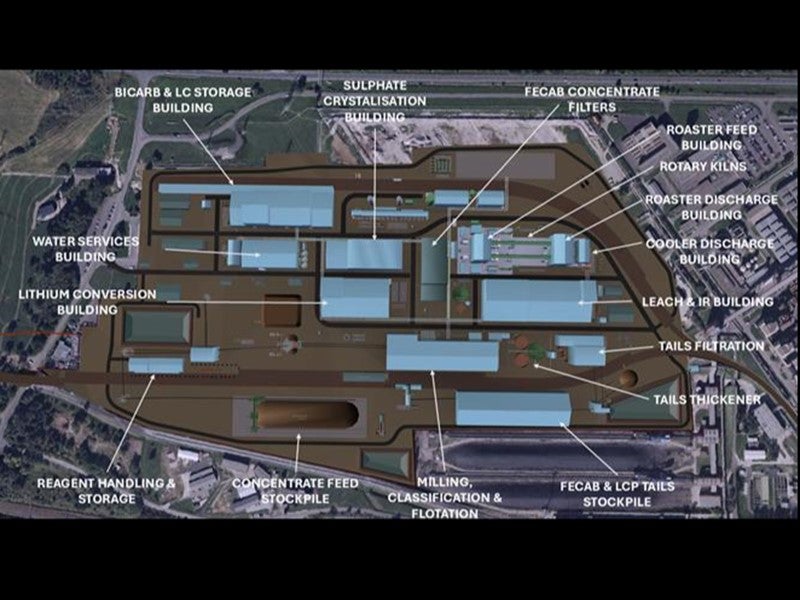
Processing at Prunerov will be divided into two principal components. FECAB will carry out the initial sorting and preparation of ore, while the lithium chemical plant (LCP) will perform the downstream refining to deliver a battery-grade lithium compound. Both facilities will be sited at the former Prunerov I power plant, about 65km from Dukla, within a total processing area of around 35.8ha.
On arrival at the processing site, ore will be re-crushed and re-sorted in a closed circuit to a nominal size in a tertiary crushing stage, including vibrating screens, cone crushers, feeders, conveyors and dust extraction equipment.
Material will then be fed to two rod mills for grinding, while the slurry will be split into a finer fraction for flotation and a coarser fraction that will be returned to the mill.
Primary separation will be based on multi-stage flotation. Mill discharge will be delivered as a suspension to classification cyclones, where the finest particles, less than 10µm, will be removed for storage as tailings. The 150µm -20µm fraction will be conditioned and treated in flotation cells to produce a cinvaldite concentrate.
The flotation concentrate will be thickened and dewatered using vacuum filters before being stored in sealed tanks. Prior to transfer to the LCP facility, the concentrate will be finely ground to less than 100µm.
The LCP facility will treat cinvaldite concentrate at a nominal rate of approximately 610,000 tonnes per annum (tpa) of dry concentrate, with output targeted at approximately 37,500tpa of LCE at 99.5% purity for battery-sector use.
The operation will run as a fully enclosed, closed-loop process, covering receipt and pre-treatment of concentrates, thermochemical treatment, removal of impurities, conversion and crystallisation, final purification of high-purity lithium carbonate, drying, micronisation, and packaging of the micronised product in large volume bags.
Cinovec project infrastructure
The Cinovec project can be accessed by a sealed road and two railway lines located within 10km of the deposit.
The project power supply will include a 20MW, 22kV connection from the Lesni brana substation, which will be linked to the Cinovec mine substation through buried cables. This arrangement will serve as a temporary supply and will provide power from 2026 to 2032.
The project will also use a 30MW, 22kV supply from the Cinovec mine substation, which will be connected to the planned CEZ Distribuce Lesni brana substation, expected in 2031-2032.
Potable water for the mine will be produced by a reverse osmosis (RO) plant or by a standard potable water treatment plant, supplied by water ingress into the decline or by a local stream or well.
The run-off water, treated grey water and water pumped from the mine will be directed to a surface water catchment dam at the portal for underground mine uses. Raw water for the Prunerov site will be sourced from the Ohre River from a pumping station at Mikulovice, via two water lines.
Financing details
In April 2025, Geomet received conditional approval for Kč800m ($36m) in funding from the EU Just Transition Fund, subject to the project EIA being submitted by 31 December 2025 and then approved by the Czech Ministry of Environment by 30 June 2026.
In November 2025, Geomet was granted up to €360m ($417.4m) for the Cinovec lithium project, pending completion of the required administrative procedures under the Strategic Investments for a Climate-Neutral Economy programme run by the Czech Ministry of Industry and Trade.
Contractors involved
Consulting company Hatch and Ausenco, an engineering, consulting and project delivery business, prepared technical reports for LCP and FECAB, respectively, in support of the PFS study.
Independent consulting company Widenbar and Associates provided the resource estimation, while Bara Consulting, a geological, mining, and processing consulting company, undertook mine design and scheduling, geotechnical logging and selection of samples for lab testing.
The DFS was prepared by the engineering, project delivery and operations management group DRA Global, which covered processing work, including FECAB and the LCP, alongside Bara Consulting, which oversaw the mining component, supported by specialist engineering, logistics, environmental and permitting consultants.
