


The mining industry’s route to net zero remains uncertain and uneven. Some operators are pursuing aggressive decarbonisation strategies, while others are focusing on incremental improvements tied to fuel efficiency and fleet performance. However, across the sector there is growing agreement that reducing diesel consumption in heavy mobile equipment is essential if mines are to meet long-term emissions targets.
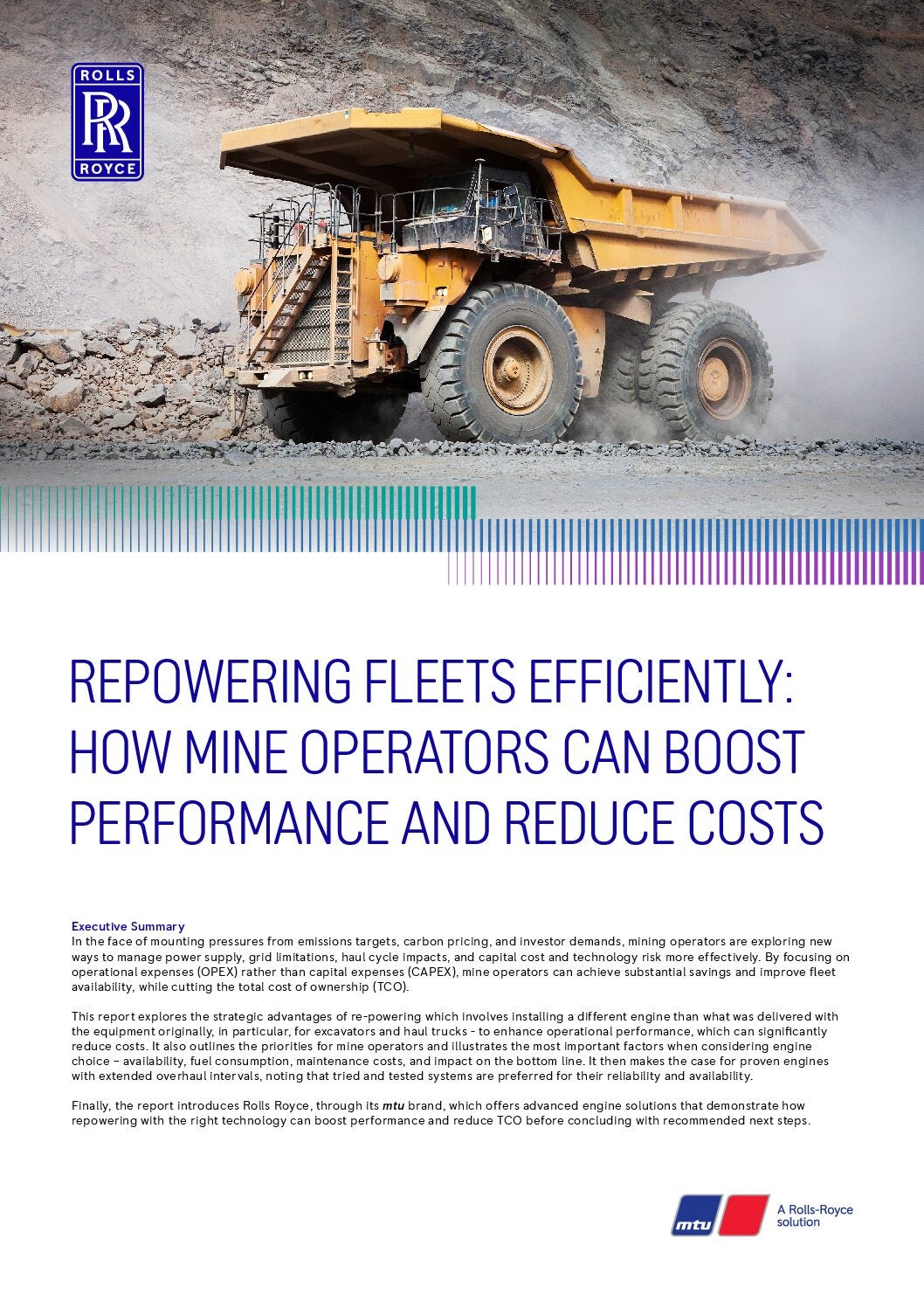
Haul trucks are at the centre of this discussion. In large open-pit operations, these vehicles move continuously across steep haul roads carrying payloads that can exceed 300 tonnes. The fuel demand involved is enormous. Because fleets often operate around the clock, even small efficiency gains can translate into substantial reductions in operating expenditure over the life of a mine.
This is helping drive renewed interest in propulsion hybridisation. The broad idea is to recover energy that would otherwise be lost during operation and reuse it to reduce engine load. In mining applications, the greatest opportunity typically comes during downhill braking cycles, where large amounts of kinetic energy can be captured and stored.
Hybrid haul truck systems and regenerative braking technology
One of the latest examples of innovations in braking systems comes from Rolls-Royce mtu, which plans to begin field testing an mtu-based hybrid propulsion system for haul trucks in late 2026. The system combines mtu Series 4000 engines with batteries, regenerative braking and electric wheel motor assistance to improve efficiency during demanding haul cycles.
Importantly, many ultra-class haul trucks already use diesel-electric drivetrains, where a diesel engine powers a generator supplying electricity to wheel motors. The newer element in systems such as this is onboard energy storage that allows braking energy to be captured and reused in a more meaningful way, rather than dissipated as heat through retarding systems.
According to Rolls-Royce Power Systems, the hybrid configuration could reduce fuel consumption and CO₂ emissions by up to 30% compared with conventional haul truck operation, depending on mine topography and duty cycle. These gains are likely to vary considerably based on ramp gradients, payload factors, stop-start frequency and the proportion of downhill travel available for regenerative recovery.
The operational logic behind the system is closely tied to how open-pit mines function. Loaded trucks descending into pits generate significant braking energy, particularly on long ramps. In hybrid systems, that energy is stored in batteries and then used to support wheel motors during uphill travel, reducing demand on the diesel engine during one of the most fuel-intensive parts of the haul cycle.
Mining fleet efficiency and lower operating costs
The financial case for reducing fuel burn is becoming increasingly compelling. Large haul trucks can consume several thousand litres of diesel every day depending on duty cycle and site conditions. Across a fleet operating continuously over multiple years, fuel savings of even 10%-15% can have a big impact on overall operating costs.
Hybridisation may also help stabilise engine loading and reduce mechanical stress during peak demand conditions. Lower engine strain during uphill haulage could extend maintenance intervals and reduce wear on drivetrain components, although long-term field data will ultimately determine how significant these gains are in real-world mining environments.
At the same time, hybrid systems avoid some of the infrastructure challenges associated with fully battery-electric haul trucks. Many remote mining operations still face limitations around grid access, charging infrastructure and power generation capacity. Hybrid propulsion offers a way to lower fuel consumption without requiring a complete redesign of mine energy systems.
However, there are trade-offs. Batteries add weight, thermal management systems increase complexity, and high-voltage equipment introduces additional training and safety requirements for maintenance teams. Operators will also be closely monitoring battery replacement costs and long-term reliability, particularly at mines operating in extreme temperatures or isolated regions where spare parts logistics can be difficult.
Retrofitting hybrid mining equipment for existing fleets
One area attracting interest is retrofitting. Mining fleets are typically long-life assets, and many operators are reluctant to replace functioning trucks before the end of their economic life simply to achieve emissions reductions. Hybrid retrofit packages offer a middle ground between maintaining existing diesel fleets and investing in entirely new battery-electric platforms.
Rolls-Royce says its system is being developed as a modular solution adaptable to different haul truck types and operating environments. In practice, retrofit feasibility will vary considerably between sites and vehicle platforms.
Hybrid systems are also entering a broader competitive landscape. For example, trolley systems can deliver substantial fuel savings on fixed uphill haul routes connected to overhead electrical lines, while hybrid systems may offer greater flexibility across more varied mine layouts where regenerative braking opportunities exist throughout the haul cycle.
Decarbonisation strategies and solutions for mining operations
The broader pressures facing the mining industry are unlikely to ease. Demand for copper, lithium, nickel and rare earth minerals continues to rise. Mining companies are therefore under pressure to increase production while simultaneously reducing emissions intensity across operations.
Hybrid propulsion systems will not solve every challenge associated with mining decarbonisation, but the direction is becoming clearer. Rather than waiting for a single breakthrough technology, many operators are moving toward layered efficiency strategies, and hybrid haulage is beginning to establish itself as one of the more practical technologies currently available.
To learn more about hybrid propulsion systems, download the document below.
