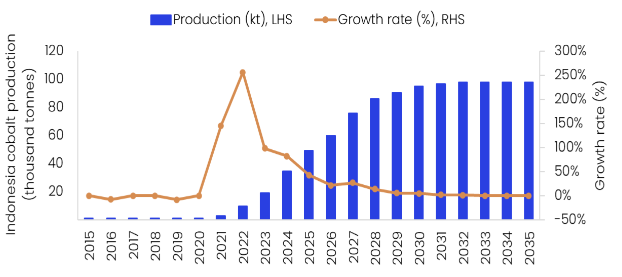

Indonesia, once a minor player in the global cobalt market, has emerged as a significant force, largely driven by investment in high-pressure acid leach (HPAL) facilities. In 2025, the country is estimated to have produced 49,300 tonnes (t) of cobalt, a 42.6% increase over the previous year, primarily driven by the increase in supply at Ningbo Lygend Mining’s PT Halmahera Persada Lygend Project, due to ongoing expansion and commissioning of additional HPAL production lines, which are reaching towards full operational capacity. The PT Halmahera Persada Lygend Project suspended operations in 2024 to cut operational costs due to the prevailing market conditions such as oversupply and lower prices.
In addition, the ongoing ramp-up of Zhejiang Huayou’s Huafei Cobalt-Nickel Project, which started production in Q1 2024, further supported the country’s growth trajectory in 2025.

Access deeper industry intelligence
Experience unmatched clarity with a single platform that combines unique data, AI, and human expertise.
Looking ahead, the country’s cobalt output is expected to grow further in 2026, by an annual growth rate of 21.2% to reach 59,800t. This will be supported by the start of the Pomalaa and Morowali coupled with the ongoing ramp-up of the Huafei Cobalt-Nickel Project and ongoing expansion at the PT Halmahera Persada Lygend Project.
Over the past decade, Indonesia has witnessed a steep rise in cobalt production, increasing from just 1,300t in 2015 to 49,300t in 2025, making it the second-largest producer globally. This transformation is a result of the government’s proactive approach to developing a domestic supply chain for electric vehicles (EVs).
The export ban in 2020 proved to be a pivotal moment, attracting substantial foreign investment, primarily from Chinese companies, into the country’s nickel and cobalt processing industries.
The Indonesia Growth Project (IGP) Pomalaa, which is owned jointly by Zhejiang Huayou Cobalt Co., PT Vale Indonesia, and Ford Motor Company, is a prime example of this. The project is developing a nickel mine and an HPAL processing plant, and the associated mine infrastructure to process nickel ore. Currently, the project is advancing its construction activities and is scheduled to commence operations in Q4 2026. The HPAL plant, once operational, will produce mixed hydroxide precipitate (MHP), a key material used in the production of EV batteries.

Other prominent investments include Indonesia Morowali Industrial Park (IMIP), which is jointly owned by China’s Tsingshan Holding Group (66.25%) and PT Bintang Delapan Group (33.75%) through their subsidiaries. The IMIP has numerous smelters and HPAL facilities. These partner companies develop infrastructure for battery material production, enabling cobalt extraction as a byproduct of nickel processing.
Upcoming HPAL projects led by Chinese companies include the PT QMB New Energy Materials HPAL project (Jingmen GEM and Guangdong Brunp (a subsidiary of CATL)), Sorowako Limonite HPAL project (PT Vale and Zhejiang Huayou Cobalt Co.), which are planned to start in Q4 2026 and Q2 2027, respectively.
Over the forecast period (2026-2035), Indonesia’s cobalt output is anticipated to grow by a CAGR of 5.6% to reach 97,900t by 2035, owing to the start of new projects. The projects that are planned to commence through to 2035 include the Pomalaa and Morowali (2026), Sorowako Limonite (2027) and Pt Ceria Nugraha Indotama Project (2028).