

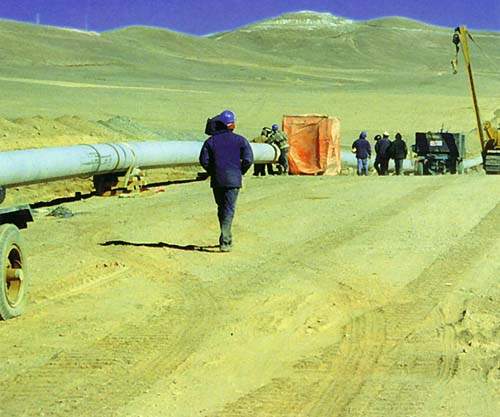
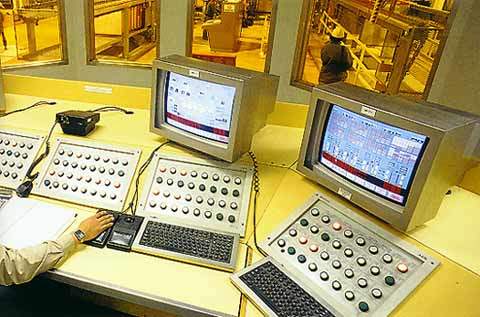
The Zaldívar porphyry copper deposit is located in Andean Precordillera in northern Chile, approximately 1,400km north of Santiago and 175km southeast of the port of Antofagasta at an altitude of 3,000m.
Opened in 1995, Zaldívar is owned and operated by Companía Minera Zaldívar which, until late 1999, was a 50% joint venture between Outokumpu and Placer Dome. In December 1999, Placer Dome paid $251m for Outokumpu’s share, with Barrick Gold Corp. acquiring full ownership following its $10.4bn takeover of Placer in 2006.
Recommended White Papers
Recommended Buyers Guides

In February 2010, the Chilean authorities approved an environmental impact study for a $38m expansion of the mine, which will increase mineral extraction by 20%. The project will allow Barrick to extract 260,000t/day of minerals, against the current 220,000t/day from the Zaldivar deposit. It will include additional logistics units and modifications to the process lines.
Geology and reserves
The deposit is part of a larger tertiary porphyry complex within the large west fissure structural system. South of the main zone, copper mineralisation has been encountered within or near the southern extension of the Portezuelo fault.
The orebody contains both sulphide and oxide copper mineralisation. The majority of the copper occurs in a supergene enrichment zone overlying deeper primary sulphide mineralisation. The main minerals are chalcocite, brochantite and chrysocolla, and mixed sulphide and oxide copper minerals. Primary sulphides are pyrite, chalcopyrite and molybdenite.
To the east of the Portezuelo fault in the main zone ore body where rhyolite is the host rock, secondary sulphide mineralisation is dominant (85–90%) with the balance of the copper present as oxide minerals.
To the east of the Portezuelo fault in the main zone ore body where rhyolite is the host rock, secondary sulphide mineralisation is dominant (85–90%) with the balance of the copper present as oxide minerals.
Zaldívar started in 2005 with proven and probable ore reserves of 421Mt of ore grading 0.67% Cu – approximately 2.67Mt of copper. As on 31 December 2009, profitable copper reserves were estimated to be about 2.72Mt. The projected mine life is 20 years.
Mining
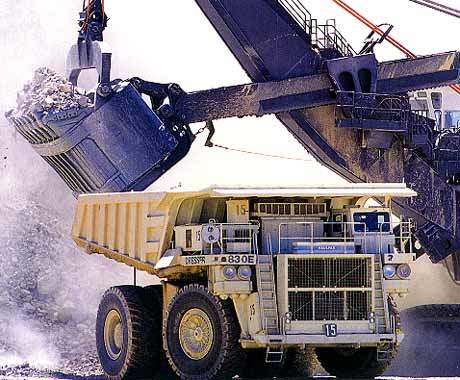
Zaldívar uses conventional open-pit mining systems. Open-pit wall slope angles vary from 38° to 50°, while haulage ramps are 30m wide with a maximum gradient of 10%. A sequence of eight open pit stages were planned, with production in 2005 coming from stages 3 and 4 of the pit.
In June 2009 a 95m steel dome was constructed at the Zaldívar mine for covering the ore pile and conveyor. It was constructed by Zaldivar’s crew in cooperation with SKM-Minmetal Geometrica. The old structure was damaged beyond repair in 2006 and needed to be replaced because the Chilean Commission prohibits uncovered piles.
Ore processing
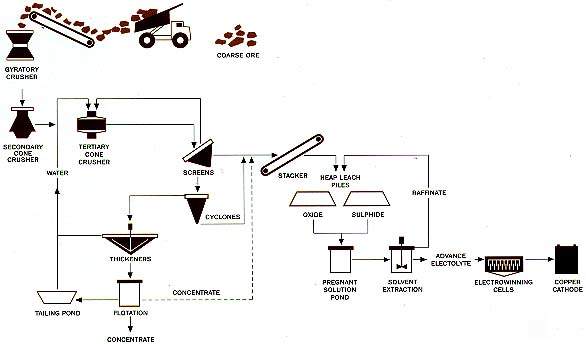
Copper is recovered by heap leaching followed by solvent-extraction and electrowinning to produce high-grade cathode copper.
There are four major processing components:
- A crushing plant reduces the ore size
- A heap-leach operation dissolves the copper, using chemical and bacteriological agents
- A solvent extraction plant concentrates and purifies the dissolved copper in the leach solutions
- An electrowinning plant produces high-grade, high-quality cathode copper – this has been modified to produce 150,000t/y of cathode copper – design capacity of the plant was exceeded throughout 2000, averaging 396t/day of cathode copper
Open-pit ore is hauled to the primary gyratory crusher and the discharge fed to two secondary cone crushers. Due to the dry, dusty nature of the ore and the fine crush required to optimise leach recoveries, waterflush crushers are used to perform the tertiary crushing reduction of the ore to –12mm. Crushed ore is screened and sized to remove fines; these are treated by flotation to produce copper concentrate that is sold for smelting to produce 10,000–12,000t/y of additional copper.
Heap leaching of ore uses dynamic stacking in 6m lifts and chemical and bacteriological dissolution of copper through consecutive lifts from the top to the bottom of the heap. Copper is recovered from the oxides by sulphuric acid in the circulating leach solutions, and from sulphides by bio-leaching using bacteria naturally present in the ore. The pregnant solution containing the dissolved copper flows by gravity to the solvent-extraction plant.
Solvent extraction mixer-settlers recover 90% of the copper from the pregnant leach solution. The remaining 10% is recycled to the heap leach. The run-of-mine dump leach material is further leached on the old sulphide ore pad.
The solvent extraction trains transfer copper to the tankhouse, which produces copper cathodes meeting LME Grade A specifications.
Production
In 2004, the mine produced 147,602t of Grade A-standard copper cathode, treating 18.2Mt of ore grading 1.0% Cu. Its production in 2005 was 123,379t of copper in cathodes and concentrates. In 2009, 136,984t of copper was produced by the Zaldívar mine at an average cost of $1.17 a pound.
