


Detailed hiring and workforce data can serve as an early warning system for business performance, giving company leaders a forward‑looking view that can facilitate investment decisions, cost control and competitiveness. By tracking which roles, skills and regions companies are hiring into, leaders can achieve a useful viewpoint, observing competitors’ movements into new products, channels and markets. This insight can help to uncover gaps or overexposure in their own strategies.

The mining equipment industry is no different. The latest GlobalData analysis shows that hiring activity in the APAC mining equipment sector is in expansion, not contraction, with active job postings standing at 4,814 in May 2026, up 30% YoY, and the sector sustaining positive momentum across ten of the trailing twelve months. The aggregate signal is constructive and the cross-sectional signal is sharper: a 477-percentage-point spread between the fastest and slowest movers, a new-entry Australian contractor from zero, and an autonomous vehicle hiring theme that does not appear in any filing.
The sector is filling faster than it is opening
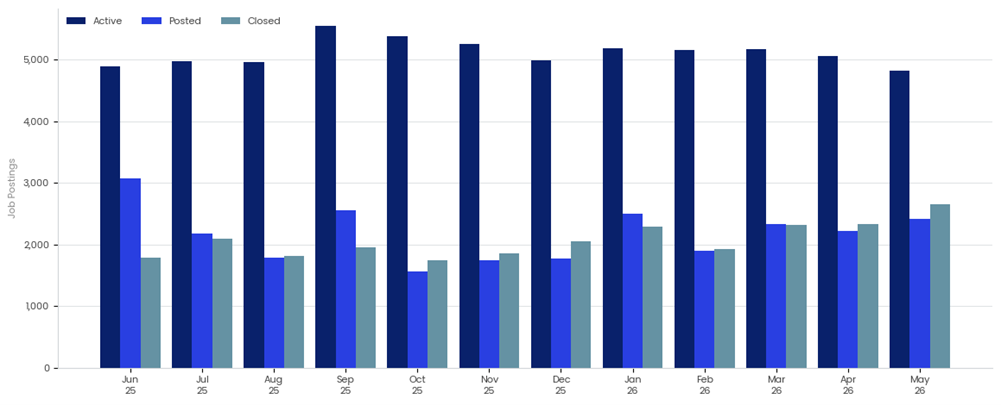
Active postings in APAC mining equipment peaked at 5,549 in September 2025 and retraced modestly to 4,814 by May 2026, still 30% above the year-ago level. Posted volume for May stood at 2,411, up 17% YoY. The YoY comparison turned briefly negative in March and April 2026, the only interruption in an otherwise sustained expansion running back to June 2025.
The more informative signal is the relationship between posted and closed postings. Closed roles have exceeded new posts in both April and May 2026, with May recording 2,659 closures against 2,411 new postings. In an expanding sector, this pattern signals accelerating fill velocity rather than drawdown. Companies are not accumulating unfilled vacancies; they are clearing them. The constraint is not demand for roles but supply of candidates.
Figure 1: Monthly Active, Posted & Closed Job Postings — Mining Equipment, APAC, Jun 2025–May 2026
Source: GlobalData Jobs Analytics
Equipment specialists are building capacity into commodity demand
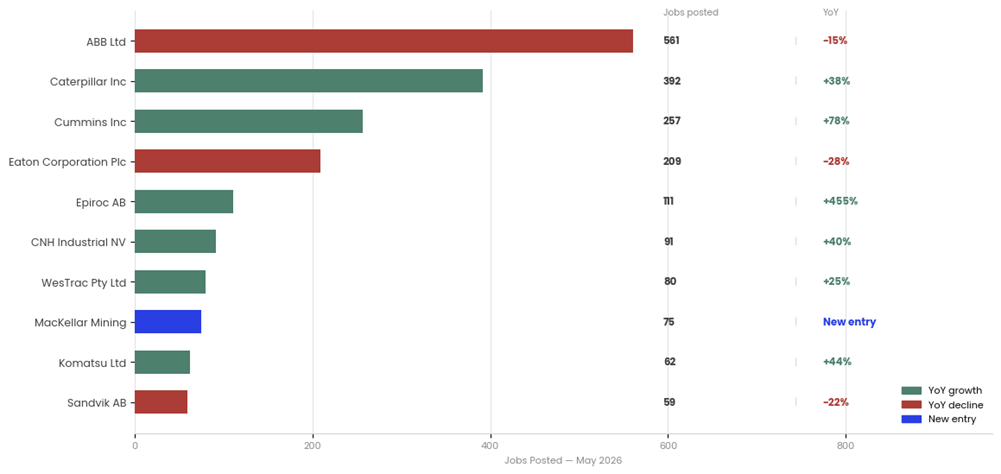
The cross-sectional range in YoY hiring change across the top ten companies spans 477 percentage points. Epiroc AB grew from 20 posted roles in May 2025 to 111 in May 2026, a 455% increase. Epiroc is a specialist in underground mining and rock excavation equipment; its hiring ramp is a direct signal of capacity investment in underground mineral extraction. Cummins, which provides power systems for mining equipment, is up 78% YoY. Caterpillar, the reference name in surface mining equipment, is up 38%.
MacKellar Mining, an Australian contract mining operator, enters the top ten from zero with 75 postings and no prior-year comparable. New entries of that scale, in a month where active sector postings are running 30% above year-ago levels, signal the start of a build rather than isolated vacancy filling. Against the expansion names, ABB is down 15% YoY and Sandvik is down 22%. Both are broad industrial technology businesses with mining exposure rather than pure-play equipment specialists. The dispersion maps onto business model as much as market position.
Figure 2: Top Companies by Jobs Posted — Mining Equipment, APAC, May 2026 vs May 2025
Source: GlobalData Jobs Analytics
Workforce scaling, not capability investment
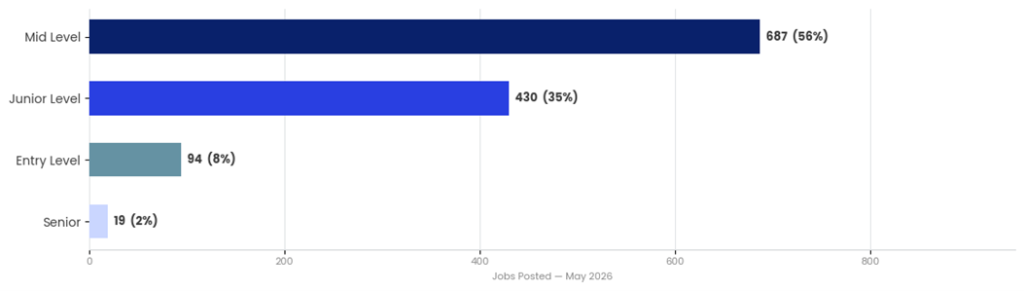
The seniority profile of May 2026 mining equipment postings is operationally concentrated. Mid-level roles account for 56% of postings, junior for 35%, entry level for 8%, and senior for just 2%. Ninety-eight% of postings sit below senior level. The pattern is consistent with equipment operators and contractors scaling site-level and maintenance workforces in response to production demand rather than building new technical or strategic capability.
The analytical value of the seniority data is comparative. Against the sector aggregate, companies running senior hiring above the 2% baseline are making deliberate capability investments into a workforce that is otherwise operationally scaled. Those hires, at companies like Epiroc and Caterpillar, where the YoY volume signal is already constructive, represent a compound signal: expanding headcount and deepening expertise simultaneously.
Figure 3: Seniority Mix of Jobs Posted — Mining Equipment, APAC, May 2026
Source: GlobalData Jobs Analytics
Commodity demand signal is concentrated in three markets
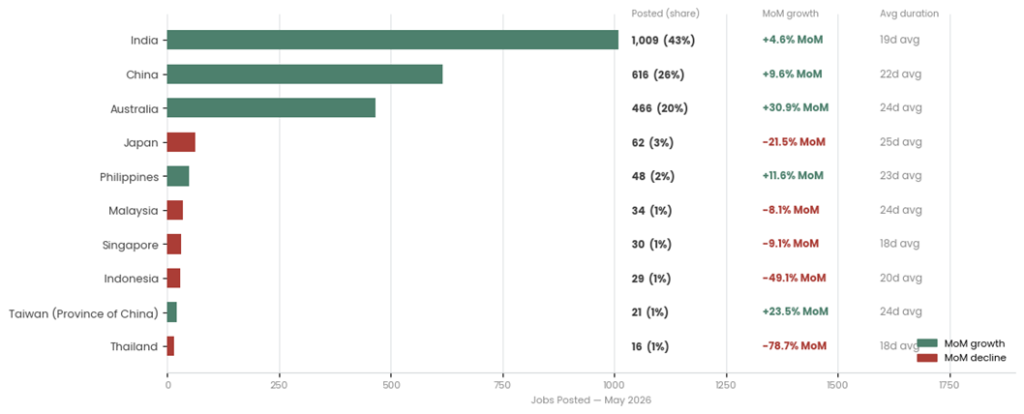
India accounts for 1,009 of 2,331 posted jobs across the APAC geographic breakdown, 43% of the total, and growing 4.6% month-on-month with a 19-day average posting duration. China follows at 616 postings and 26% share, up 9.6% month-on-month. Australia, at 466 postings and 20% share, is the fastest-growing of the three major markets at 30.9% month-on-month. Together, India, China and Australia account for 90% of APAC mining equipment hiring.
SE Asia is bifurcating sharply. Indonesia is down 49% month-on-month and Thailand is down 79%, the two sharpest contractions in the geography. The Philippines, at 48 postings, is up 11.6%, and Taiwan (province of China) at 21 postings, is up 23.5%. The divergence between the India-China-Australia expansion and the Indonesia-Thailand contraction is a commodity demand signal as much as a hiring signal. The markets growing are those tied to active commodity extraction cycles; the markets contracting are where mining equipment activity is most sensitive to commodity price softness.
Figure 4: Jobs Posted by Geography — Mining Equipment, APAC, May 2026
Source: GlobalData Jobs Analytics
What this means for you
The expansion at Epiroc, Caterpillar and Cummins, the entry of MacKellar Mining from zero, and the autonomous vehicle hiring theme running across India, China and Australia are not visible in equipment order books, earnings guidance or analyst consensus. They surface in job postings first, and the positioning window closes before the signal reaches public disclosure. The combination of volume trajectory, company-level dispersion, seniority composition, and thematic investment priorities produces a multi-factor signal that ranks companies differently than any single-variable screen.
A systematic read of hiring intent across the sector, with decomposition at the company and country level, is what converts a data point into a durable, repeatable factor. Hiring and workforce data offers an early, forward-looking view of where investment, capacity and risk are shifting. By tracking how roles, skills and locations are changing before they appear in financial results or consensus, leaders and investors can make sharper decisions on where to back growth, where to pull back, and how to stay ahead of competitors.
GlobalData Jobs Analytics delivers point‑in‑time postings direct from company career pages, tagged by company, sector and theme. Request a data sample today, by contacting hirendra.vikram@globaldata.com or download the white paper below to start translating complex hiring patterns into straightforward signals you can use in your planning and investment decisions.
