
The Perron gold project is an underground development in Québec by Canadian mining company Amex Exploration.
A preliminary economic assessment (PEA) was completed in November 2024 and updated in September 2025.
Recommended Buyers Guides

A phase one feasibility study began in September 2025 and was completed in April 2026. The study envisages two years of pre-production work followed by five years of underground production, with ore treated through toll milling and initial capital estimated at around C$193.9m ($139.8m).
While phase one is in production, work will focus on evaluating and advancing phase two, which is expected to expand both the underground and open-pit operations. Phase two is also expected to consider building an on-site mill and supporting infrastructure to process the remaining mineralisation.
Perron gold project location
The Perron property is located near Valcanton, approximately 6.5km north-west of Normétal town in the Abitibi region of Quebec, Canada.
Amex holds 100% ownership of the Perron Property, which spans approximately 4,560 hectares (11,268 acres) across the Perron and Desmeloizes townships in Nord-du-Québec and Abitibi-Témiscamingue.
Geology and mineralisation
The Perron gold project sits within the Abitibi subprovince of the Archean Superior Province on the Canadian Shield. The property is dominated by rhyolite, with basalt, andesite, dacite and volcano-sedimentary units, and is cut by mafic to intermediate intrusions.
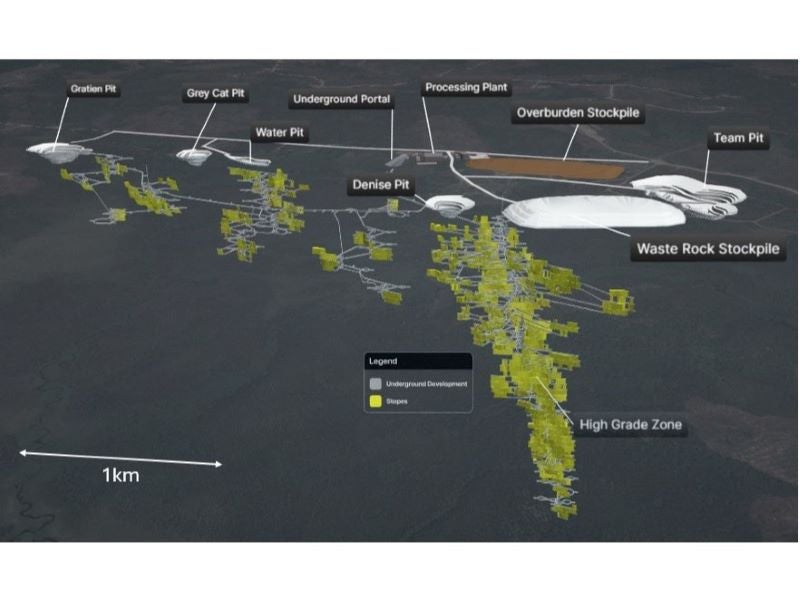
The project hosts multiple gold mineralised areas such as the Champagne, Denise, Gratien, Teams and Grey Cat zones, along with several additional satellite targets.
Gold and base metal mineralisation is linked to greenschist metamorphism and brittle-ductile deformation, with structurally controlled gold occurring in disseminated sulphides and gold-bearing quartz veins.
Mineralisation is mainly associated with quartz-carbonate-sulphide veins and stockworks, hosted primarily in rhyolite within the Beaupré Block, and to a lesser extent in the Normétal South Block near the Perron Fault.
Perron gold project reserves
The proven and probable mineral reserves at the Perron gold project were estimated at 1.99 million tonnes (mt) grading 12.10 grams per tonne gold, with a total of 774,000oz in contained gold as of March 2026.
Mining method
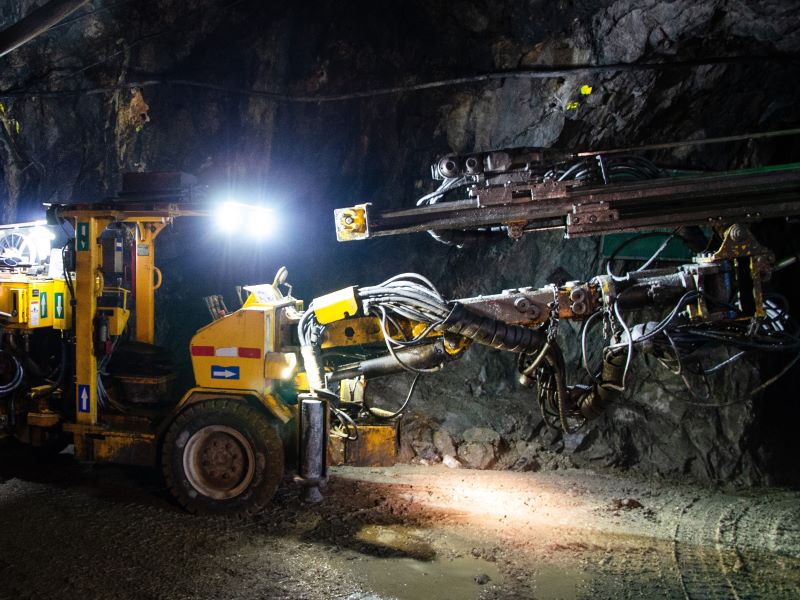
Mining is planned as a mechanised underground operation using longitudinal longhole open stoping with cemented rockfill.
Phase one mining is expected to focus on the high-grade Champagne Zone, accessed via a surface portal and ramp measuring 5m in width and 5.3m in height, extending to a maximum depth of 1,385m. The design targets a nominal rate of 1,100 tonnes per day (tpd) over a five-year production period following a two-year development phase.
The mine plan includes ten sills mined sequentially from bottom to top, with stopes typically designed at around 17.5m strike length and 25m height, and an average mining width of 4.7m including dilution.
Operations are expected to be carried out by a contractor using diesel underground equipment such as 10t load haul dump units and 42t haul trucks.
Ore will be hauled to the surface for off-site processing, while waste rock will be placed on the surface or used underground as backfill.
Ore processing
The feasibility study is based on toll treatment of all Perron ore at an existing regional cyanidation plant, assuming a haulage distance of roughly 160km.
Metallurgical testing indicated that the material is suitable for conventional grinding, gravity recovery and cyanide leaching without the need for specialised changes. Test work also suggests whole-ore cyanidation can deliver the best recovery, with more than 75% of the gold potentially recoverable through gravity concentration ahead of leaching. A target grind of around P80 100 micrometres is considered compatible with standard gold plant circuits.
Processing is expected to be carried out in discrete campaigns, with material stockpiled at the toll mill before treatment to support reconciliation and grade control. The toll-treatment plant is forecast to achieve an overall gold recovery of approximately 97.5%.
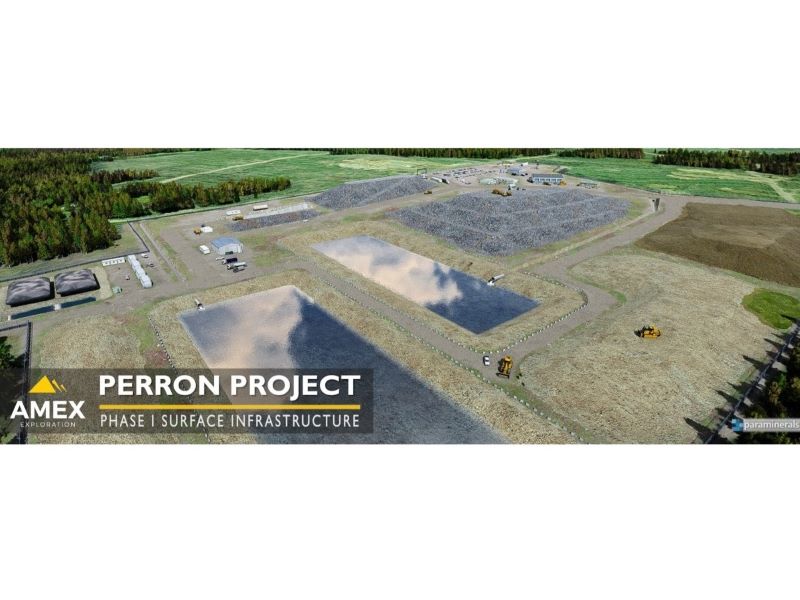
Perron gold project site infrastructure
The Perron project site is accessible year-round from Normétal, which can be reached via Québec Route 111 north of Val-d’Or. The project can be accessed via several logging roads, secondary roads and trails.
Power required for the project is expected to be supplied through a new 25kV transmission line tied to the Hydro-Québec substation in Normétal, while emergency backup power will be supplied by diesel generators.
The project also includes a private long-term evolution network for underground and surface communications, data and tracking for the mining operations.
Water supply for operations is expected to come from an on-site groundwater well, providing non-potable water for site facilities and industrial use, supported by pumping, distribution, storage and treatment to meet relevant standards.
Contractors involved
The PEA and updated PEA for the project were prepared in collaboration with independent engineering and geological companies Evomine, Bumigeme, P&E Mining Consultants, Norda Stelo, Alphard, as well as GoldMinds and Laurentia Exploration.
The feasibility study for the project was prepared by P&E Mining Consultants, Laurentia Exploration, Evomine Consulting, A2GC, Hydro-Ressources, plus Soutex and Norda Stelo.
Amex Exploration appointed Moreau, an industrial electrical infrastructure contractor, to undertake early-stage preparatory activities and to assist with the regulatory approvals required for the dedicated power line for the Perron gold project.
