

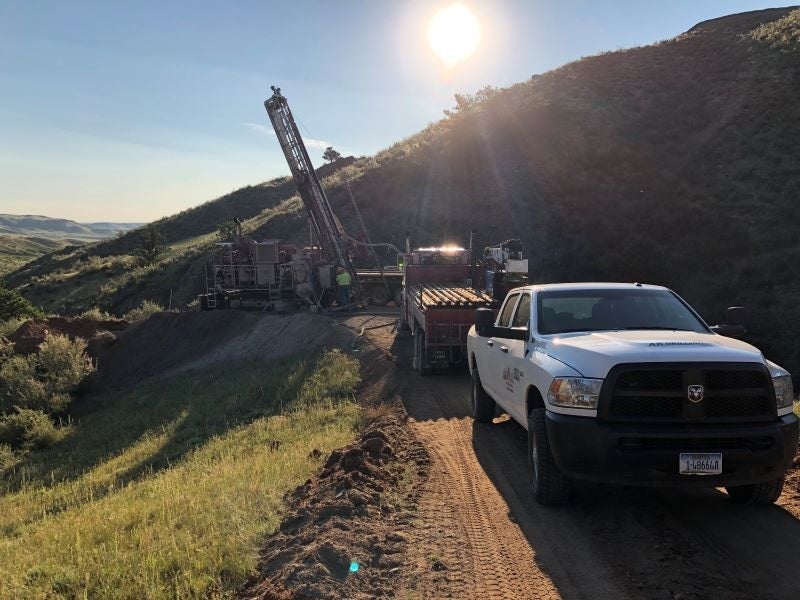
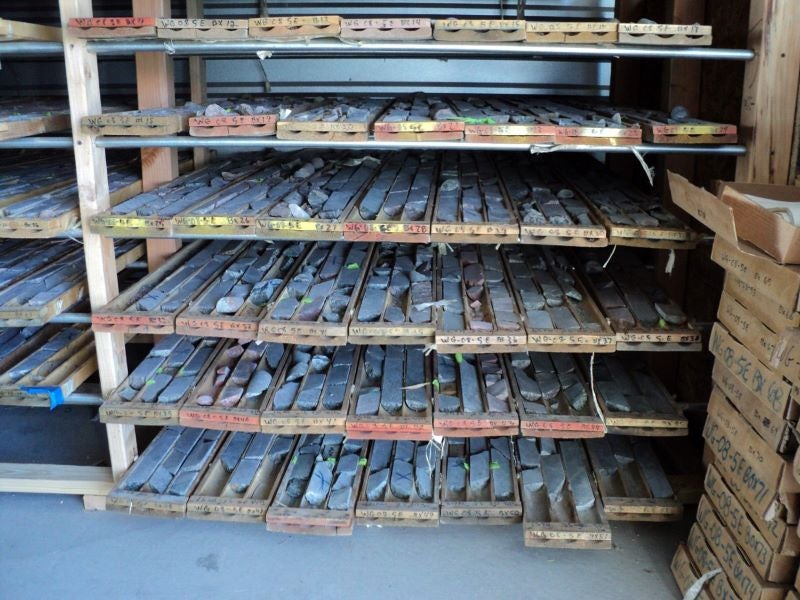
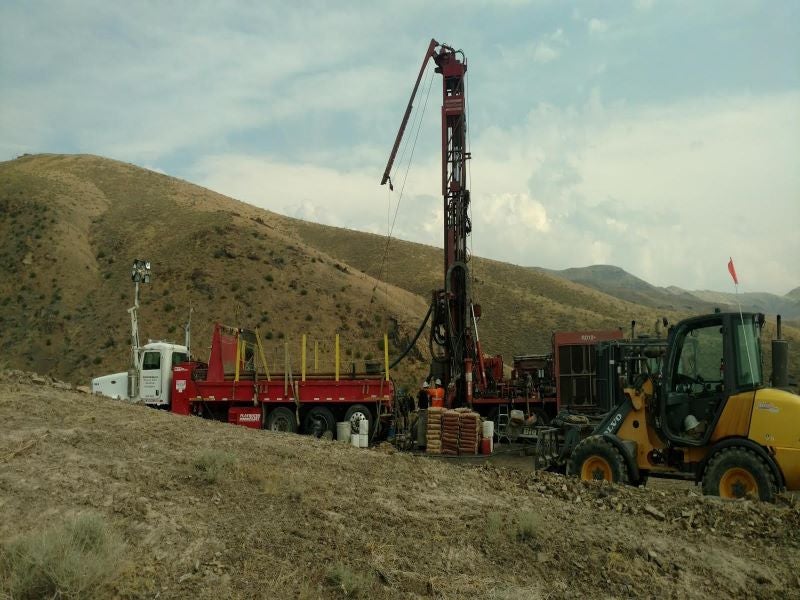
The CK Gold Project, known historically as the Copper King, is an open-pit mine being developed in Wyoming, US, by gold exploration and development company U.S. Gold.
A pre-feasibility study (PFS) for the project was completed in December 2021, while an updated PFS was completed in February 2025.
Recommended White Papers

Recommended Buyers Guides

A feasibility study for the project was completed in March 2026, outlining an 11-year operating mine life with an estimated investment of $394m.
The project has secured full state-level approval from Wyoming agencies, with all necessary permits obtained and a $5m reclamation bond lodged for the initial construction phase.
The final decision on the construction of the project is anticipated in 2026.
Project location
The CK Gold Project is located in the Silver Crown mining district, 32.1km west of the city of Cheyenne in Wyoming. The property encompasses an area of approximately 453 hectares.
Geology and mineralisation
The Silver Crown mining district is underlain by Proterozoic rocks with metavolcanic and metasedimentary rocks intruded by the Sherman Granite and associated felsic rocks. Aplitic quartz monzonite dikes, pegmatite dikes and thin mafic dikes intrude the foliated granodiorite in the project area.
The CK Gold Project comprises a shear-zone controlled, disseminated and stockwork gold-copper deposit in intrusive rocks of the Proterozoic era. The mineralisation is mainly found in granodiorite, while lesser amounts are also situated in quartz monzonite and thin mafic dikes.
A central thin quartz vein and stockwork host the higher-grade mineralisation within the main core area, surrounded by a zone of lower-grade disseminated mineralisation.
CK Gold Project reserves
The proven and probable mineral reserves at the CK Gold Project are estimated at 74.5 million tonnes (mt) grading 0.01 ounces per short tonne (oz/st) of gold, 0.17% of copper and 0.4oz/st of silver as of March 2026.
Mining method at CK Gold Project
The CK Gold Project is set to be developed as a conventional open-pit truck-and-shovel operation. The plan prioritises higher-grade gold equivalent feed in the early years through stockpiling, followed by processing of the lower-grade material accumulated in the stockpile later in the project.
Over the 13-year operating life, the schedule allows for 163mt of total material movement, including rehandling of the low-grade stockpile and waste placed for tailings management facility (TMF) capping.
The life-of-mine strip ratio averages 0.89–1. Ore production is set at 20,000 tonnes per day, with extraction limited to a maximum of 12 benches each year.
Mining is staged through four internal pit phases to bring higher-grade material forward while supporting the stockpiling approach. This sequencing also provides flexibility to refine the ultimate pit wall design, including final geotechnical slope angles, and to assess potential pit expansions aimed at recovering remaining resources and any additions to the current inventory.
The proposed mining fleet comprises up to 18 haul trucks, supported by excavators and shovels selected to maintain efficient loading and haulage cycles.
Processing methods
The proposed process plant will use Jameson cell flotation technology, which has been selected based on test results, improving metal recovery and reducing the plant footprint compared with conventional flotation.
The processing circuit comprises primary crushing, semi-autogenous and ball mill grinding to a p80 of 90 microns (µm), followed by rougher flotation. Rougher and scavenger concentrate will be reground to a p80 of 25µm before cleaner flotation in smaller Jameson cell units.
The concentrate will be dewatered using a filter press and then transported to a smelter for metal recovery. Meanwhile, the tailings will also be filtered and placed in a dedicated TMF, where waste rock will be used to build supporting embankments and form a cover over the tailings ahead of rehabilitation.
The TMF is expected to use around half of the mine waste for stabilisation and capping, leaving around 35mt for waste rock storage facilities. A portion of the waste rock will be crushed for start-up and ongoing on-site construction.
The remainder has been assessed for aggregate quality and found suitable for rock aggregate and rail ballast. Subject to market conditions and operational requirements, sales of up to one million tonnes per year could be possible during operations and into the reclamation period.
CK Gold Project infrastructure
The project can be reached by travelling 4.5 miles (7.2km) east along a private road from Laramie County Road 210. This access route will be a controlled-entry gravel road.
The project is expected to require up to 30MW of electricity, which will be supplied by Black Hills Energy via a 115kV transmission line.
Power will be distributed across the site through a new substation and a 13.8kV distribution network. A 1MW backup generator is planned to provide emergency power. Black Hills Energy will construct the transmission line extension to the site, with the associated cost recovered through a minimum demand charge alongside consumption charges.
The mine will receive its water supply under a contract with the Cheyenne Board of Public Utilities. Water will be delivered via a pipeline from the Crystal Reservoir, which the utility operates, and will be billed at the city’s published raw water rate with an additional 1.5-times surcharge.
Over the life of the mine, make-up water is expected to be purchased on an ongoing basis, while water collected on site will reduce the volume required and partially offset costs.
Contractors involved
Oil, gas and mining consultancy Gustavson Associates received a contract to conduct the PFS for the project.
Geotechnical investigation was conducted by Piteau Associates, a mine geotechnical engineering and waste rock management services company.
AFK Mining was engaged to develop a mine design and schedule for the project. Alquimia Engineers (Chile) worked with U.S. Gold to develop detailed process the design criteria, main equipment list and flowsheets.
Hazen Research performed the comminution test work, while Pocock International conducted test work related to thickening/filtration. Mineralogy evaluation on tailings, concentrate and feed samples was performed by the multinational engineering company FLSmidth.
Kappes, Cassiday & Associates, a laboratory testing company, conducted gravity and flotation test work, while Base Metals Lab performed high-grade oxide test work.
Micon International and Halyard was contracted in June 2025 to conduct the next phase of engineering involving the feasibility study. The feasibility study was prepared with additional inputs from Drift Geo and Tierra Group International.
The updated PFS was prepared with inputs from Samuel Engineering, AKF Mining, Drift Geo, John Wells and Tierra Group International.
