

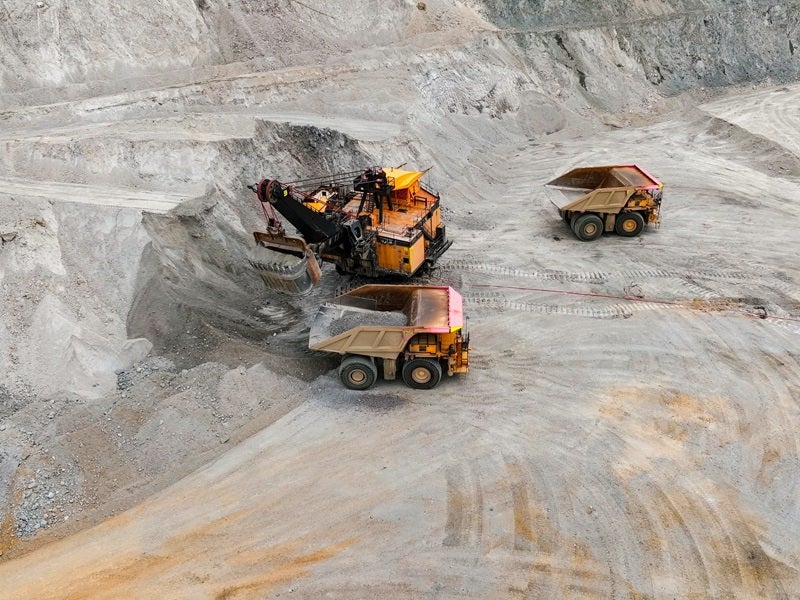
The Bilboes gold project is an open-pit mine being developed by Caledonia Mining (Caledonia) in Zimbabwe.
The project was previously owned by Bilboes Gold through its Zimbabwean subsidiary Bilboes Holdings Private. In January 2023, Caledonia completed the acquisition of Bilboes Gold, taking ownership of the project.
Recommended Buyers Guides

A preliminary economic assessment (PEA) for the project was filed in June 2024, followed by a feasibility study in November 2025.
The feasibility study outlined a mine plan structured across two phases for a total life of mine (LOM) of 10.8 years. The staged development includes initial capital of $492m for phase one and a further $91m for phase two.
First production from the Bilboes gold project is expected in late 2029.
Bilboes gold project location
The Bilboes gold project is located in Zimbabwe’s Matabeleland North Province. It comprises three groups of claims comprising four mining areas: Isabella North, Isabella South, McCays and Bubi. The three claim groups cover an area of 2,731.6 hectares.
The Isabella North, Isabella South and McCays properties lie around 80km north of Bulawayo, while Bubi is roughly 100km north of the city and around 32km north-east of Isabella.
Geology and mineralisation
The Bilboes properties are underlain by the Archean Bubi Greenstone Belt, made up of volcanic rocks of the Upper Bulawayan Group overlain by sedimentary sequences of the Shamvaian Group, all metamorphosed into felsic and mafic schists.
Gold mineralisation is concentrated near the contact between these units, where structural breaks and splays provided conduits for hydrothermal vein systems. Gold occurs with sulphides typical of such settings, particularly pyrite and arsenopyrite, with some deposits also containing copper, lead, zinc and antimony. Alteration is dominated by silicification, with lesser sericite and chlorite.
Bilboes gold project reserves
The proven and probable mineral reserves at Bilboes are estimated at 24.1 million tonnes (mt) grading 2.26 grams per tonne of gold, with 1,749,000oz in contained metal as of October 2025.
Mining method
Open-pit operations are expected to be undertaken by a contractor using conventional truck-and-shovel methods, with drilling and blasting for transitional and fresh material.
Ore will be hauled in 40t or 60t trucks to the plant run-of-mine (ROM) pad for direct tipping to the crusher or placement on ROM stockpiles. Waste will be hauled in 60t trucks to designated dumps and progressively dozed and levelled to support staged lifts.
The mining fleet will include 100t excavators with 7m³ buckets for waste and 70t excavators with 4m³ buckets for ore.
Phase one is based on a processing rate of 2.88 million tonnes per annum (mtpa) from McCays and Isabella North and South, with blending limits set so that Isabella North contributes no more than half of plant feed, with the remainder coming mainly from Isabella South or from McCays.
Phase two allows for 2.16mtpa from Bubi, with Bubi ore stockpiled at the pit and later rehandled for road transport to the central processing facility north of the Isabella North pit.
Ore processing
Processing throughput is planned at 240,000t per month for the first six years, reducing to 180,000t per month for the balance of the project.
Feed is expected to come primarily from Isabella McCays and Bubi, phased through the LOM to reflect tonnage, proximity to the plant and metallurgical performance. Bubi material will be trucked around 23km to the plant located at the Isabella McCays complex.
ROM ore will be treated through two-stage crushing using a primary jaw crusher and a secondary cone crusher, followed by ball milling and cyclone classification. The cyclone overflow will undergo sampling and screening before entering the flotation process, while the cyclone underflow will be returned to the mill for regrinding.
The flotation circuit is designed to operate at natural pH, facilitating maximum gold and sulphide concentrate recoveries in a rougher, cleaner, recleaner and cleaner scavenger arrangement. The concentrate will then be processed through biological oxidation for approximately 6.5 days at around 20% solids to oxidise sulphides.
The concentrate will then move to a carbon-in-leach circuit for cyanide leaching and adsorption onto activated carbon. Gold will then be eluted, recovered by electrowinning and then undergo smelting in an electric furnace to produce doré.
Bilboes site infrastructure
The mining areas can be reached via public roads of mixed quality. By road, Isabella is around 110km from Bulawayo, and Bubi is roughly 140km, with Bubi also accessible from Isabella.
Power required for the project will be supplied from the Zimbabwe National Grid via a 70km 132kV Lynx line from the Shangani substation, including a new line bay at Shangani and a mine substation at Isabella.
Raw water is expected to be supplied from the nearby Bafana dam to a storage tank with 2,568m³ of live capacity.
Funding details
In January 2026, Caledonia completed its previously announced upsized offering of 5.875% convertible senior notes due 2033, raising total gross proceeds of $150m after the initial purchasers fully exercised their option to buy an additional $25m in notes.
The notes form part of a four-stage funding plan intended to support delivery of the project.
Contractors involved
DRA Projects, a multi-disciplinary engineering and project delivery company, prepared the PEA and the feasibility study technical report.
The environmental and social impact assessment was carried out by SLR Consulting in partnership with GryinOva Environmental Consultants.
SLR Consulting was also engaged to design and cost a new tailings storage facility and associated infrastructure, including silt traps, a pollution control system, access roads and perimeter fencing.
