

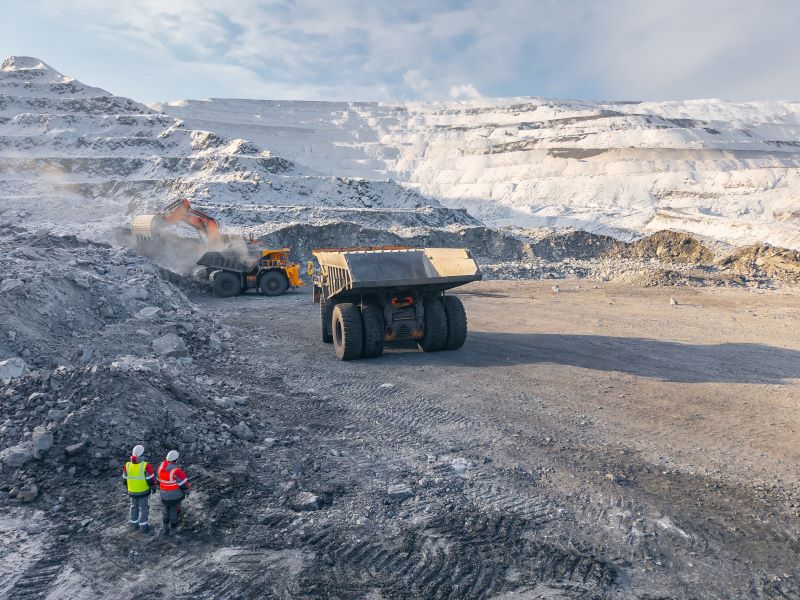
The Lawyers-Ranch gold and silver project in British Columbia (BC), Canada, is being advanced by Thesis Gold & Silver.
A preliminary economic assessment (PEA) for the project was completed in September 2024, followed by a pre-feasibility study (PFS) in December 2025.
Recommended White Papers

Recommended Buyers Guides

The PFS outlined a 15-year mine life supported by an investment of approximately $530.3m (C$736.2m) and a 13,700 tonnes per day (tpd) processing plant operating across two phases.
Thesis initiated the project’s environmental assessment and permitting workstreams in December 2025, engaging both provincial and federal regulators. The company filed an Initial Project Description (IPD) and Engagement Plan with BC’s Environmental Assessment Office (EAO) and separately submitted the IPD and a Plain Language Summary to the Impact Assessment Agency of Canada (IAAC).
In June 2026, Thesis was advised by the Government of Canada that the project’s impact assessment would be transferred to the Province of BC, with the EAO conducting the review under the Environmental Assessment Act, SBC 2018, C.51, on behalf of the IAAC.
Lawyers-Ranch gold and silver project location
The Lawyers-Ranch property is located in north-central BC within the Toodoggone Mining District, around 300km north of the town of Smithers and roughly 45km north-west of the Kemess South Mine. The property combines two distinct sections: the Lawyers Area and the Ranch Area.
The tenure comprises 133 mineral claims for a total area of 50,291.52 hectares. The Lawyers area tenure comprises 46 contiguous mineral claims, while the Ranch area tenure comprises 56 contiguous mineral claims and 31 non-contiguous claims. The claims are reported to be in good standing and are 100% owned by Thesis.
Geology and mineralisation
The Lawyers area comprises two units in the lower volcanic cycle: a quartz-andesitic tuff overlain by a succession of trachyandesites and a package of welded tuffs positioned above the ash tuffs of the Adoogacho Member.
The Ranch area is underlain mainly by volcanic rocks of the Lower-Middle Jurassic Toodoggone Formation, where dacite ash-flows in the northernmost two-thirds of the area transition into lapilli tuffs and reworked equivalents of the Adoogacho Member.
Mineralisation within the Lawyers Area occurs in a series of intermediate, porphyritic lithologies that have been separated into distinct, mappable units according to volcanic fabric and phenocryst composition. Sulphide content is generally low, and some veins display banded and crustiform textures consistent with low-sulphidation epithermal systems.
Mineralisation within the Ranch Area is closely associated with the principal alteration assemblages and is typically hosted in leached and vuggy silica zones developed within Lower Toodoggone volcanic rocks, with higher grades closely associated with strong vuggy silica alteration and hydrothermal brecciation.
Lawyers-Ranch gold and silver reserves
The proven and probable mineral reserves at the Lawyers-Ranch gold silver project were estimated at 76.1 million tonnes (mt) grading 0.97 grams per tonne (g/t) gold and 28.08g/t silver, with 2.39 million ounces (moz) and 68.74moz in contained gold and silver, respectively, as of October 2025.
Mining method
Mining at the Lawyers area is set to combine open-pit and underground methods, while the Ranch area is expected to be mined by open-pit only.
At Lawyers, most open-pit operations are planned under an owner-operator approach. The pit designs incorporate 10m benches, with diesel production drills using 203mm hole diameters for ore and mill feed patterns. Loading is centred on diesel hydraulic excavators, with a front-end loader retained for flexibility. Material haulage is set to use 144t trucks for both ore and waste.
Underground mining at Lawyers is scheduled over the first seven years of the 15-year mining life. The proposed method is longitudinal longhole retreat, using unconsolidated rock fill and cemented rock fill for backfill.
The Lawyers area is divided into three discrete zones, spaced 500–1,000m apart. Given this separation, the underground development has been planned as two independent mining operations: the North Mine and the South Mine. The North Mine will focus on the Cliff Creek North zone, while the South Mine will incorporate both the Dukes Ridge and Cliff Creek South zones.
Two portals are planned, with Cliff Creek North using an existing historic access planned for rehabilitation and enlargement early in the development. A new portal at Dukes Ridge is expected to be developed approximately 400m to the east. The Cliff Creek North portal is intended to serve the Cliff Creek North zone, while the Dukes Ridge portal is set to provide access to the Dukes Ridge and Cliff Creek South zones.
The underground schedule divides extraction into seven clusters, with stoping scheduled to progress bottom-up using an Avoca mining approach. Five clusters are designed for single-level extraction using unconsolidated rock fill.
Stopes are planned between 40m and 505m below ground surface with 15m sublevel spacing. Stope widths are expected to range from 2.3m to 10m, averaging 3m, and the hanging wall generally dips at around 60 degrees, with a minimum of 44 degrees. To support sustained production, the deepest areas at Dukes Ridge in the South Mine and Cliff Creek North in the North Mine are divided into three blocks separated by consolidated rockfill, including two cemented rockfill levels per deposit.
At the Ranch area, mining is limited to open-pit extraction and is due to be undertaken by a contractor across eight stand-alone pits. Mined material is expected to be delivered to a run of mine (ROM) stockpile at Ranch, then rehandled and trucked to the primary crusher at Lawyers using a separate haulage fleet. Smaller haul trucks with lower payload capacities than those used at Lawyers are anticipated for the on-site Ranch work.
Ore processing at Lawyers-Ranch
The Lawyers-Ranch processing plant is designed to treat five million tonnes per annum of ore over the mine life, with feed expected from both open-pit and underground sources. The flowsheet is planned in two stages. Phase one covers years one to three, using a 13,700tpd plant to produce a saleable flotation concentrate as well as gold-silver doré. Phase two spans years four to 15, maintaining the same throughput, with production focused on gold-silver doré.
The ROM ore will undergo primary crushing and stockpiling before entering the grinding circuit, comprising a semi-autogenous grinding mill with pebble crushing and a ball mill in closed circuit with a hydrocyclone cluster. A bleed stream from the cyclone feed will report to gravity concentration followed by intensive leaching.
The hydrocyclone overflow will feed the flotation circuit, starting with rougher flotation, followed by regrind and cleaner flotation. Rougher concentrate will be reground and treated in selective cleaner flotation to produce a saleable gold and silver concentrate, then thickened and filtered prior to load-out. Rougher tailings are intended to pass to scavenger flotation to produce a pyrite-rich concentrate.
Both leaching circuits are designed to target gold and silver recovery, followed by counter current decanting to separate metal-bearing solution from solids. The pregnant solution will be processed through a Merrill-Crowe circuit to produce sludge for refining into doré.
In phase two, the cleaner flotation circuits and concentrate dewatering circuit are set to be removed. Under this configuration, rougher concentrate and scavenger concentrate will be reground in the first regrind mill, then directed through scavenger cleaner flotation to produce a concentrate for the second regrind mill ahead of concentrate leaching.
Site infrastructure
Site access is available via the Finlay Forest Service Road south of the town of Mackenzie, connecting to the Omineca Resource Access Road and continuing to the Lawyers-Ranch Ring Road, also known as Cheni Road. This route provides access from the Sturdee Airstrip to the Lawyers and Ranch area camps. Helicopter access is available year-round from Smithers, BC, and seasonally from Kemess South Mine when exploration is active.
Power is due to be supplied by connecting to the existing 230kV Kemess Transmission Line, Circuit 2L320, via a dedicated line tap near the Kemess Mine area. The privately owned line connects to the BC Hydro network at the Kennedy Substation near Mackenzie, BC, which is part of BC Hydro’s 500kV transmission system in northern BC.
A dedicated 230/69kV step-down substation is planned at the interconnection point, and a new 69kV single-circuit overhead transmission line of around 70–72km from the interconnection substation to the Lawyers site will be constructed.
Water is due to be sourced from both surface and underground supplies, with each facility managing flows using pumps and pipelines, ponds and gravity-fed channels. Non-contact water will be separated from contact water and, where practicable, diverted around mine facilities through diversion channels and returned to downstream waterways.
Accommodation is planned through a prefabricated modular construction camp designed for 632 persons, with modifications scheduled once operations begin to accommodate 316 operational staff.
Contractors involved
The PEA for the project was prepared by JDS Energy & Mining.
The PFS was prepared by Ausenco Engineering Canada with inputs from P&E Mining Consultants, F. Wright Consulting, Mining Plus Canada, Equilibrium Mining and Knight Piesold, as well as SLR Consulting and pHase Geochemistry.
