

The Diamba Sud gold project is an open-pit mining development in Senegal by Canadian mining company Fortuna Mining.
A preliminary economic assessment for the project was completed in October 2025.
Recommended White Papers

Recommended Buyers Guides

A feasibility study was completed in June 2026, which outlined a 9.4-year life of mine with an estimated capital requirement of approximately $397.5m (C$558.35m).
In the same month, the project received an environmental decree from Senegal’s Ministry of Environment and Ecological Transition.
Fortuna applied to the Ministry of Energy, Petroleum and Mines for an exploitation permit in February 2026. The company intends to take a final investment decision on the project once the permit is granted.
The project is operated by Boya, an indirect wholly owned subsidiary of Fortuna. Boya holds surface rights over the exploration permit area in line with applicable mining regulations. If an exploitation permit is awarded, the State of Senegal will take a 10% free-carried interest in the project.
First gold is targeted for the second quarter of 2028 (Q2 2028).
Diamba Sud gold project location
Diamba Sud is located in the Saraya Department of the Kédougou Region, within the Bembou Arrondissement, around 50km north of the Senegal-Guinea border and roughly 7km west of the Falémé River.
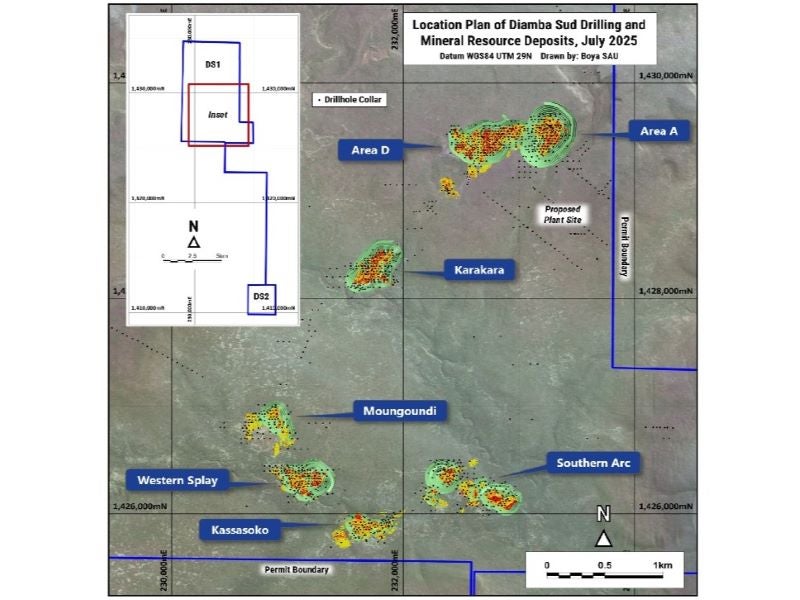
The permit comprises two blocks – DS1 in the north and DS2 in the south – linked by a narrow 25km-wide strip, allowing the area to be managed as a single continuous permit. DS1 covers approximately 46.56km² and DS2 approximately 6.31km², for a combined area of 53.46km².
Geology and mineralisation
The Diamba Sud project lies within the West Africa Craton in the Loulo mining district. The setting is characterised by plutonic intrusions associated with the Falémé Volcanic Belt, with roof pendants and xenolith screens of the Bambadji Formation. The Bambadji Formation sits unconformably above the Kofi Series sediments, which sub-crop to the east.
Gold mineralisation is largely pyrite-dominated, with minor chalcopyrite and magnetite. The principal style is orogenic lode gold, with supergene-enriched saprolite overprinting reported in one of the deposits, Area D. Mineralisation occurs as veins and disseminations within altered, commonly silicified host rocks, and may also appear as broad zones of pervasive alteration.
Diamba Sud gold project reserves
Probable mineral reserves at the Diamba Sud gold project were estimated at 20.5 million tonnes (mt) grading 1.75 grams per tonne gold for 1.1mt in contained gold metal as of April 2026.
Mining methods
Mining is set to use conventional open-pit methods across seven deposits: Area A, Area D, Karakara, Kassassoko, Moungoundi, Southern Arc and Western Splay.
Area A and Area D are intended to be mined as a single pit in three stages to prioritise higher-value oxide ore, mainly from Area D. Southern Arc is also planned in three stages, producing two distinct pits. Karakara is expected to be developed in two stages to accelerate access to fresh ore, while Kassassoko, Moungoundi and Western Splay are each designed as single-stage pits.
The operating plan includes drilling and blasting for oxide, transitional and fresh mill feed, as well as for waste, followed by excavator-and-truck mining. Free digging may be applied in oxide zones where practical, although blasting is otherwise assumed across all weathering horizons. Material is due to be mined on 5m benches in two 2.5m flitches, with 10m benches used where feasible in waste-dominant phases while maintaining suitable stand-off from ore.
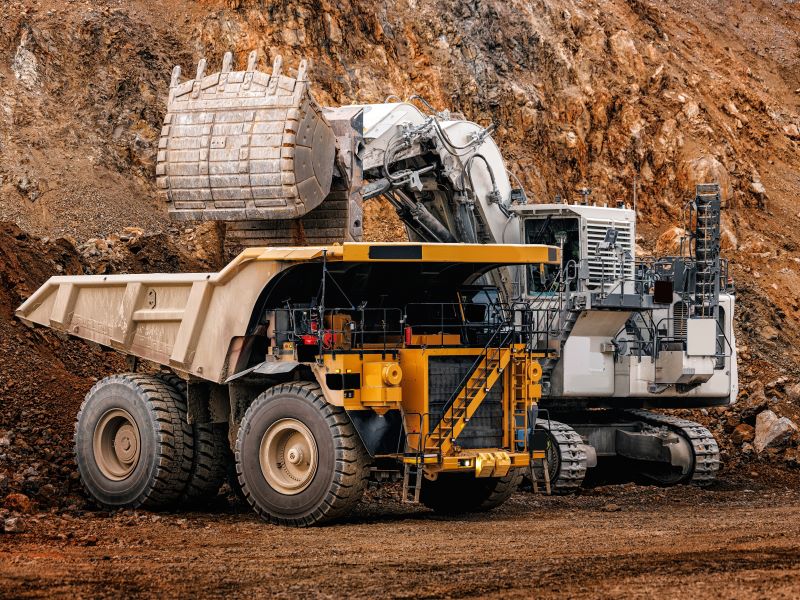
The mining fleet is set to be comprised of 120t and 200t excavators, along with 90t haul trucks.
Ore processing
The Diamba Sud processing facilities are designed to treat oxide and fresh ore, with throughput set at two million tonnes per annum (mtpa) of fresh ore or 2.5mtpa based on a blend of at least 63% fresh and 37% oxide ores.
The run-of-mine ore will undergo crushing in a primary jaw crusher, with crushed material stockpiled and fed via an apron feeder to a semi-autogenous grinding mill.
Slurry from the mill discharge hopper will be pumped to a 20-pack cyclone cluster with 13 operating cyclones and seven standby units. Underflow from three operating cyclones will be routed to gravity recovery, with the balance returned to the mill.
The gravity circuit is set to include one centrifugal concentrator and an intensive leach reactor to treat the gravity concentrate.
The carbon-in-leach circuit will comprise a leach feed thickener, one pre-leach tank and six leach tanks treating cyclone overflow. The pre-leach tank is designed for approximately four hours of residence time and the total leaching residence time is approximately 24 hours across the leach tanks.
Recovery and refining are planned through a six-tonne split AARL elution system, electrowinning and smelting to produce doré.
Site infrastructure
The project site is accessible from Dakar via the paved N1 highway to Tambacounda, then the N7 to Kédougou and onwards on the Kédougou–Saraya road to Saraya. From there, the paved N24 road crosses the permit area. Air access is available through an asphalt airfield at Kédougou.
Power required for operations will be supplied from an on-site heavy fuel oil thermal plant rather than the national grid. A photovoltaic solar farm with a battery energy storage system is scheduled for installation in year one of operations upon commissioning of the power plant, to lower the project’s carbon footprint.
Water make-up is planned from harvested rainfall runoff and pit dewatering directed to a storage dam, with additional harvesting from the Gamba Gamba Creek, also referred to as the Karakara watercourse, which runs north to south through the DS1 block.
An accommodation camp and associated facilities for 329 non-local personnel are planned, with a proposed location west of the process plant.
Contractors involved
The feasibility study for the Diamba Sud gold project was prepared by Fortuna with contributions from Lycopodium, Knight Piésold, Kenmore Mine Consulting, SOJUFISC and Infinity Corporate Finance, as well as Piteau Associates, Entech and Earth Systems.
Comminution circuit modelling was undertaken by Orway Minerals Consultants.
A letter of intent was signed with African Power Services to act as the power station engineering, procurement and construction contractor for the heavy fuel oil and light fuel oil generators.
