

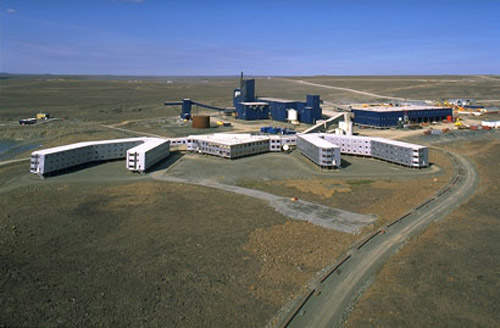
Situated in the Nunavik territory of Northern Quebec, Canada, the Raglan nickel-copper mine is part of Falconbridge’s Integrated Nickel Operations (INO). Commercial production began in 1998, following the investment of around C$550m in the mine, concentrator and infrastructure.
In June 2005, Falconbridge merged with its parent company, Noranda, with the ‘new Falconbridge’ being taken over in mid-2006 by the Swiss-based company, Xstrata. Raglan now lies within Xstrata’s nickel division, being operated by Société Minière Raglan du Quebec Ltée.
Recommended White Papers
Recommended Buyers Guides

The mine was originally designed to produce 130,000t/y of high grade nickel-copper concentrate containing 21,000t of nickel, 5,000t of copper and 200t of cobalt, plus precious metals. It is one of the world’s lowest-cost nickel producers, despite its remote location, and is in the process of being expanded.
Geology and reserves
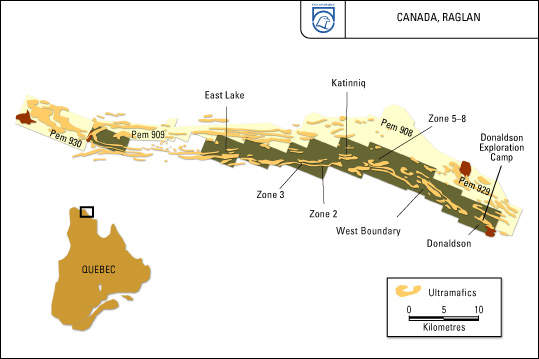
The mineralisation at Raglan consists of sulphide lenses associated with Proterozoic ultramafic flows that lie along the contact of tholeiitic basalts and sediments of the Povungnituk Group and komatiitic basalts of the Chukotat Group within the Labrador Trough.
Nine peridotitic flows contain significant mineralisation over a distance of 55km. The nine areas are: Donaldson, Boundary, West Boundary, 13–15, 5–8, Kaatinniq, 2–3, East Lake and Cross Lake. These ultramafic bodies contain sulphide mineralisation, mostly in the form of pentlandite and pyrrhotite, but also contain chalcopyrite, magnetite and pyrite with associated cobalt and platinum-group metals.
In 2008, a scoping study of the mineralised zones 5-8 was completed. Pre-feasibility for mine 7 is currently under way.
As of June 2009, Falconbridge estimated that Raglan had proven and probable reserves of 11.5Mt grading 2.94% nickel, 0.77% copper and 0.07% cobalt. Measured and indicated resources totalled a further 16.4Mt at 3.18% nickel, 0.9% copper and 0.07% cobalt. Inferred resources were 14Mt at 2.9% nickel, 0.9% copper and 0.1% cobalt.
Mining methods
Mining is predominantly conventional shovel-and-truck open pit with an underground mine at Katinniq. The first open pit mine in Zone 2, had a stripping ratio of 4:1 and benches in waste are 10m high while those in the ore are 5m high.
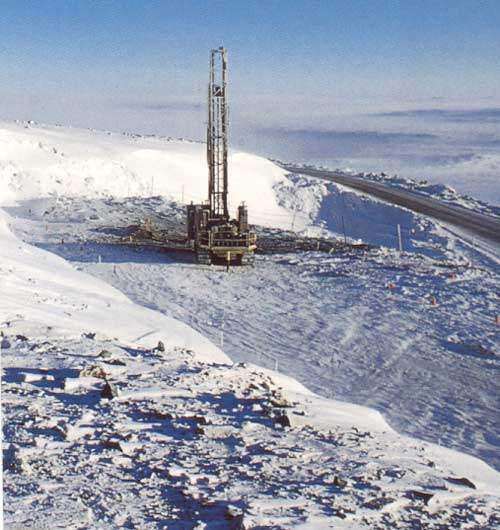
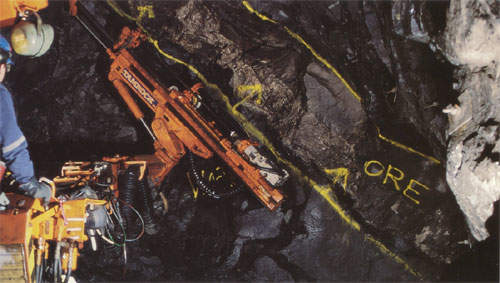
Underground mining uses a single-pass mechanised cut-and-fill method in 8–10m-wide by 5m-high panels. Backfill is supplied from the open pits and underground development. As the permafrost extends below the level of mining, air temperatures underground must remain cold to maintain the stability of the permafrost. Wet drilling is used with a saline flush, as fresh water instantly freezes.
Processing
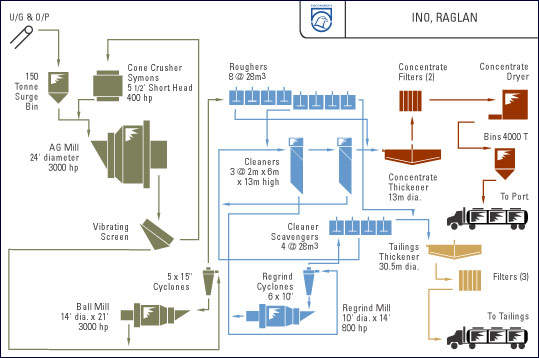
The original design for the processing plant involved ore from the mine being conveyed to a 150t surge bin before grinding in a fully autogenous mill. This mill was converted during 2005 to semi-autogenous, allowing the plant to handle harder ore as well as increasing the plant throughput to around 1Mt/y.
The outflow from the mill enters a vibrating screen and the oversize is directed to a Symons cone crusher before being returned to the mill. Screen undersize enters a ball mill/cyclone circuit before entering the flotation plant rougher cells. The flotation plant consists of eight rougher cells, three cleaners, four cleaner/scavengers, regrind cyclones and a regrind mill. The overflow from the cleaners enters a concentrate thickener before being filtered and dried for shipment.
Transport
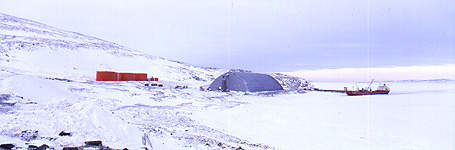
Its isolated location means that Raglan has to rely on shipping links during the ice-free season for both supplies and concentrate shipments. Concentrate is transported by road from the mine to the port at Deception Bay, then shipped to Quebec City. From there it is transported by rail to Falconbridge’s smelter at Sudbury, Ontario. Smelted matte is returned to Quebec City and shipped to the company’s Nikkelwerk refinery in Norway for final nickel production.
Production
In 2009, Raglan produced 1.31Mt of ore milled containing 29kt nickel in concentrate. Nickel grade was 2.56%, an increase by 11% over 2008. Production of concentrate during the year was 172,668t, an increase of 13% over 2008. In the first quarter of 2010, due to the planned maintenance shut-down of the mill, production at Raglan declined by 8%.
Expansion
A two-phase expansion programme has been completed at Raglan. The first stage, involving the mill convertion, has cost some C$33m. The second stage, completed in 2008, increased mine production and mill throughput to 1.3Mt/y, giving a design output of 30,500t/y of contained nickel. Further expansions to increase throughput capacity to 2Mt will be completed by 2011. The expansions are expected to make Raglan one of the world’s largest nickel mine with a designed output of 50,000t/y of contained nickel.
