

Grey Fox is an underground gold mine in Ontario, Canada, being developed by McEwen, a Canada-based gold and silver mining company.
The mine forms part of the wider Fox Complex, which is shifting from a single-mine operation to a multi-deposit platform with a longer operating horizon.
Recommended Buyers Guides

A pre-feasibility study for Grey Fox was completed in June 2026, which outlined a 15-year mine life based on a $181m (C$257.14m) investment, extending the Fox Complex operating timeline to 2041.
Grey Fox is expected to become a key source of ore for the complex, supporting production of approximately 100,000oz of gold in 2029 and an average of 87,000oz of gold a year from 2028 to 2041. Between 2035 and 2040, it is set to be the only producing source, averaging 87,000oz of gold per year, before output declines in 2041.
Site works at the mine are scheduled to begin in 2027, with underground development planned for the third quarter of the same year and commercial production expected to start in 2029.
Grey Fox project location
The Grey Fox project sits within the Fox Complex near Timmins, Ontario, a well-established gold mining district.
The complex includes Fox East, which hosts the Black Fox mine, Fox Central, which includes the Stock mine, and Fox West, which covers the Lexam property.
Geology and mineralisation
The Fox properties are underlain by Precambrian rocks of the Southern Abitibi Greenstone Belt in the Wawa-Abitibi Sub-province of the Superior Province in north-eastern Ontario. Lithologies across the complex are grouped into the Tisdale volcanic sequence, the Porcupine clastic sediments and the less extensive Timiskaming assemblage.
At Grey Fox, mineralisation is associated with quartz-carbonate veins that are commonly sheeted and intersected. Gold-bearing zones contain quartz, carbonates, alkali feldspar, mainly albite, sericite, pyrite, tourmaline, arsenopyrite, plus scheelite and molybdenite, while pyrrhotite is more common at depth and in banded iron formation-hosted mineralisation.
Grey Fox reserves
The probable mineral reserves at Grey Fox were estimated at 9.41 million tonnes (mt) grading 3.24 grams per tonne gold with 980,300oz in contained metal as of March 2026.
Mining and processing methods
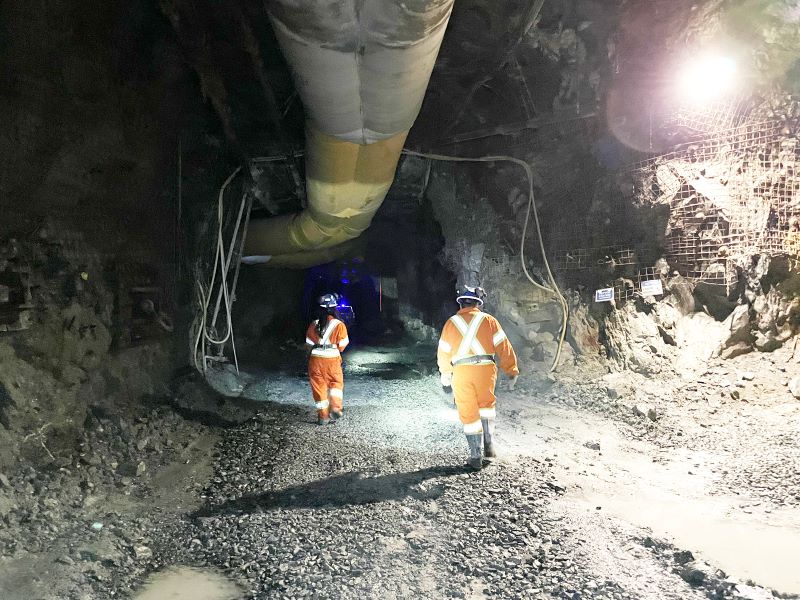
Mining is planned as two separate underground operations accessed via two portals. The North (Gibson) portal is designed to serve the Whiskey Jack, Gibson, Contact and 147 North-East zones, while the South portal is intended to access the 147 and South zones.
The mine plan is based on longhole stoping, supported by cut-and-fill methods where required. Ore will be brought to the surface and transported 35km to McEwen’s Stock Mill.
Grey Fox material will be crushed on site before haulage to the Stock Mill, where it will be blended with Stock Mine mineralised material. Gold recovery is estimated at 87.5% from laboratory testwork.
Stock Mill details
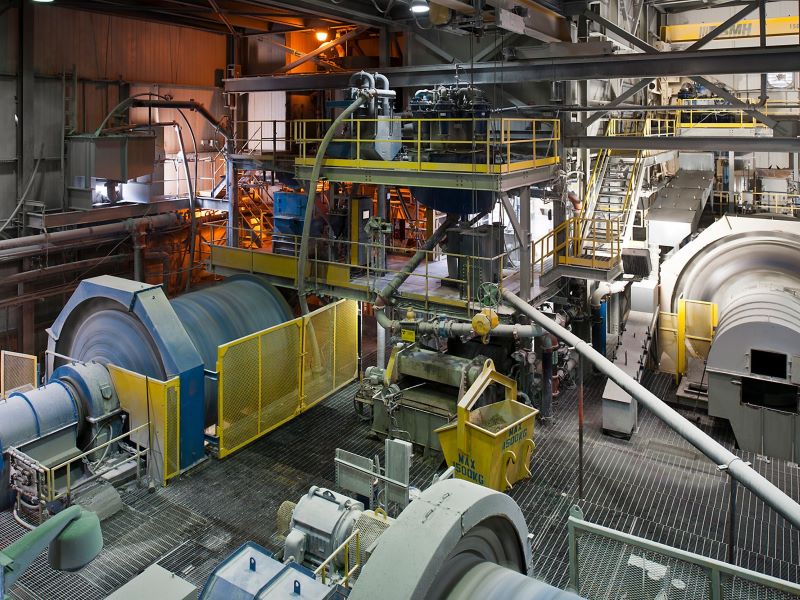
The Stock Mill typically operates at 1,200t per day with a target grind of 75 microns and runs on a 24/7 basis.
Plant feed at the mill includes a pre-crush stage using a Cedarapids portable crusher, with crushed ore conveyed from the fine ore bin to the primary ball mill, which operates in closed circuit with three hydrocyclones and one stand-by. The underflow returns to the mill and the overflow is directed to the secondary cyclone feed pumpbox.
The secondary cyclone cluster operates with five cyclones and one stand-by, with underflow split between two parallel regrind mills and overflow passing to a trash screen and thickener feed box.
Slurry is thickened before pumping to the first of two leach tanks, then flows into a six-tank carbon-in-leach circuit. Loaded carbon is sent to stripping and electrowinning, while tailings pass over a safety screen before being pumped to the tailings dam.
Gold is stripped from carbon using a Zadra process, with the pregnant solution cooled through a heat exchanger and sent to electrowinning, where gold plates onto stainless steel cathodes.
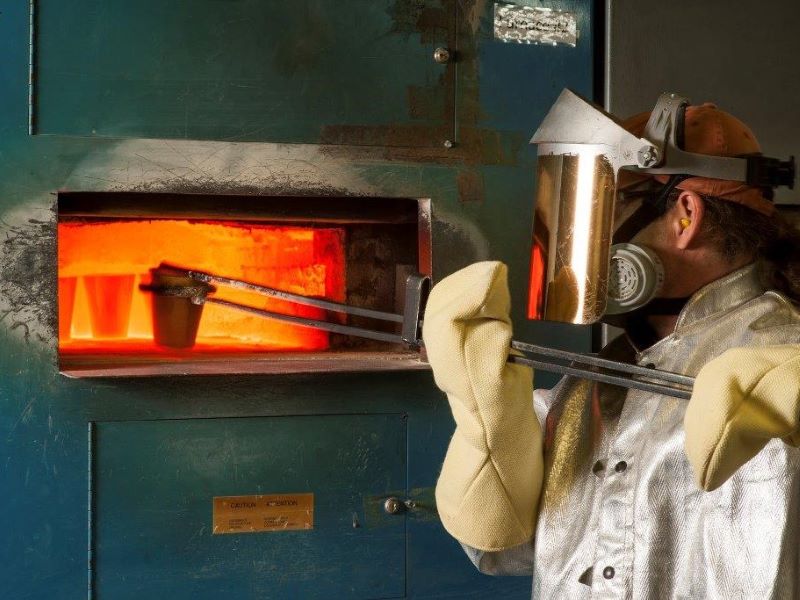
The recovered sludge is pressure-washed, collected and pumped to a filter press, then dried, smelted and poured into doré bars. Barren solution is returned to the strip circuit until stripping is completed.
Site infrastructure
The Fox Complex is accessible from Toronto via Highways 400 and 69 to Sudbury and Highway 144 to Timmins, or via Highway 11 from Barrie to Matheson and Highway 101 west to Timmins.
The Grey Fox mine can be reached from Highway 101 and then by travelling 2km south along a township road, either Hislop 2 or Tamarack Road, roughly 10km east of Matheson, Ontario.
Power is supplied by a 27.6kV line, with available capacity of up to 7.5MW of load demand.
Grey Fox is expected to rely on the existing Stock Mill and tailings facilities and the established workforce in the area.
