

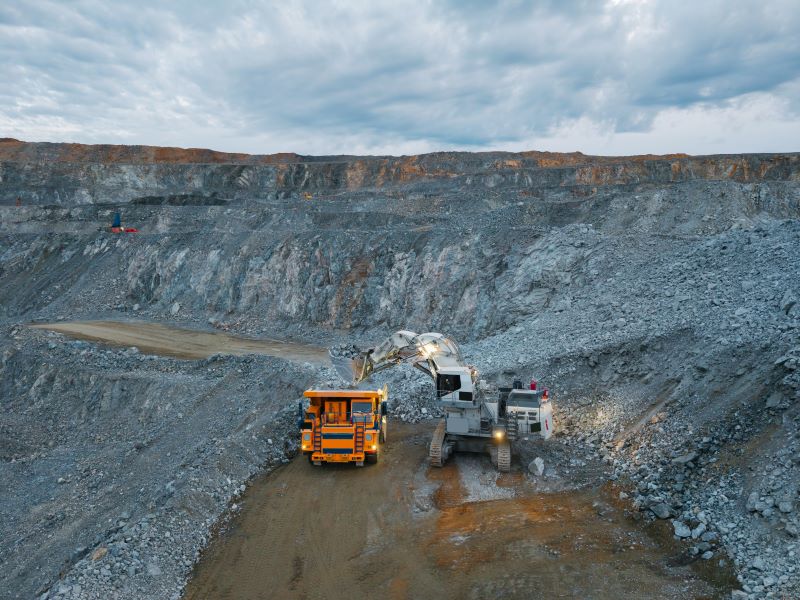
The Kanyika niobium project is an open-pit mining operation in northern Malawi being developed by Globe Metals & Mining.
A feasibility study for the project was announced in 2021, followed by an optimisation study completed in February 2024 that supported the project’s technical and financial assumptions.
Recommended White Papers

Recommended Buyers Guides

A bankable feasibility study (BFS) was completed in April 2026, setting out a 24-year mine life and an initial capital requirement of around $139m (A$197.08m).
The Kanyika niobium project is due to be developed in a staged manner to reduce upfront capital and execution risk.
Phase one is designed to produce around 1,502 tonnes per annum (tpa) of niobium pentoxide and roughly 65tpa of tantalum pentoxide, based on approximately 500,000tpa of mined and processed ore.
A later expansion option will increase output to around 3,477tpa of niobium pentoxide and approximately 156tpa of tantalum pentoxide, with annual ore mining and processing rising to around 1.5 million tonnes (mt).
Globe Metals & Mining is expected to commence first production from the project in the first quarter of 2028.
Kanyika niobium project location
The Kanyika niobium project area is located around 55km north-east of Kasungu and roughly 190km from Lilongwe, within customary land under Traditional Authority Mabulabo.
Mining activities are covered by Large-Scale Mining Licence LML0216/21, granted in August 2021 under Malawi’s Mines and Minerals Act 2019. The licence runs for 25 years to August 2046, with renewal options in 15-year periods, subject to compliance.
The licensed footprint covers around 3.8km² in the Milenje area of Mzimba District and includes rights over niobium and tantalum as well as uranium, zirconium, hafnium, praseodymium and neodymium.
Geology and mineralisation
Kanyika sits within the Mozambique Orogenic Belt and is hosted by a north-north-east striking, west-dipping alkali granitoid intrusion.
The host granitoid geology is divided into saprock, transition and fresh rock domains, and the continuity of mineralisation at depth supports open-pit extraction.
Mineralisation is described as an intrusion-hosted niobium, tantalum, uranium and zirconium system dominated by pyrochlore, with minor columbite and zircon and associated rare earth elements.
Four mineralised zones are interpreted within two parallel sheets, with higher-grade shoots in gently dipping en-echelon structures.
Mineral reserves
The proven and probable mineral reserves at the Kanyika niobium project are estimated to be 33.8mt grading 3,050 parts per million (ppm) niobium pentoxide and 142ppm tantalum pentoxide, as of March 2026.
Kanyika mining method
Mining at the Kanyika niobium project is planned as a conventional contractor-operated open pit using drill and blast operations.
The average strip ratio is estimated at 1.6:1, with mining undertaken on 2.5m flitches and 5m blast benches. Minimum mining widths are set at 20m at pit bases and 50m for cutbacks, with ramp widths of 16m for two-way access and 12m for single-lane sections at a 10% gradient.
The equipment selection is based on a 70t excavator and 41t articulated dump trucks, supported by ancillary units.
The mine closure assumptions include flattening the upper pit crest and restricting access using bunds and a rock berm located 50m from the edge, with no backfilling included.
Stockpiles are expected to be processed by the end of mine life, followed by scarification, topsoiling and rehabilitation.
Early works on the project began in January 2026 under an early contractor involvement model.
Ore processing
The processing facility is designed to produce refined niobium pentoxide and tantalum pentoxide via a concentrator feeding a hydrometallurgical refinery.
The initial plant is planned for around 500,000tpa of run-of-mine feed, with provision to expand to 1.5 million tonnes per annum by duplicating selected circuits.
The comminution comprises three-stage crushing, followed by ball milling in closed circuit with hydrocyclones and high-frequency screens. The ground product will be classified into coarse and fine fractions, with low-intensity magnetic separation applied to remove iron-bearing gangue.
The coarse non-magnetic material will be treated by spirals for niobium and zircon recovery, with additional milling of a screened fraction and subsequent zircon flotation.
The fine material will be deslimed using two-stage hydrocyclones to remove ultrafine material before further magnetic separation and multi-gravity separation. The concentrates will be combined for zircon flotation ahead of pyrochlore flotation.
The pyrochlore concentrate will undergo thickening and then be filtered for refinery feed. In the refinery, pyrochlore concentrate will be digested using hydrofluoric and sulphuric acids, followed by filtration and solvent extraction to separate tantalum and niobium streams.
Both metals will then be precipitated, filtered and calcined to produce 99.9% niobium pentoxide and 99.9% tantalum pentoxide. The final products will be dried, packaged and made ready for export.
Site infrastructure
Water for processing is expected to be sourced from the Milenje River via an off-river reservoir of around 150,000m³.
A larger upstream dam storage option of approximately two million cubic metres, with a diversion delivering water to an existing gully downstream of the orebody, is planned for a later expansion stage.
Power is proposed to come from an on-site hybrid power system using solar photovoltaic, battery storage and diesel back-up, with grid connection retained as a potential future option.
Workforce requirements are estimated at 300 people, accommodated in a permanent village and a construction camp, while the mining contractor is expected to provide separate accommodation for its personnel.
Financing
In December 2024, the company entered a non-binding term sheet with South Africa’s state-owned Industrial Development Corporation (IDC) for a convertible loan of approximately $10m to fund a BFS.
Offtake agreements
In September 2024, a letter of intent was signed with Affilips, a master alloys supplier, for up to 100t of refined high-purity niobium pentoxide, linked to negotiations for a binding agreement covering 32% of phase one output.
In March 2025, a non-binding memorandum of understanding (MoU) was signed with Myst Trading, a Singapore-based company specialising in the trading of physical metals and concentrates, covering 14t of refined high-purity tantalum pentoxide and 76t of refined high-purity niobium pentoxide.
Globe Metals signed a non-binding MoU in April 2025 with Neo Performance Materials, a rare earth and rare metal products manufacturer, for the offtake of up to 150tpa of niobium pentoxide. The offtake agreement is expected to be renewed annually following the fulfilment of the initial purchase amounts.
Contractors involved
LogiProc acted as lead for the BFS, including its compilation, while SLR Consulting was responsible for the environmental baseline work, resettlement support, water permitting and mineral resource estimation.
Orelogy was engaged for pit optimisation, mine design, scheduling and reserve estimation.
Eco Elementum was responsible for tailings storage facility design and BCQS for quantity surveying and contract management.
Capital and operating estimates for the concentrator and refinery were provided by Solo Resources and AR Process Projects, respectively.
A binding pre-development collaboration agreement was signed with Sinomine International (Zambia) Engineering Company, part of Sinomine Resource Group, for the early construction works at the Kanyika niobium project. The 2021 feasibility study was prepared with inputs from organisations such as Quantitative Group (QG), BMGS, Synergistics Environmental Services, Coffey Mining Perth and Orelogy Mining, along with Ammtec, Jones and Wagener, Knight Piesold, Mining One, Overflow Engineers and Wood.
