

The Douta gold project is an open-pit mine in eastern Senegal being developed by Thor Explorations.
The project was originally owned by International Mining Company (IMC), which carried out the initial exploration activities.
Recommended Buyers Guides

African Star Resources, a subsidiary of Thor, signed an option agreement with IMC in February 2011 to acquire a 70% interest in the project. The following year, Thor exercised its option and gained the 70% stake.
Thor filed the technical report for the project in April 2023.
In September 2025, Thor entered a binding sale and purchase agreement with IMC to acquire the remaining 30% interest for a cash consideration of $3m (C$4.1m), including a 1.5% net smelter royalty, which is capped at $60m.
A pre-feasibility study (PFS) for the Douta gold project was completed in January 2026, outlining initial development capital of $253.5m and an expected mine life of 12.6 years. The project’s Environmental and Social Impact Assessment received approval from Senegal’s Ministry of Environment in the same month.
Thor anticipates finalising the Mining Convention with the Senegal Government and commencing detailed design and construction in the second half of 2026.
Operations at the mine are expected to commence in 2027, with first production anticipated in 2028.
The project is projected to deliver around one million ounces (moz) of gold over its operational life.
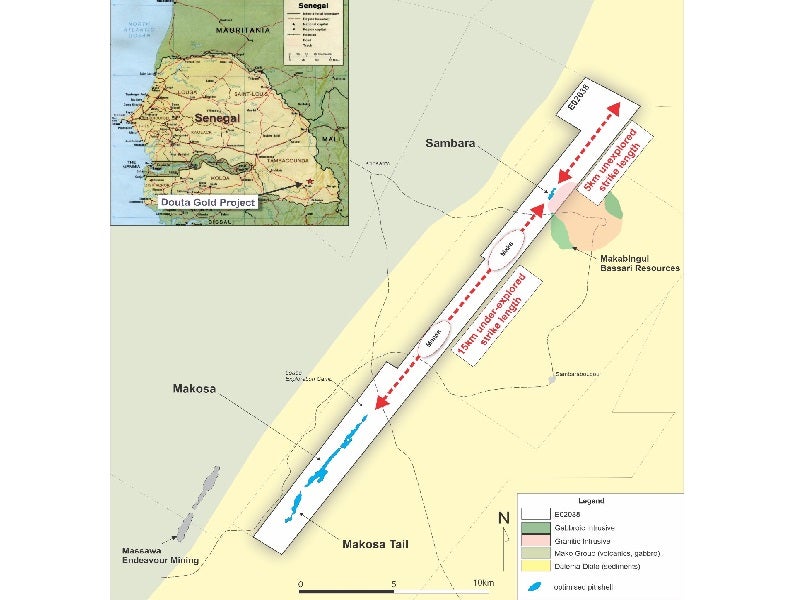
Douta gold project location
The Douta gold project is located in eastern Senegal and includes the De11618 mining lease application covering 58km², alongside the Douta-West exploration permit EL03709 and the Bousankhoba exploration permit EL02254.
The De11618 and EL03709 leases together host all the resources defined so far.
Geology and mineralisation
The Douta project sits within the Kedougou-Kenieba inlier, with Diale sedimentary formations dominating the eastern part of the permit area and mafic and volcaniclastic rocks of the Mako Belt to the west.
Gold mineralisation occurs in deformed sedimentary rocks near contacts with gabbro and volcaniclastic units. Alteration is associated with low-temperature quartz stockworks containing sericite, chlorite and calcite, while the host rocks typically include fine-grained disseminated pyrite and arsenopyrite.
Reserves
The probable mineral reserves at the Douta gold project are estimated to be 36.6 million tonnes (mt), grading 1.03 grams per tonne gold, with a total of 1.2moz in contained gold, as of January 2026.
Mining methods
The Douta gold project is due to be developed as an open-pit mining operation using conventional truck and shovel mining.
Mining operations are set to commence towards the end of 2027, with processing plant commissioning and ramp-up planned for the first quarter of 2028.
The mine plan is structured in two phases, covering oxide ore followed by primary ore phases.
The oxide stage is expected to mine 15.7mt at a strip ratio of 2:9, before transitioning to the primary ore stage with a strip ratio of 4:7.
Ore processing
The processing plant is designed to follow a staged approach for the two mining phases.
The oxide ore phase is intended to treat four million tonnes per annum (mtpa) of oxide ore over four years and produce an average of 103,000oz per year.
Processing is based on gravity and carbon-in-leach processing. Material will be crushed and milled, with gravity concentration recovering free gold, followed by leaching and adsorption, then elution and smelting, and disposal of tailings.
The primary ore phase will process 2.4mtpa of fresh sulphide ore for around 7.8 years, averaging 61,000oz per year, with the final seven months treating 2.3mt of mixed oxide and transitional ore to produce 47,000oz.
The flowsheet for this phase will be expanded to include suspension roasting to liberate refractory gold before cyanide leaching, with dewatering ahead of roasting, feed storage in a silo, suspension roasting, then repulping and regrinding of calcine.
Recovery rates are expected at 87.9% and 84.7% for the oxide and primary phases, respectively.
Douta gold project site infrastructure
Power required for the mining operation is due to be supplied by a dedicated heavy fuel oil plant, built, owned and operated by an independent provider under a long-term supply agreement.
The tailings storage facility is planned as a single-cell facility with a cross-valley embankment raised in three downstream stages, with HDPE lining in the normal operating pond areas to reduce seepage.
Drainage measures are planned at the basin and embankment, including sub-liner drainage, to manage seepage and support tailings consolidation. Process water recovery is expected to be drawn from the decant pond using floating intake lines to keep pumps above pond level.
Contractors involved
The project’s technical report was prepared by MineralMind Australia, while the PFS was prepared by AMC Consultants.
