

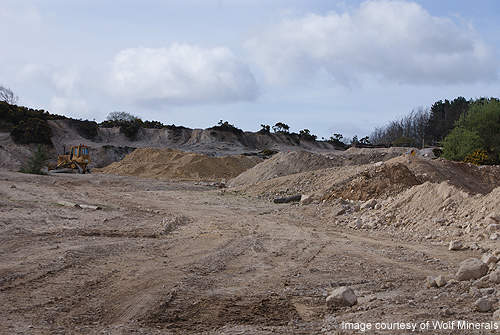
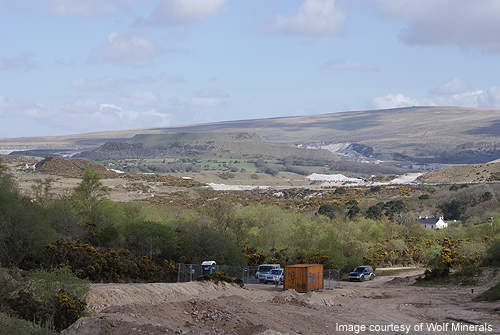
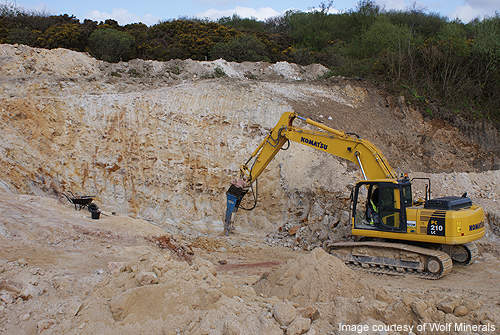
The Hemerdon Ball mine, renamed as Drakelands Mine in 2007 and believed to hold one of the world’s largest tungsten and tin resources, is located in Devon, approximately seven miles north-east of Plymouth, UK.
The historic mine was discovered in 1867 and was mined briefly twice in the 1900s and 1940s before going out of operation in 1944. The Drakelands Mine is the fourth largest tungsten deposit in the world, according to the British Geological Survey.
Recommended White Papers
Recommended Buyers Guides

A comprehensive feasibility study for further development of the mine was completed in 1981 by joint venture partners AMAX and Hemerdon Mining and Smelting (HMSL), who acquired the property in 1976. Planning permission was obtained in 1986 to develop the mine until 2021. The mine was sold to Wolf minerals in December 2007.
Announced on 16 May 2011, Wolf Minerals expedited the development after a positive result from a definitive feasibility study (DFS). The £140m project involves the development of a two-phase open pit and a three million tonnes per annum (Mtpa) concentrator with the related infrastructure. The Environment Agency granted major environmental approvals for the Hemerdon project in September 2012. The engineering design for the project was completed in 2013 and construction began in February 2014.
The Drakelands Mine began production in August 2015 and was officially opened and commissioned in September 2015. The mine has the production capacity of more than 3Mtpa over an estimated ten-year life.
Reserves
The mine contains 27.9Mt of proven reserves grading at 0.19% WO3 (tungstic oxide) and 0.03% Sn (Tin). Probable reserves total 7.8Mt graded at 0.15% WO3 and 0.02% Sn. Resources in the measured category amount to 39.9Mt graded at 0.02% Sn, 0.15% W (tungsten) and 0.18%WO3.
Indicated resources were estimated to be 18.7Mt graded at 0.02% Sn, and 0.16% WO3. Inferred resources are 86.6Mt graded at 0.02% Sn, and 0.14% WO3.
Geology
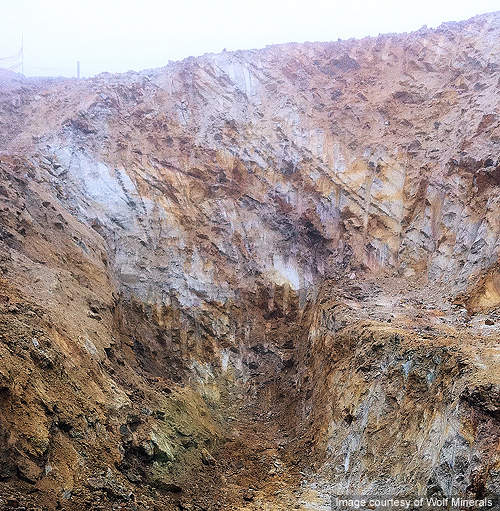
The deposit is a remote cupola intrusion bordered by Devonian aged slates that are locally referred to as killas. Mineralisation begins near surface and continues till a depth of 400m. The mineralisation remains open at depth and along strike. Two vein types are distinguished by three different orientations.
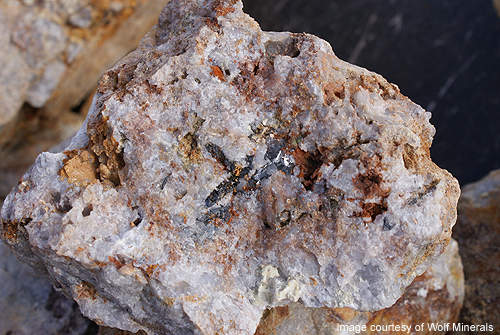
The first type includes a stockwork of quartz and quartz-feldspar veins that host minor mineralisation. Veins bordered by greisens are hosted in a sheeted vein system with wolframite and minor cassiterite mineralisation. The veins system occurs within a steeply dipping dyke granite structure, which is flanked by killas formed due to contact metamorphism.
The killas also host veins of low wolframite and cassiterite content. Kaolinisation up to a depth of 50m is observed in the granite structure.
Secondary arsenate minerals include Scorodite and Pharmacosiderite, hosted in the upper oxidation zones of the ore structures. The minerals have been formed due to arsenopyrite alteration and occur within the weathered regions of the deposit.
Mining
The mining involves a standard hydraulic excavator and truck operation. The pit measures 850m in length, 450m in width and 200m in depth.
The waste to ore strip ratio is 0.7:1 in the first stage of open pit development. It will be 1.5:1 for the life of mine.
The mine operates on three shifts for six days weekly. The ore is sent to the run of mine (ROM) over the three shifts, while waste is delivered to the waste dump over two shifts. Mine waste is used to build the Tailings management facility embankment.
Ore processing
Processing is a three-stage operation, including comminution, pre-concentration and final concentrate production.
Wolframite (tungsten) and the cassiterite (tin) are separated from the gangue in a 3Mt processing plant. The plant’s operations involve crushing, screening, scrubbing, dense media separation, de-slime and gravity separation, concentrate processing, tailings thickening and disposal.
Production
A total of 7Mt of waste rock and 3Mt of ore is mined a year, including 5,000t of tungsten concentrate and 1,000t of tin concentrate.
A saleable concentrate grade of 65% WO3 is produced from approximately 58% of tungsten that is recovered from the soft granite and 66%is recovered from the hard granite. Wolf Minerals produces approximately 345,000t of WO3 a year. In April 2012, Wolf signed production offtake agreements for the Drakelands Mine project with Wolfram Bergbau und Hütten and Global Tungsten & Powders.
Contractors and financing for the Drakelands Mine project
Wolf obtained A$216.5m ($218m) of equity and debt package for the Drakelands Mine project construction and working capital requirements. The funding includes $82m of secured bridge financing by Resource Capital Fund V LP, in addition to £75m ($118.5 m) of senior debt funding by UniCredit Bank, ING Bank and Caterpillar Financial SARL.
The engineering, procurement and construction (EPC) contract for the Drakelands Mine project was awarded to GR Engineering in March 2013. The EPC contract is valued at £75m (approximately $110m) for a term of 24 months.
Bardon Contracting completed the construction of a 600m-long link road to the Hemerdon site in July 2012. Wolf Minerals awarded an £85m ($134m) mining services contract to CA Blackwell in July 2013.
