


Across most mine sites, mobile equipment still runs on diesel. A single ultra-class haul truck can burn up to 900,000 litres of diesel per year[i]. That is before counting the loaders, diggers, dozers and service vehicles that keep an operation moving day and night.
This dependency seems set to continue for some time. On average operators expect diesel powertrains to form the largest share of haul truck operations by 2040, with the share of performance diesel and biofuels increasing.[ii]
Electrification is set to play an increasing role, but the numbers show it remains in its infancy. With fewer than 5% of underground loaders electric today, and the largest switch to electric not expected until 2031–2035, near-term operational improvements can help carry the load from an efficiency standpoint.[iii]
Altogether, biofuel with lower lifecycle greenhouse gas (GHG) emissions[iv] and better formulations will gain ground. The internal combustion engine is likely set to play an important role in the mining haul fleet for at least another decade and a half.
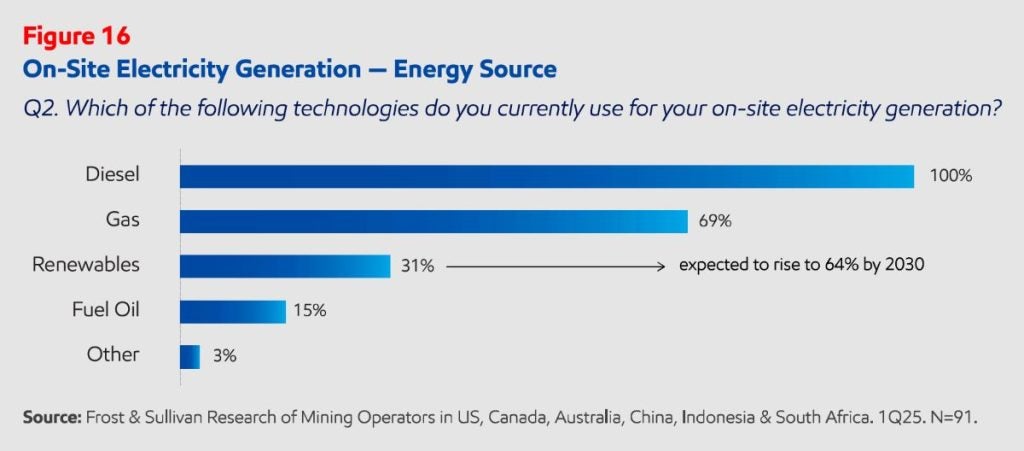
For many mining operators, therefore, it’s an “and/both” challenge – exploring electrification while continuing to optimize the haul trucks of today. They must treat efficiency as a systemic undertaking: planning, maintenance, operator practice and dispatch working together as one to extract more productive work from the same fuel burn.
The systems toolkit beyond the fuel tank: practical levers
What are the foundations of a mine working at optimal efficiency?
One pillar is better planning software and connectivity. In a recent mine-site technology adoption survey run by market intelligence firm GlobalData, more than 60% of mines reported they had made either significant investments in, or fully implemented, a combination of planning, scheduling and/or bespoke communication software[v].
The deepest penetration of these technologies was in Canada. Safety technologies such as collision avoidance are also used widely, particularly in South Africa.[vi]
Accurate plans and reliable communications reduce queuing at shovels, smooth haul cycles and cut wasted trips – all of which have potential to lower litres per tonne moved.
Maintenance is next. Almost half of major mining firms expect to invest in predictive maintenance for plant and mobile equipment over the next two years, while drones are gaining ground for their ability to collect data and monitor project progress.
Together, these tools both help to spot problems before failures occur and make it easier to inspect slopes, stockpiles and infrastructure without having to deploy either manpower or machines. This helps reduce breakdowns, optimises truck and loader uptime and helps ensure engines and drivetrains are running in the sweet spot where fuel efficiency is highest.
Driving practice is likewise important. Because fleets run long shifts, trimming idle time and keeping payloads within targets can quickly help lower litres per tonne moved. Taking a data-driven approach can slash inefficiencies like these. Simple changes – such as cutting waiting with engines idling, avoiding over – or under – loading and smoothing acceleration on ramps – add up fast when repeated across hundreds of cycles per shift.[vii]
Finally, dispatch optimisation is starting to change how haul fleets are run. The move to smarter dispatch is under way; the latest GlobalData figures suggest around 2% of haul trucks are already autonomous, with adoption doubling over the past two years.[viii]
Even where fleets are still manually driven, dispatch systems that allocate trucks dynamically, balance shovel loading and manage queue times can deliver sizeable efficiency improvements.[ix] As autonomy expands, consistent driving and tighter control of haul cycles should reinforce those gains.
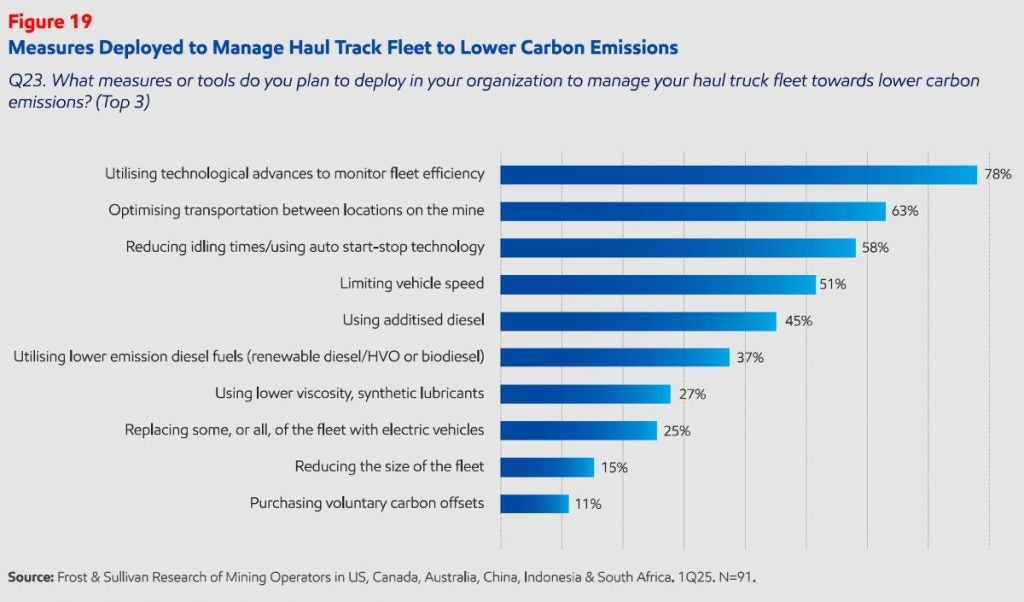
What links these levers is that they work with the existing fleet. They do not require a wholesale switch in powertrain or infrastructure; they unlock efficiency via better decisions, better maintenance and better use of assets already on the balance sheet.
Why work with an expert like ExxonMobil
Coordinating all of this is a challenge for sites already stretched by production targets and cost pressures. Yet pairing performance diesel fuels, like Mobil Diesel EfficientTM, synthetic lubricants and field engineering with data diagnostics can help capture overlapping benefits in fuel economy, uptime and emissions[x].
That is where the support of an expert can help turn disparate actions into a coherent programme. Rather than treating fuel, lubricants, monitoring and operator training as separate undertakings, they can be combined and the benefits reinforced.
Experience in harsh conditions counts. For mine managers worrying about risk to production, evidence that fuels and lubricants perform reliably on large, heavily loaded trucks is just as important as lab test results. Real-world trials show that efficiency gains do not have to come at the expense of power, reliability or component life.
The process works best when it follows a clear roadmap. Experts in the field, like ExxonMobil, have a proven track record of doing just this: establishing proven, data-driven baseline KPIs (think litres/hour, litres/tonne and idle %), coaching operators, aligning with OEMs and scaling what works.[xi]
In practice, that means starting with a diagnostic of the current fleet, developing a set of metrics, running pilots on selected routes or trucks, and then extending successful measures across the operation in stages.
ExxonMobil’s combination of high-quality diesel, synthetic lubricants, field engineering and data-led support is a core part of the company’s offering for the mining sector. For the mining operators on the frontline, the prize is straightforward: more tonnes moved for the same fuel burn, higher equipment availability and a step towards lower greenhouse gas emissions, all while the industry works through the long transition from diesel to new powertrains.
Curious to learn more? Explore ExxonMobil’s perspectives on the potential for lower emission, higher efficiency mining operations in the whitepaper below.
[i] Rocky Mountain Institute 2019, “Pulling the Weight of Heavy Truck Decarbonization”
[ii] ExxonMobil commissioned research by Frost & Sullivan Research of Mining Operators in US, Canada, Australia, China, Indonesia & South Africa. 1Q25. N=91.
[iii] GlobalData Analyst Briefing, “Mobile mining equipment to accelerate switch from diesel to electric in early 2030s”, 2023.
[iv] For emissions factors for biofuels like biodiesel, HVO, renewable natural gas or biomethane, see, for example, Renewable Energy Directive 2018/2001/EU Annex V. The estimated lifecycle GHG emissions reduction potential depends on several factors, including the bio-feedstock and production method. Models recognized by policymakers vary by jurisdiction, but, for illustration, EU’s RED II (Renewable Energy Directive II) assign to renewable diesel from used cooking oil a default carbon intensity reduction of 83% and a typical reduction of 87% vs B0 diesel.
[v] GlobalData, Global Mine-Site Technology Adoption Survey, 2025
[vi] GlobalData, Global Mine-Site Technology Adoption Survey, 2025
[vii] McKinsey, Advanced analytics can help achieve fuel optimization in open pit mining
[viii] GlobalData, Global Surface Mining Equipment: Populations & Forecasts to 2030, 2024
[ix] McKinsey, Advanced analytics can help achieve fuel optimization in open pit mining
[x] Case study: ExxonMobil’s “Mining Forward, Digging into the potential for lower emission mining operations”
[xi] See for example CAT 793 C/D/F production haul truck case study in ExxonMobil’s “Mining Forward, Digging into the potential for lower emission mining operations”.