

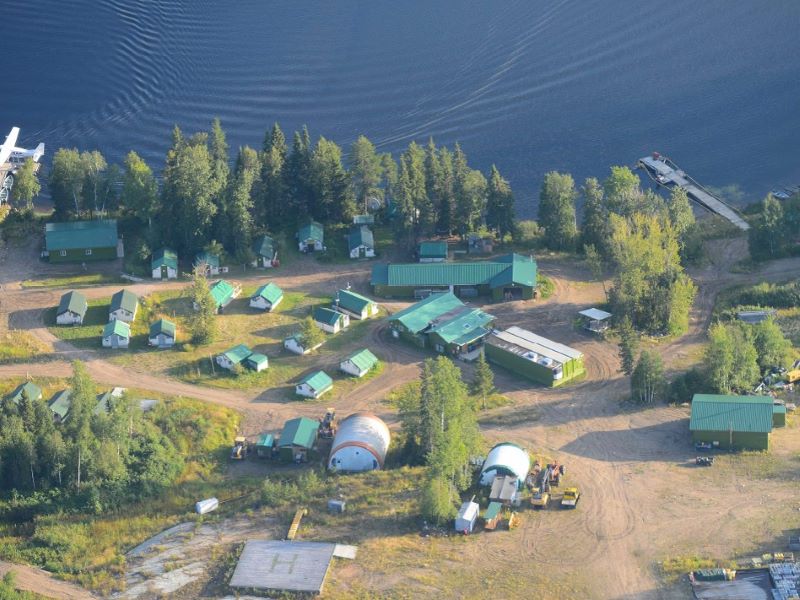
The Springpole gold project is an open-pit mining development by First Mining Gold in Ontario, Canada.
First Mining acquired the project in November 2015 through the acquisition of Gold Canyon Resources.
Recommended Buyers Guides

The company completed a preliminary economic assessment (PEA) in September 2017, while the pre-feasibility study (PFS) for the project was completed in January 2021.
Additionally, in July 2020, First Mining announced the completion of an earlier silver purchase agreement transaction with First Majestic Silver. The latter agreed to provide a total consideration of $22.5m (C$30.74m) in three tranches in return for the right to 50% of the payable silver produced at Springpole over the life of the project.
The Final Environmental Impact Statement/Environmental Assessment for the Springpole gold project was submitted in November 2024.
First Mining announced the completion of an updated PFS in November 2025 with a life of mine of 9.4 years. The initial capital cost for the project development is estimated at $1.1bn.
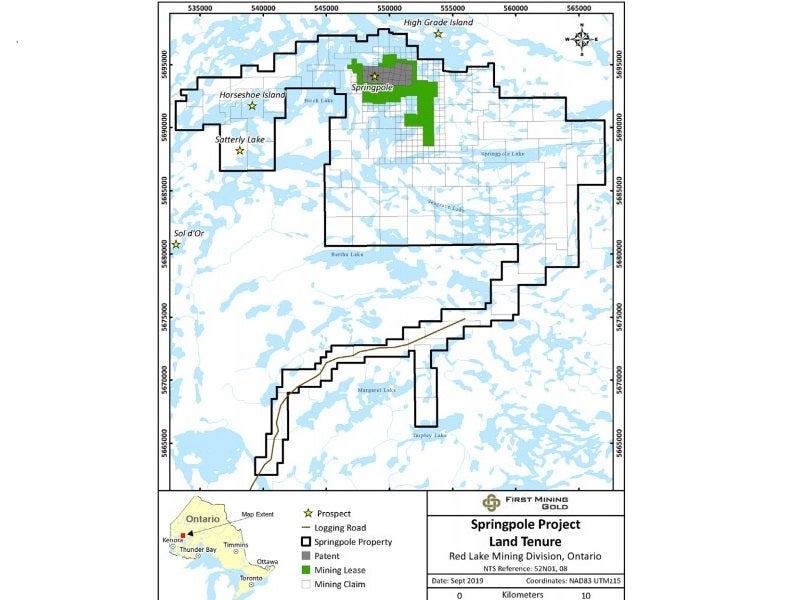
Springpole gold project location
The Springpole gold project lies in north-western Ontario in an 800-hectare (ha) site. In total, the wider landholding extends across 41,943ha, comprising 30 patented mining claims, 282 mining claims and 13 mining leases.
The project site is located roughly 110km north-east of the Municipality of Red Lake and sits within the Birch-Uchi Greenstone Belt.
Geology and mineralisation
The project is located within the Birch-Uchi Greenstone Belt, which is dominated by volcanic and sedimentary sequences alongside syntectonic intrusive bodies.
Mineralisation at the Springpole deposit is defined by three distinct mineralised zones, each with different geological and alteration features. The principal intrusive complex appears to display several features consistent with alkaline, porphyry-style mineralisation linked to diatreme breccias.
The Portage zone is hosted by volcanic trachyte and heterolithic breccia and is characterised by potassic biotite alteration with associated pyrite. The Camp zone is primarily contained within sheared mafic volcanic rocks and shows strong ankerite and sericite alteration linked to a more lode-style gold mineralisation.
The East Extension zone is tied to intrusive megacrystic trachyte and heterolithic breccia and displays a mineralisation and alteration pattern broadly comparable to Portage, including biotite alteration and pyrite.
Springpole gold project reserves
The proven and probable mineral reserves at the Springpole gold project are estimated at 102 million tonnes (mt), grading 0.94 grams per tonne (g/t) gold and 4.90g/t silver, containing 3.1 million ounces (moz) of gold and 16.1moz of silver, as of November 2025.
Mining methods
The Springpole gold project will be operated as an open-pit mine, with a single pit having a three-stage layout using 12m benches.
The proposed Springpole pit is expected to deliver 102mt of mill feed. Mining is scheduled to maintain the 30,000 tonnes per day mill feed rate over its mining life, following one year of pre-production stripping, with the final 1.4 years planned as stockpile reclaim.
The primary mining fleet is expected to include up to four 251mm rotary drills and two 140mm drills, two 37m³ electric hydraulic shovels and three 23m³ front-end loaders. At peak activity, the haulage fleet is set to reach 25 trucks with 240t of capacity, reflecting extended haul distances to the co-disposal facility.
The standard ancillary equipment will comprise dozers, graders, smaller backhoes and other support units. A 13m³ front-end loader is due to be operated at the primary crusher.
Beyond the open pit, two quarries are planned, one to be developed during the pre-production period and another associated with closure activities.
Ore processing
The run-of-mine ore will be processed through primary crushing, after which the crushed material will be stored in a covered stockpile. The stockpiled ore will then be reclaimed to a grinding circuit comprising a semi-autogenous grinding mill and a ball mill operating in closed circuit with a cyclone classification cluster.
Cyclone overflow will feed a single-stage rougher flotation circuit, with the resulting concentrate undergoing regrinding.
The reground concentrate will be directed to a concentrate thickener, while flotation tailings will be sent to a tailings thickener. In the concentrate stream, thickened concentrate will pass through cyanide leaching and counter-current decantation, followed by Merrill–Crowe precipitation and smelting to produce doré.
The tailings stream will be treated using cyanide leaching and a carbon-in-pulp (CIP) circuit, followed by elution, Merrill–Crowe recovery and smelting, also producing doré.
Residue from concentrate leaching will be treated in a dedicated concentrate cyanide detoxification circuit, while residue from the CIP circuit will be treated in a separate tailings detoxification circuit. Detoxified concentrate material will be sent to the potentially acid-generating (PAG) tailings deposition cell, and detoxified tailings material will be routed to the co-disposal facility.
Design operating availability is set at 75% for primary crushing and 92% for the downstream grinding, flotation and gold recovery circuits.
Springpole gold project site infrastructure
The Springpole gold project can be reached in late spring, summer and early autumn by floatplane from Red Lake, Ear Falls and Sioux Lookout in Ontario. Access during winter is through a seasonal road, typically open from January to March, which runs for around 40km from the 85km point on the South Bay Mine Road east of Ear Falls.
The nearest existing road access is currently around 15km away via the extension of the Wenasaga forestry access road. During the spring break-up and autumn freeze-up periods, access is limited to helicopter transport.
Freshwater for the project is due to be pumped from Birch Lake to on-site storage tanks. A potable water treatment system will be installed to supply water for human consumption, while bottled water may be used for drinking, particularly during the construction period.
Most process water will be obtained by recovering water from tailings and concentrate thickeners, as well as from the co-disposal tailings facility and the PAG tailings deposition cell. Freshwater and contact water will be used to supplement make-up requirements when reclaimed supplies are insufficient.
Site-wide average electrical demand is estimated at around 60MW, which is expected to be supplied via a new single-circuit 230kV overhead transmission line to the provincial distribution grid.
The line will run roughly 90km to the south-east to connect with a new 230kV line between Dinorwic and Pickle Lake, which is under construction by Wataynikaneyap Power.
A 450–500-person construction camp is due to be constructed. Upon completion of construction, the camp will be significantly reduced in size and reconfigured to operate as the permanent accommodation facility for around 200 operational staff.
Contractors involved
SRK Consulting (Canada) prepared the PEA report for the project.
The PFS for the Springpole gold project was prepared by AGP Mining Consultants.
The updated PFS was prepared by Ausenco Engineering Canada in partnership with AGP Mining Consultants, SRK Consulting and WSP Global.
