

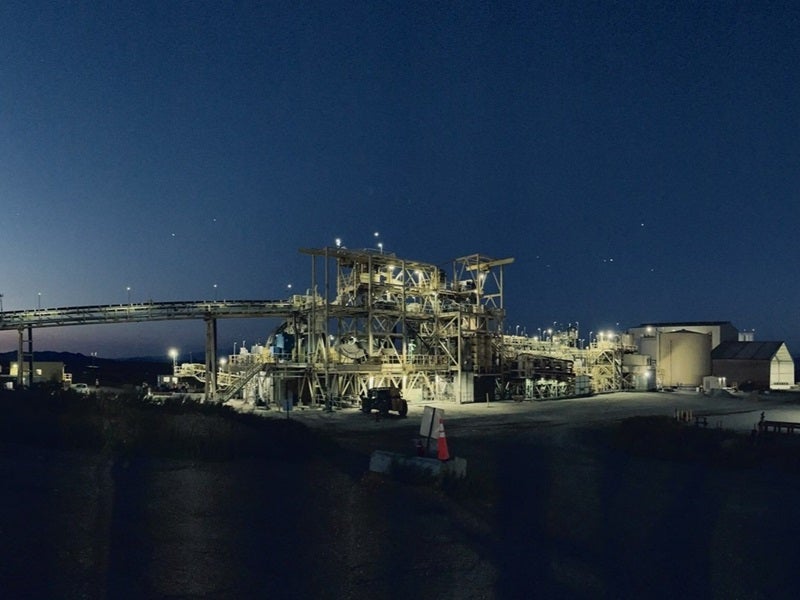
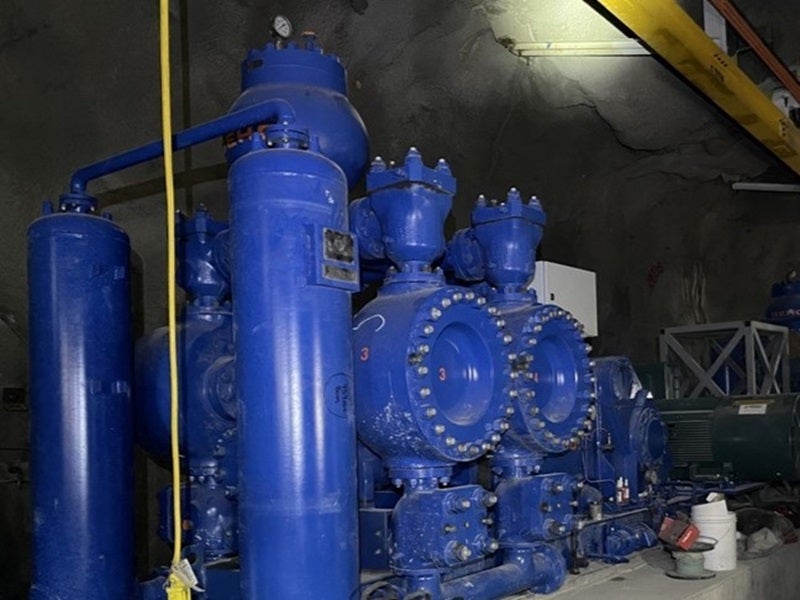
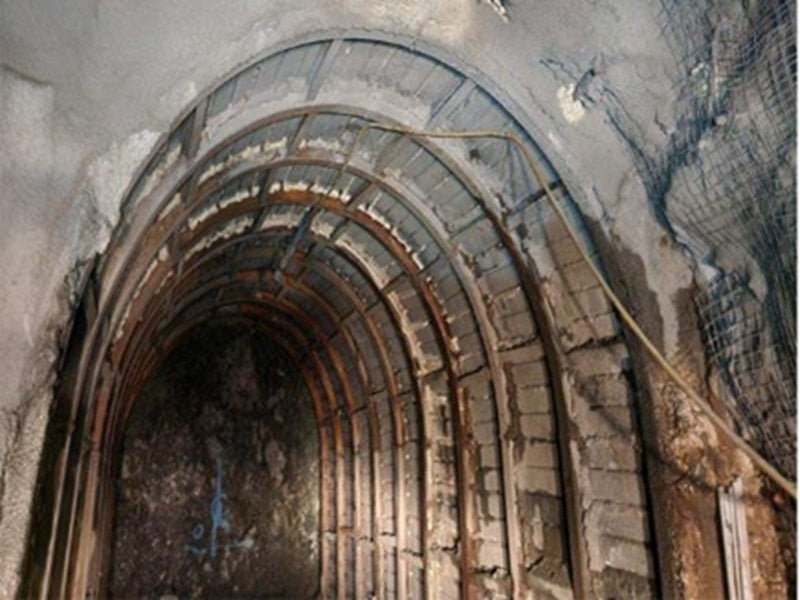
The Pumpkin Hollow project is a high-grade iron-oxide copper-gold deposit located south-east of Yerington, Nevada, US.
The mine is being developed as both an open-pit and an underground mine. It was discovered by US Steel in 1960 and acquired by Nevada Copper in 2015.
Recommended Buyers Guides

Nevada Copper announced the filing of a voluntary petition for relief under Chapter 11 of the US Bankruptcy Code in June 2024.
In September 2024, Nevada Copper announced an asset purchase agreement with Southwest Critical Minerals, an affiliate of Kinterra Capital, under which the buyer will acquire almost all of the assets owned by the company and its subsidiaries.
The agreed consideration comprises a cash payment of around $128m, together with the buyer covering the cure costs associated with the contracts it takes on, as well as a further price adjustment linked to the assumption of specific liabilities.
In October 2024, Southwest Critical Materials completed the acquisition of the project from Nevada Copper.
The firm plans to apply its technical capabilities and operational rigour to progress the various assets included within the Pumpkin Hollow package, with the intention of aligning future development with its sustainability framework and the priorities of key stakeholders.
In September 2025, Kinterra Capital announced that it plans to restart copper production at Pumpkin Hollow within 24 months.
Restart efforts will focus on addressing legacy shortcomings, completing thorough data gathering and trade-off assessments, and progressing multi-discipline engineering to recognised industry standards.
This programme also covers a full update of the geological resource model using advanced core-scanning techniques to enhance mineral identification and strengthen geological interpretation. At the same time, Kinterra is progressing offtake-linked financing discussions with downstream partners.
Pumpkin Hollow mine location
The Pumpkin Hollow property is situated roughly seven miles (11.26km) south-east of Yerington, Nevada, within Lyon County. The project area spans 22,862 acres within the Mason Valley, which runs north-south and lies between the Singatse and Wassuk mountain ranges.
Geology and mineralisation of Pumpkin Hollow
The property is situated on the eastern fringe of the Quaternary gravel-covered Mason Valley, and comprises a tertiary (Oligocene) tuffaceous volcanic assembly. This volcanic sequence includes quartz-latite ash flows and crystal tuffs, which are surmounted by the Singatse Tuff Formation, characterised by lithic-rich tuffs.
The south-western segment of the Pumpkin Hollow property is primarily characterised by Mesozoic strata from the early Jurassic, consisting of fine-grained felsitic siltstones and tuffs, which are in turn overlaid by thinly bedded carbonaceous, calcareous argillites, tuffs and limestones.
The Jurassic Yerington Batholith intrusion has resulted in extensive iron oxide copper gold mineralisation, mainly skarn, which contains copper, magnetite, and varying amounts of gold and silver. This skarn mineralisation is primarily located in the middle-to-lower sections of the Gardnerville Formation, the upper part of the Mason Valley Formation and within the intrusive granitoid.
Reserves at Pumpkin Hollow mine
The project hosts an estimated 1.7 billion pounds of copper resources.
Financing
In September 2025, Kinterra Capital completed $80m (C$111.02m) in equity financing led by Lionhead.
The company plans to use the proceeds from the financing to support the restart of the Pumpkin Hollow underground mine.
Mining method at Pumpkin Hollow
The Pumpkin Hollow property is being developed using both open-pit and underground mining methods.
The transverse long-hole stoping method was chosen as the optimal mining technique for all three zones – EN, ES and E2 – of the underground project due to safety, mining recovery, dilution control and productivity considerations.
The stopes are 100ft high × 50ft wide for the ES and E2 zones, and 75ft high × 50ft wide for the EN zone.
Stopes are mined bottom-up to minimise lead time and upfront development. In narrower sections of the E2 zone, longitudinal long-hole stoping is used for greater efficiency in lateral development.
The open-pit development includes two mining areas: the North Pit and the South Pit. Mining began in the higher-grade North Pit, followed by the lower-grade South Pit. The North Pit is designed in four phases, while the South Pit is designed in two phases.
Underground ore processing at Pumpkin Hollow
The Pumpkin Hollow copper underground ore concentrator is designed to process 5,000 short tonnes per day of copper ore sourced from the East and E2 deposits.
The run-of-mine ore undergoes crushing in a primary jaw crusher before being transferred to the grinding circuit. This circuit comprises a semi-autogenous grinding (SAG) mill and a ball mill, which together facilitate a two-stage grinding process within a closed circuit that includes a pebble crusher and classifying cyclones. The grinding occurs as a wet process.
The discharges from both the ball mill and the SAG mill converge into a common cyclone feed hopper. From here, the slurry is propelled to a cluster of cyclones. The overflow from these cyclones is directed into the rougher flotation conditioning tank, marking the commencement of the flotation process. The pulp density of the slurry feeding the rougher flotation is consistently maintained at approximately 35% weight/weight solids.
In the rougher flotation circuit, the milled pulp is treated to recover the desired minerals. The resulting rougher concentrate is ground further and then passed through cleaner flotation to enhance the concentrate to a marketable quality. Subsequently, the flotation concentrate undergoes thickening, filtration and storage in preparation for shipment.
Open-pit ore processing details
The phase one ore processing facility is designed to handle 13.5 million tonnes per annum (mtpa) and phase two adds capacity for another 12mtpa.
In phases one and two, ore from the north and south Pits is crushed at the pit crest by a single crusher. The crushed ore is transported via an overland conveyor to coarse ore stockpiles for each phase, providing surge capacity for feeding into the grinding circuits.
Ore is reclaimed from the stockpiles using apron feeders and is discharged onto conveyor belts that feed the SAG mills. Both phases utilise a two-stage grinding circuit, with SAG mills in a closed circuit with pebble crushers and ball mills also in a closed circuit with hydrocyclones.
The ball mill and SAG mill both discharge into the common cyclone feed hopper, from which slurry is pumped to a cyclone cluster.
The milled pulp undergoes rougher flotation to recover target minerals. The rougher concentrate is ground and processed through cleaner flotation to produce a high-grade copper concentrate. The final concentrate is thickened, filtered and stored before shipment.
Site infrastructure at Pumpkin Hollow
The property is accessed via a sealed public road network to E Pursel Lane to within 3.5 miles (5.6km) of the property.
A new 120kV transmission line is being built from a service point on the existing NV Energy System to the mine site.
Fresh water is sourced from dewatering well WW-01.
