
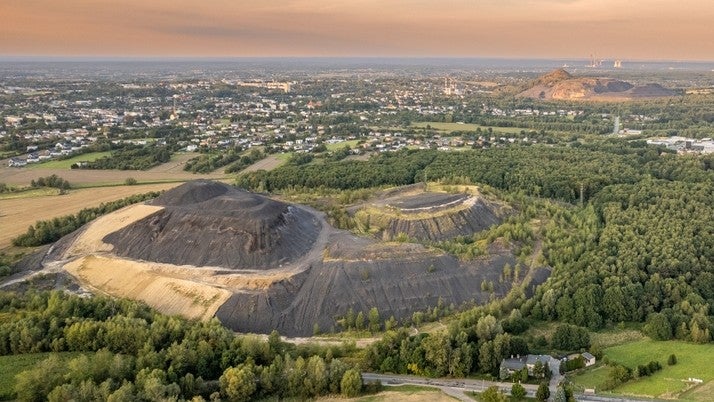
Long treated as a long-term environmental and financial liability, mine tailings are attracting renewed scrutiny as operators search for additional revenue streams amid declining ore grades and ambitious decarbonisation targets. However, while the theoretical value of tailings is substantial, the economic case for reprocessing remains highly site and commodity specific.
The Minerals Research Institute of Western Australia estimates the global value of precious, critical and strategic metals in tailings to be more than $3.4tn. Canada’s gold waste alone is estimated to hold $10bn (C$13.85bn) of metal value, while the decades-old tailings in Sudbury alone are thought to hold between $8bn and $10bn worth of nickel.
Go deeper with GlobalData


Discover B2B Marketing That Performs
Combine business intelligence and editorial excellence to reach engaged professionals across 36 leading media platforms.
The mindset around tailings is shifting. As governments prioritise domestic supply chains for critical minerals and operators face increasing pressure to reduce environmental liabilities, tailings are emerging as a potential bridge between resource security and reversing environmental damage. Rejected, often-unclassified waste is increasingly being viewed as a partially processed, valuable and accessible source of critical minerals. Innovators developing technologies in the space are seeing a surge of interest, as governments and operators look to mine tailings to boost domestic supply chains and reduce environmental pressures.
At the forefront of the shift in Canada is the country’s Mining Innovation Commercialisation Accelerator (MICA) Network, managed by the Centre for Excellence in Mining Innovation (CEMI). A $112.4m pan-Canadian initiative, MICA uses cross-sector insights to accelerate and deploy commercial innovative technologies.
MICA network director and executive vice-president of CEMI Chamirai Nyabeze works to connect technology providers with industry leaders to streamline the market entry of future industry-defining technologies, in mine tailings and beyond. In practice, this places him at the intersection of pilot-stage innovation and commercial deployment, with visability over which technologies are progressing beyond trials and which are not.
This includes in tailings, which he compares to dirty dishes. “They just pile up, layer after layer, and then no one remembers what is at the bottom,” he explains. Sitting down with Mining Technology, he considers how this is set to change.
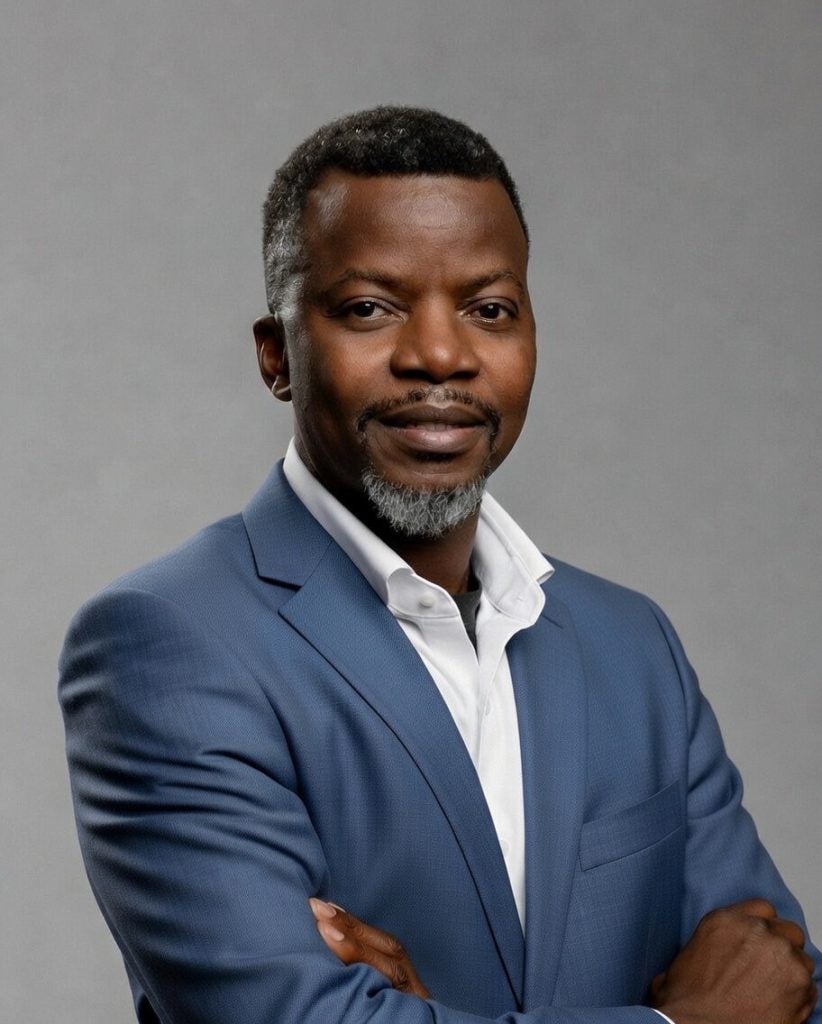
Chamirai Nyabeze.
Eve Thomas (ET): Thinking broadly about mining’s waste problem, what are some of the technologies that MICA has worked with that have reached commercial viability, or are on track to do so soon?
Chamirai Nyabeze (CN): To date, we have around 40 technologies that we are supporting that have commercial traction, by which I mean that these technologies are being trailed or utilised within an operating environment. Some of those have resulted in purchase orders to trial the technology, and some have achieved market entry. A good example is LOOPX’s technology, a collision avoidance solution being implemented in utility vehicles, which is being looked at for some mines in Nevada, and also in some mines located in Quebec.
Another example is a company called Litus, which has a direct lithium extraction technology for low concentration brines. This technology is being utilised for pilot tests in some oilfields in Texas; they take the wastewater and extract lithium from it. Another company is MIRARCO, which MICA supported to create a workflow to extract battery grade minerals out of solution from tailings. Interestingly, they have established a biowaste facility, where they have integrated this into their testing regimes so that when a client has a similar ore type, they bring it to their site for testing.
Another company we are working with that has been able to commercialise is a company called Rithmik. Rithmik is a technology for predictive maintenance – kind of an equipment doctor – to better predict equipment failure before it becomes catastrophic. The last company I will highlight is Destiny Copper, which has a low-energy technology to extract copper out of solution. One of the cool things about Destiny Copper is its ability to create what they will call spherical copper, which is used as an additive for various industrial applications.
ET: What do you have to think about when assessing commercial viability in mine tailings?
CN: In Canada, companies have an obligation to put up funding to prove that they can maintain sites into perpetuity, so these companies provide collateral to maintain a tailings site forever. That liability is not going anywhere.
Technology that can reduce liability is a good thing, especially when it gets value out of the waste. However, the issue is many of the tailing sites have never really been classified, so we don’t know what is in them. The original rock was mined because it had something inside that we wanted, but everything else was just deemed to be useless. It is like harvesting corn and just taking the kernels; everything else is considered junk, so we don’t bother to extract the liquid or the fibres from it, or to assess what else might be there. Once tailings are classified, we know what we have and then there is an economic case.
Canada is currently trying to classify our tailing sites, but each site has to be investigated separately. The good news is that the most energy-intensive bit has already been done: breaking down the material. Working with material that is already partly processed is a huge economic benefit. In the future, we are going to have integrated processing facilities, so that we don’t put tailings down until more value has been extracted within the same process.
The second thing to consider is that tailings’ value is more than just extraction, it is about what you enable. There is a value in cleaning up mess, to enable you to make more money in the future. Think: what are you mitigating? What are you resolving responsibly?
ET: When considering the viability of mine tailings technologies at MICA, how much do you consider the economic case and how much is the focus on environmental benefits?
CN: It is both, but it also depends on who you are asking. If you are asking the mine operator, they don’t want to lose the societal backing for what they are trying to achieve. However, if you look at a private sector company looking to address tailings, they are thinking about the bottom line.
The good news for tailings is that things we didn’t think were valuable are valuable now. It is like someone finding out that you are richer than you think. Now, there is an opportunity to do urban mining, and it is not just tailings; even the municipal dumps have been found to hold value.
But yes, the business case has to be there. The business case is either reducing the cost on the liability side or making money by extracting something. However, you have to then ask: do you create another tailing?
One line of thinking is that you need progressive separation: to keep reprocessing and separating things out. The plant should be a really long plant, where at the very end of the pipe is a little crucible of the really bad stuff that you can’t do anything with, but the existing processes are not like that. The mindset is usually ‘I am mining for gold and I don’t care that there is something in the ore body that is not gold’. That mindset needs to change, and it is changing in some companies as the necessary technologies are coming online. The opportunity for mindset change is better now than it was in the past.
ET: What tailing extraction technologies are emerging that are worth being excited about?
CN: Leaching technologies can play a big role, because the material is already a certain size. Nanotechnology also works, especially for innovating around separating material. If you are sorting things that are really small, then you are doing what the perfume, or the pharmaceutical, industry does. It is the same thing with mining, and those lessons are being learned.
There are some emerging solutions that are looking to use biotech – advanced chemistry solutions, advanced sorting technologies – to separate mine tailings out to make them easier to sort and to store. Tailings are a mishmash of everything: the good, the bad and the ugly. That is a risk too: tailings can expose liability in a way that some companies would rather not.
ET: You posted the message below on LinkedIn last year. What does creativity look like in mining innovation?
CN: I got that quotation from the CEO of a company called Allonnia, which is in the business of creating value from waste. With creativity, you have to admit that you don’t know what you don’t know, because that opens room for you to be able to think differently. In mining, we are finding that innovations in other sectors are making an impact; for example, nanotechnologies developed for pharma can be implemented in the mining industry to extract elements out of solution.
We find this crossover a lot. Mining is a very remote industry, so technologies used in remote defensive operations, or remote offshore operations, can also have applications in mining. I think creativity comes from looking at other industries and asking: ‘what is possible over there?’
Then the other piece about the mining industry is that most of our processes are sequential, which means that, if anything on the series line fails, everything else stops. Being creative means finding ways to reroute. Utilising technologies like robotics allows multiple things to happen at the same time. Think about underground mining industries especially; when you blast underground, you have to remove people until the air is clear for them to breathe. However, you can send a robot in to work where it doesn’t need oxygen, or even lights – you can use infrared.
For mining, creativity means not being hard sold that the way we did it in the past is the right way, and being open to the future. We have got things like the advent of quantum computing now: a way for you to review multiple options at the same time, so that you end up choosing the better option faster. Things like this are making mining better, because mining comes back to just making good decisions at the right time.
ET: How is the mindset around tailings changing in Canada?
CN: Canada sees waste as a huge opportunity. We are getting minerals without mining them, at least for a second time.
Natural Resources Canada, our ministry of natural resources, is getting organised and I am seeing a lot of movement from our government to address this. There is something called the Critical Minerals Research, and Development and Demonstration Fund: it is a resource set to address some of these pain points.
The Canadian Government is very aware that circularity is part of the conversation, and tailings features in a in a big way. However, the technologies to extract value from mine tailings are still under refinement; when they get to a high enough level, we will see a lot more players in the space, because we already have resources on the surface – it is just an easier way to do mining than having to dig a bunch of holes in the ground.



