

The 2025 iteration of one of Europe’s biggest mining events was extensive in its coverage of topics, from leveraging AI and optimising mining operations to environmental, social and governance (ESG) and the rapidly growing artisanal mining sector.
Emerging technologies lead the future in mining
Of course, the minerals the world wants to benefit from the most right now are the critical variety – especially those key to energy transition technologies. Their necessity has sparked a global race, with nations attempting to challenge China’s monopoly over the market. China dominates the production of more than 15 critical minerals and has virtually no competition when it comes to producing the likes of gallium and magnesium.
Go deeper with GlobalData


Discover B2B Marketing That Performs
Combine business intelligence and editorial excellence to reach engaged professionals across 36 leading media platforms.
One nation that is positioning itself as a major contender is Australia, a country rich in critical mineral reserves and home to a thriving mining industry that generates more than 12% of its gross domestic product.
Karol Czarnota, senior science advisor at governmental agency Geoscience Australia, told Mining Technology at Resourcing Tomorrow how it plans to help the country capitalise on it.
“Australia has the periodic table of critical minerals and, because of the breadth of expertise across the mining sector, is looking to progress industry around a lot of them,” he explained.
As for Geoscience Australia’s role in this progression, he said: “We take datasets and fuse them together to make mineral potential maps. They are like heat maps for where you should go and explore certain styles of deposits. We couple this with a whole series of technological economic assessments, so you can find the sweet spots.”
US Tariffs are shifting - will you react or anticipate?
Don’t let policy changes catch you off guard. Stay proactive with real-time data and expert analysis.
By GlobalDataCrucial to Geoscience Australia’s work is the advanced technology necessary to collect comprehensive datasets.
“One thing that we have done, which is super exciting, is the AusAEM survey,” said Czarnota. “We fly an aircraft that generates an electromagnetic field (a secondary field within the earth) and measure its decay, then we use that to make cross-sections of the conductivity of the earth down to between 300m and 500m in depth. We are doing this across the entire country, with 20km spacing, and we have covered around 70% of Australia as of now.”
New technologies are not only allowing countries to boost domestic production – they are revolutionising mining operations across the globe.
For Jef Caers, founder of Mineral-X, an industrial affiliates programme at Stanford University’s School of Sustainability, self-driving vehicles are a clear example of how automation is enhancing mining operations.
“If you are mining the wrong way, the robots are going to fix that,” he told Mining Technology at Resourcing Tomorrow.
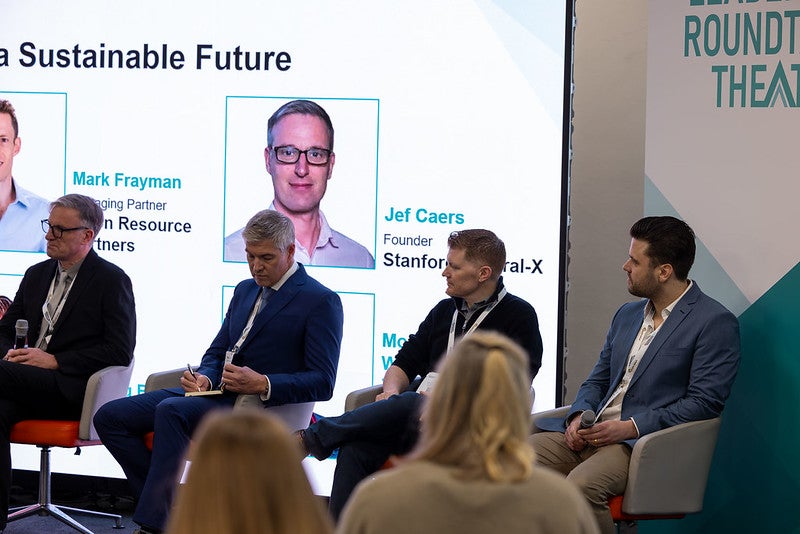
A partnership between Caers’ programme and US-based mine exploration company KoBold Metals leveraged AI and automation technologies, leading to what they claim is the largest copper discovery in a decade.
The mining industry is also adopting new technologies from the space sector. Satellite technology, for example, is integral to the remote element of certain aspects of mining.
According to Craig Brown, director of investment at the UK Space Agency, 40% of applications for the agency’s most recent development programmes incorporate AI on some level, and many would have direct applications in the mining sector. Any company that wants a commercial advantage and is keen on innovation and staying ahead of the curve “should consider the new services that are coming through some of the technology [the space domain] supports”, Brown says.
Satellites, for instance, are cross-applicable to space and mining. For both “you need to take imagery, navigate in areas where there isn’t very good ground infrastructure, where you are in remote regions”, he says.
Mining companies are already using satellite technology to send data from their mine sites to their headquarters. This includes information processed by cameras and microphones, on the behaviour of tired workers in the field using heavy equipment. Through analysis techniques the companies can determine whether the drivers are behaving in a way that poses a safety risk.
Spotlighting artisanal mining
A less prominent topic in mining, the artisanal mining sector was also discussed at Resourcing Tomorrow. The sector contributes substantially more to global commodity supply in both volume and range since the 1990s. For example, it produced approximately 4% of the world’s gold then, compared to 20% today.
While the traditional mining industry doesn’t appear to be responding as quickly to its growth, Resourcing Tomorrow provided a platform for industry experts to shine a light on it.
“It is a subject that I hope is not going to be left aside or sidelined in the interest of critical minerals,” said Brent Bergeron, Pan American Silver’s senior vice-president of corporate affairs and sustainability, during a panel discussion.
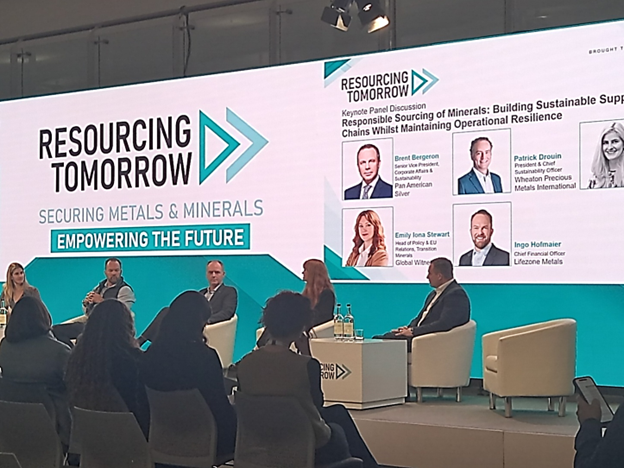
He spotlighted the artisanal gold market in Peru. “Around $8bn in gold makes its way outside the country on a yearly basis – it is not a small market – but where does it go? How does it get out? Which groups are in charge of it? These are the questions we are trying to answer.”
The mostly unregulated artisanal mining sector has also led to social and environmental risks such as poor health and safety and environmental degradation, reflecting broader concerns around ESG in mining.
Is ESG dying or rebranding in mining?
Following years of companies attempting to align with ESG frameworks, Resourcing Tomorrow emphasised the reality of its relevance today. According to experts, it is at a minimum “rebranding” and at most “dying”.
Panellists suggested a new acronym has taken centre stage: VUCA, standing for volatile, uncertain, complex and ambiguous. Rather than a call for ethical considerations, VUCA reflects the state of supply chains and mining operations squeezed by critical mineral demands. However, VUCA extends beyond mining, seeping into everyday life.
“We are increasingly seeing that the world around us, the world of resourcing, the world of our jobs, the world of our homes, is increasingly uncertain,” said Beverley Adams, head of client engagement and consulting director of strategic risk practice at Bowring Marsh. “Uncertainty is the new normal.”
Presenting another angle, Gerhald Bolt, principal of climate and sustainability at dss+ Consulting, suggested that ESG is becoming the basis on which to manage VUCA risks, helping to answer questions such as “How can I advise ESG to advance my brand equity? How can I use it to increase revenue? Can I use it to reduce cost and how can it significantly reduce risk?”
Adams closed the panel, saying: “ESG isn’t dead, but the language of ESG, whether it is sustainability, social licence or co-design – ESG is evolving.”
Regardless of whether ESG is dead or alive, ethical practices in resource sourcing still remains a key consideration in mining but there are obstacles.
“The biggest challenge the industry sees at whatever level in the value chain is where you have very big differences in regulation in markets in which you operate, or where your customers operate around the world,” said Julian Hetherington MBE, director of automotive transformation at the Advanced Propulsion Centre UK. “Trying to keep ahead of and balance compliance with all of those regulations is a big challenge.”
Ntokozo Nzimande, deputy director general of South Africa’s Department of Mineral and Petroleum Resources, brought insight from the perspective of the country’s industry, advising that it needs to reinforce its supply chain resilience.
“Firstly, we must agree we need to fix our infrastructure [to better align with ESG standards], and investors must assist in these efforts. Then, in order for us to contribute to the regulation, we must be able to work with all partners that need it,” she said.
Another attempt by mining to operate under ESG frameworks is circularity, as managing director of the World Resources Forum, Mathias Schluep, emphasised to Mining Technology.
“I think mining companies sit at the beginning and somehow also outside of the circular economy. They feed in the raw materials, but they have a lot of decision power, knowledge power and technology power they can use to support circularity,” Schluep said.
He believes that a lot of mining companies are “getting into the field of secondary raw materials” but there is yet more attention needed in “the way they sell those raw materials”.
“Material as a service – giving the material to be used as a service – completely changes the picture of how somebody is using this material and what the interest is of the mining company. They want this material back,” he notes.



