


MINEXCHANGE / SME 2026 in Salt Lake City, Utah delivered a clear message for mining leaders: the sector’s next decade will be defined by the ability to produce more critical materials 1 with greater resilience, while also reducing emissions intensity.
At the event, I had the opportunity to present findings from ExxonMobil’s thought leadership report Mining Forward: Digging into the Potential for Lower Emission Mining Operations, for which we interviewed more than 90 mining operators across the US, Canada, South Africa, China, to explore how the global industry is squaring the circle of transitioning to lower-emission operations while taking into account productivity and cost considerations.
The presentation focused on what operators are actually doing today, what’s slowing progress, and where “no-regrets” steps can unlock momentum, especially where productivity, cost-per-ton and emissions improvements align. You can find that report at the end of this article.
Beyond the keynote stages and expo floor at the event, what stood out was the technical depth: multiple days of submitted-paper sessions plus panels where operators and solution providers compared notes on what scales, what doesn’t, and why when it comes to reducing emissions in operations.
Below are my headline takeaways from the event for mining executives.
1) Mining’s “energy transition” is real—but it’s site-specific, not slogan-driven
Mining is a large diesel consumer, and that matters. Globally, diesel demand is still dominated by on-road fleets (roughly two-thirds), with off-road (including mining) comprising much of the remainder. Yet mining presents unique constraints: remote locations, off-grid power, harsh duty cycles, and an absolute requirement for uptime.
Haul trucks are the clearest example, often running 16–18 hours a day, and in many operations effectively expected to run day and night. Electrification may be compelling in certain contexts, but there is no universal pathway that can be copied and pasted.
The consistent theme across sessions: context is strategy. Whether a mine is grid-connected or not, greenfield or brownfield, and where it is in its remaining life heavily dictates what is economically and operationally feasible.
2) Brownfield realities raise the hurdle—and explain the pace
Mining is capital intensive, and mining assets are long-lived. Unlike passenger vehicles that may turn over every four to five years, major mining equipment can remain in service for decades; some haul fleets and processing systems are effectively designed around multi-decade operating models.
That makes emissions reduction a systems decision, not a quick swap. For brownfield sites in particular, sunk capital and infrastructure lock-in mean the best answer is often: improve what you have now, while planning what you’ll build next.
3) “Win-win-win” solutions are the ones that get funded
One of the strongest cross-conference themes was that initiatives gain traction fastest when they deliver three wins:
- Productivity (tons moved/processed, availability, throughput)
- Efficiency (energy per ton, cost per ton)
- Emissions intensity (without sacrificing the first two)
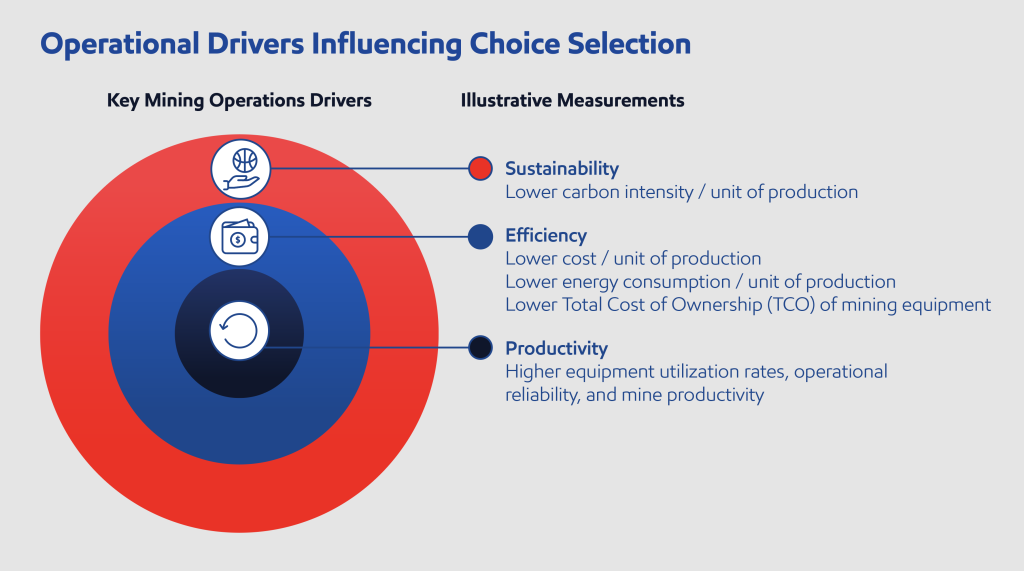
Mining is a commodity business. Market prices are set externally; therefore, most mines cannot “spend their way” to lower emissions unless the economics work. Executives are rightly prioritizing solutions that protect competitiveness while improving emissions reduction outcomes.
4) Productivity and efficiency: the “quiet giant” of any transition
From automation and digitization to anti-idle strategies, the conference leaned heavily into practical performance improvements. A recurring point: strong efficiency gains can be achievable with existing fleets when organizations aggregate many small wins, backed by data and discipline.
The keynote perspective from FLSmidth reinforced this: next-generation processing and comminution technologies can markedly improve productivity and reduce energy intensity. For many operations, the biggest emissions reduction lever isn’t a single breakthrough, it’s systematic optimization.
5) Renewable diesel: a pragmatic lever for existing fleets today
For operations that will continue to rely on liquid fuels, especially in remote, off-grid environments – renewable diesel emerged as a practical option to reduce lifecycle greenhouse gas emissions using existing equipment and logistics in many cases.2
Real examples matter, and it was notable to see discussion of regional adoption, including Rio Tinto Kennecott (local to the Salt Lake City area) as an illustration of how existing fleets can take steps now, not only in future fleet cycles.
6) Electrification is progressing – but still early for many
Electrification is happening, but at different speeds depending on application. The most compelling discussions were upfront about trade-offs: infrastructure requirements, grid access, charging constraints, and operational flexibility.
Case studies included an operational underground trolley system (Boliden/Epiroc/ABB collaboration in Sweden) and alternative approaches such as Caterpillar’s Dynamic Energy Transfer (DET) concept. The take-home for leadership: electrification is promising, but it’s not a single decision. It’s a portfolio of design choices that must match the mine’s operating reality.
7) People, capability and mineral security are becoming strategic constraints
Two adjacent themes stood out strongly:
- Domestic mineral security is driving urgency in the US, intensified by electrification and AI-driven demand growth and concerns about supply concentration for critical minerals.
- The talent pipeline is a real concern. It was encouraging to see undergraduates engaged at the event but scaling production while digitizing operations will require new skills, and reskilling current workforces, at pace.
Bottom line for mining leaders
MINEXCHANGE / SME 2026 reinforced a practical truth: mining’s transition will be won through site-specific strategies and operational excellence, not generic templates. The most investable pathways are those that improve productivity and efficiency first, then convert those gains into lower emissions intensity.
That’s why collaboration mattered so much across the week. Operator-to-operator learning, OEM and technology partnerships and the contribution of teams like our Mobil™ lubricants and fuels specialists. In mining, resilience isn’t a marketing message. It’s uptime, cost control, safety, and credibility with stakeholders, delivered simultaneously.
Author
Dr. Andy Hattersley is Senior Global Product Advisor at ExxonMobil, supporting solutions across energy-intensive sectors including mining.
Exxon Mobil Corporation has numerous affiliates, many with names that include ExxonMobil, Exxon, Mobil, Esso, and XTO. For convenience and simplicity, those terms and terms such as Corporation, company, our, we, and its are sometimes used as abbreviated references to specific affiliates or affiliate groups. Nothing contained herein is intended to override the corporate separateness of affiliated companies.
- For more on “critical minerals”, see for instance Vision 2035: Critical Minerals Strategy – GOV.UK.
- Renewable diesel can be used in most modern diesel engines without modifying the engine or blending with conventional petroleum diesel. Suitable for use in diesel engines certified to use CAN/CGSB 3.520, ASTM D975 and EN15940 specifications fuel. Verify fuel compatibility with your vehicle owner’s manual or by contacting your vehicle manufacturer.