
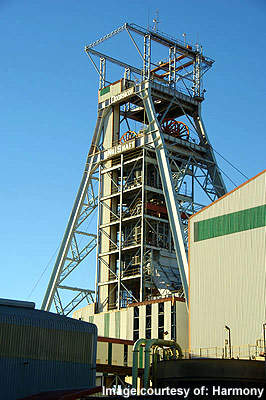
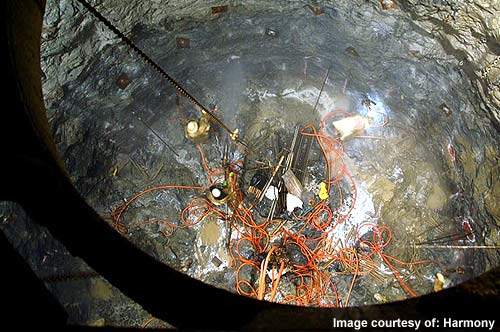
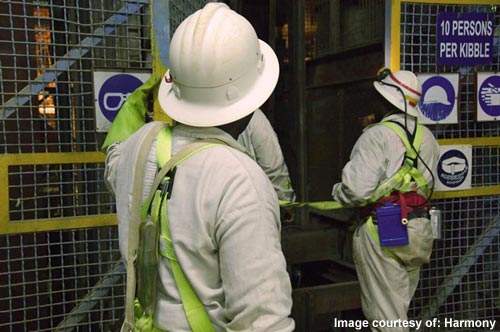
Intended to bring to account around three million ounces of gold during the mine’s anticipated 11-year lifetime, the Doornkop South Reef project involves deepening the mine’s main shaft by a little over 670m to an eventual final level of 1,973m below collar.
The Doornkop Shaft complex is located south of Krugersdorp, on the north-west rim of the Witwatersrand Basin and lies between the Cooke 1 Shaft and Durban Roodepoort Deep Mines.
Recommended White Papers

Recommended Buyers Guides

The estimated in-situ proven and probable reserves are 3.2Mt graded at 5.33g/t as of 2011. The measured, indicated and inferred resources totalled23.1Mt graded at 8.25g/t.
A joint venture between Harmony and African Vanguard Resources (AVR) has been established to manage the project, with AVR gaining a 16% share of the profits in exchange for contributing their 26% share of the mineral rights to the joint venture. In March 2010, Harmony acquired the 26% share from AVR for R398 million.
Reef geology
The South Reef is a very thin, carbonaceous and friable seam, typically 1–10cm thick, lying between 1,650m and 2,000m below surface, 900m below the Kimberley Reef and inclined downwards by 10 degrees to the south-east.
Bounded to the north-west by the Roodepoort Fault, the reef plane itself is divided into large blocks by the series of faults associated with the Witpoortjie Horst, with further structural breaks being formed by a number of other local faults, including the Saxon Fault.
The Doornkop Fault runs to the southern end of the project area. However, within the principal structural blocks, the reef plane itself is relatively uncomplicated and although the ‘Black Duck Dyke’ – a prominent water-carrying intrusive – cuts across the site, previous mining activities have managed to overcome it successfully. Around 70% of the gold mineralisation is in the form of free gold.
Mining the south reef
Exploration of the Doornkop area began in the early 1930s, with investigations revealing economic concentrations of gold in the South Reef. The sinking of the Doornkop main shaft and the ventilation shaft started in 1983 – the initial intention being to mine both the South Reef and the Kimberley Reef – but later put on hold when it was subsequently decided to concentrate on the shallower Kimberley Reef.
Work began again in 1991, with some prospect development being carried out – including some 450m of on-reef development – before stopping again for a year in 1995.
Deepening of the main shaft recommenced in November 1996 and continued until May 1999, by which time the sub-vertical shaft sinking had been completed and the main shaft had reached 1,340m below ground.
When Harmony took control of Randfontein early in 2000, they acquired Doornkop and carried out a series of investigations on the South Reef confirming the presence of a central pay shoot, indicating a robust project involving low technical risks and excellent returns. In January 2003, the go-ahead was announced.
Further exploration drilling at the reef will be carried out in 2010 to increase the rate of obtaining geological information on the orebody. Drilling platforms are being developed besides the normal access development.
Design
The design of the mine has been based around conventional mining methods, proven technology and established blasting techniques to result in a tramming width of 130cm and an average stoping width of 120cm.
The shaft itself was sunk from two points simultaneously – said to be a world first – and culminated in the removal of the plug between the 192 and 197 levels. This required a deflector to be set up on 197 level to allow for loading of the rock level while work continued below in the shaft at 212 level.
In addition to deepening the main shaft, the project also calls for four new working levels and associated infrastructure to be put in place to allow the South Reef to be successfully exploited.
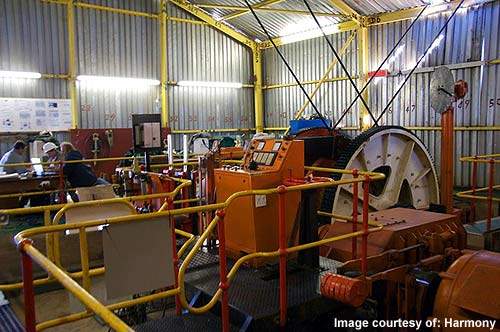
At the beginning of 2007, a second winder was commissioned in the sub-shaft which has allowed the extensive access development programme to be accelerated.
In addition, the dual-purpose winder compartment was equipped from 132 level to 192 level and commissioned in 2009, enhancing transport from surface to the levels and allowing the development to proceed on schedule.
By the second half of 2009, the north and south winder compartments were installed to 212 level. During the same time, production on level 197 of the South Reef project commenced. By February 2010, construction of the 212 level conveyor belt was also achieved. The surface rock winder was commissioned and fully automated in 2011. Full production is expected in 2015.
Production and costs
The total project cost has been estimated at R1.1bn, with almost R1bn of this budget having been accounted for to date. South Reef produced 62,694oz in 2010 and 80,763oz in 2011.
The average recovery grade is 4.5g/t. At a gold price of R115,000/kg, the NPV is R1,189m and the IRR exceeds 50%, making the project financials very attractive.
Harmony initiated a project to install and replace the equipment in the plant for optimising gold recovery in the fourth quarter of 2010. The phase 1 of the project is scheduled to be completed by March 2012.